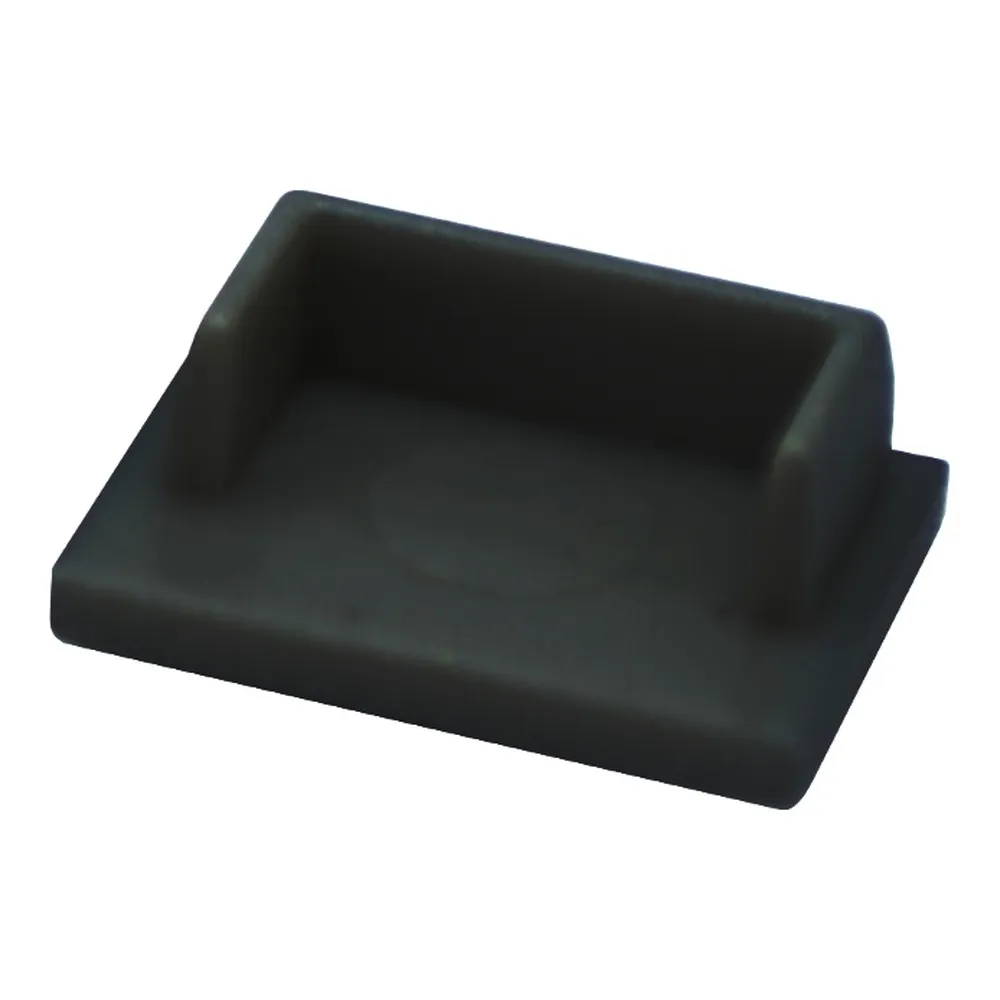
What this end cap doesAn aluminum LED profile is an open extrusion: cut it to length and both ends are raw, showing the channel walls, the tape and the edge of the diffuser. A finishing end cap closes that opening. This is the
standard #85 end cap, the closed version supplied
without a hole, meant for the terminating end of a channel run where no conductor has to exit. Paired with a hole version at the feed end, you get a fully enclosed extrusion from one end to the other — clean at the wire entry, clean at the dead end.
Fit and finishEnd caps are not universal. They are
profile-specific, so the cap has to match the channel family you are installing — this one is made for the #85 profile and is shaped to seat flush against the extrusion and against its diffuser. The
black finish blends with darker profiles and darker diffusers, which is exactly what you want on a black linear fixture where a light-coloured cap would break the line. On long runs assembled from several lengths of extrusion, the matching caps at each visible end keep the whole assembly reading as a single, uniform
LED profile rather than a series of pieces.
Technical specificationsSKU: LCENDCAP-STAND-85-BK
Type: Finishing end cap, standard
Profile compatibility: #85 aluminum LED profile
Cable opening: without hole (closed)
Finish: black
Quantity: sold individually (1 unit)
Installation tipsWork in order. Cut the extrusion to length and clean the cut so the ends are square and free of shavings, then insert the
LED strip and the diffuser, and fit the cap last so everything sits true. Dry-fit and press the cap in before final mounting — on surface, recessed or suspended channels it's far easier to verify alignment while the profile is still loose in your hands. For a permanent hold, and especially on ceiling runs or vertical installations where gravity and vibration will eventually work a friction-fit cap loose, put a small dab of adhesive inside the cap before seating it. And buy a few spares: caps are the single easiest component to lose on a job site, and extras let you shorten or reconfigure a run months later without compromising the finish.
Where it gets used and what else you may needKitchen under-cabinet and toe-kick lighting, cove and ceiling perimeter details, staircases, walk-in closets, bathroom vanity and mirror surrounds, garage and workshop task lighting, plus commercial work — retail shelving, display cases, reception desks, restaurant millwork and office linear runs. Plan one cap per visible end: a closed one like this where the run stops, and an open one where the lead comes out. If your project uses a different channel family, the same logic applies with the matching caps, such as the
Finishing end cap #11 without hole and the
Finishing end cap #11 with hole. For flexible neon projects, the equivalent parts are the
Flex neon end cap 3x6 without hole and the
Flex neon end cap 6x6 with hole. No spec sheet, IES file or video is provided for this accessory — it is a mechanical finishing part, and the profile you are installing determines the model you need.