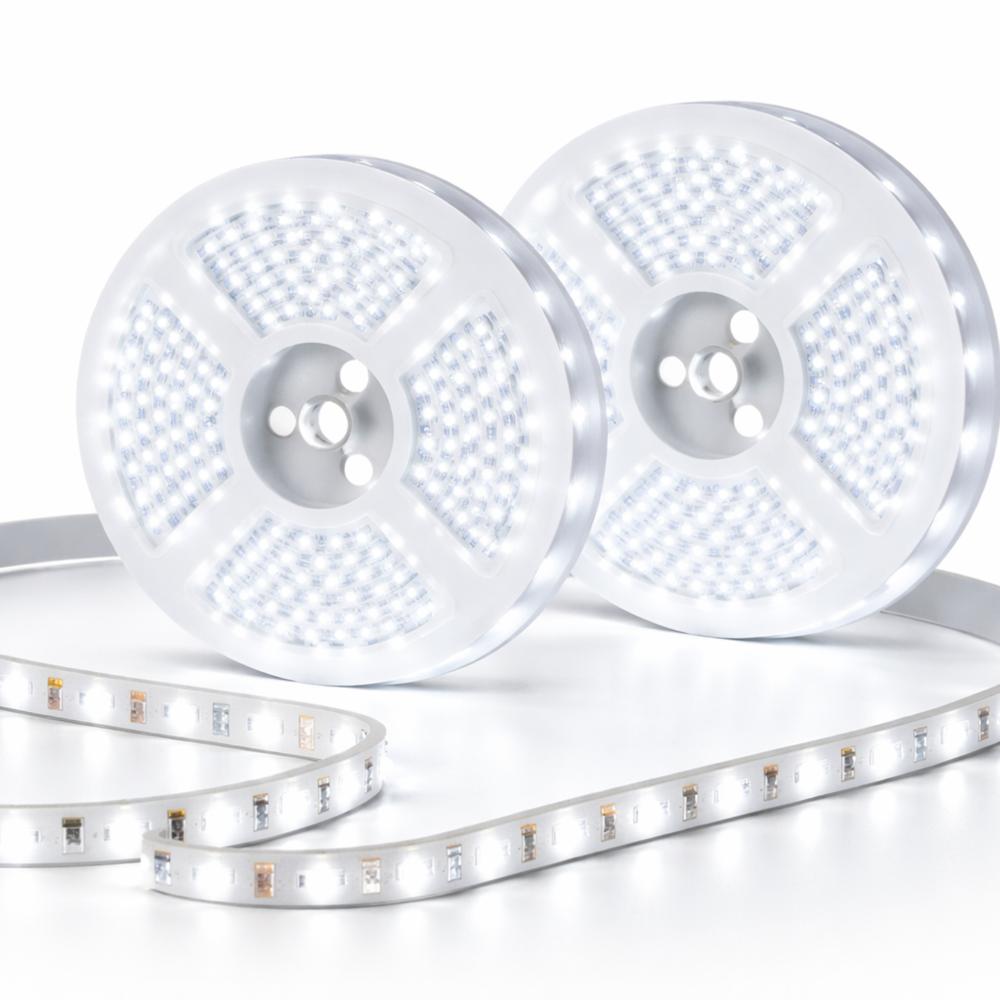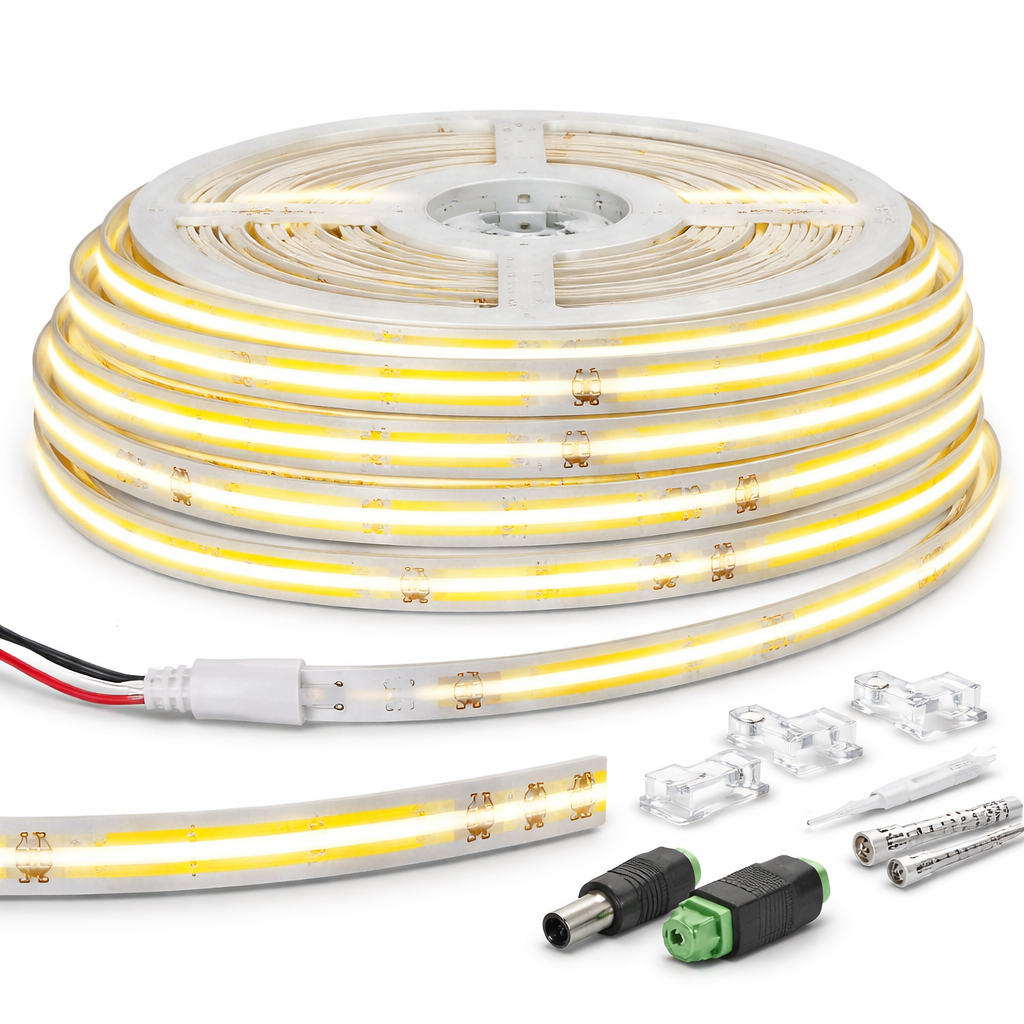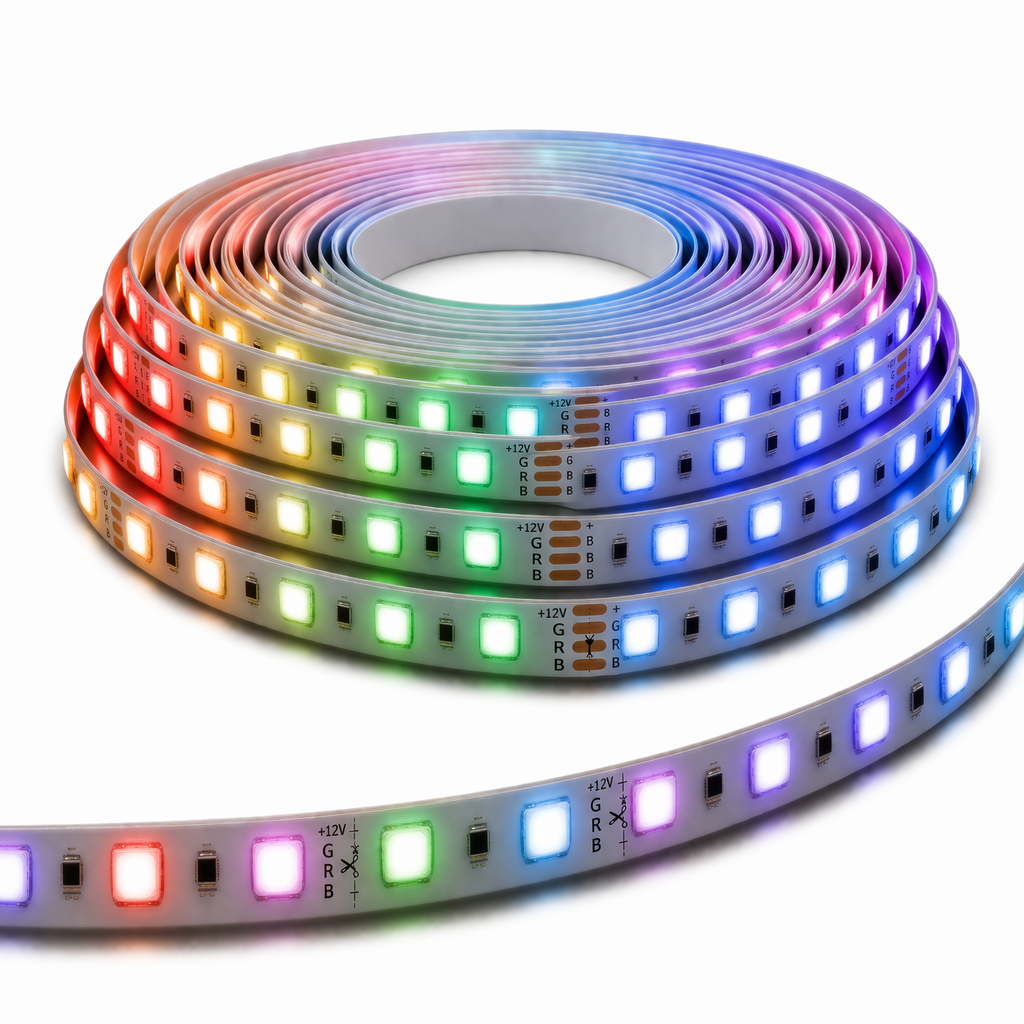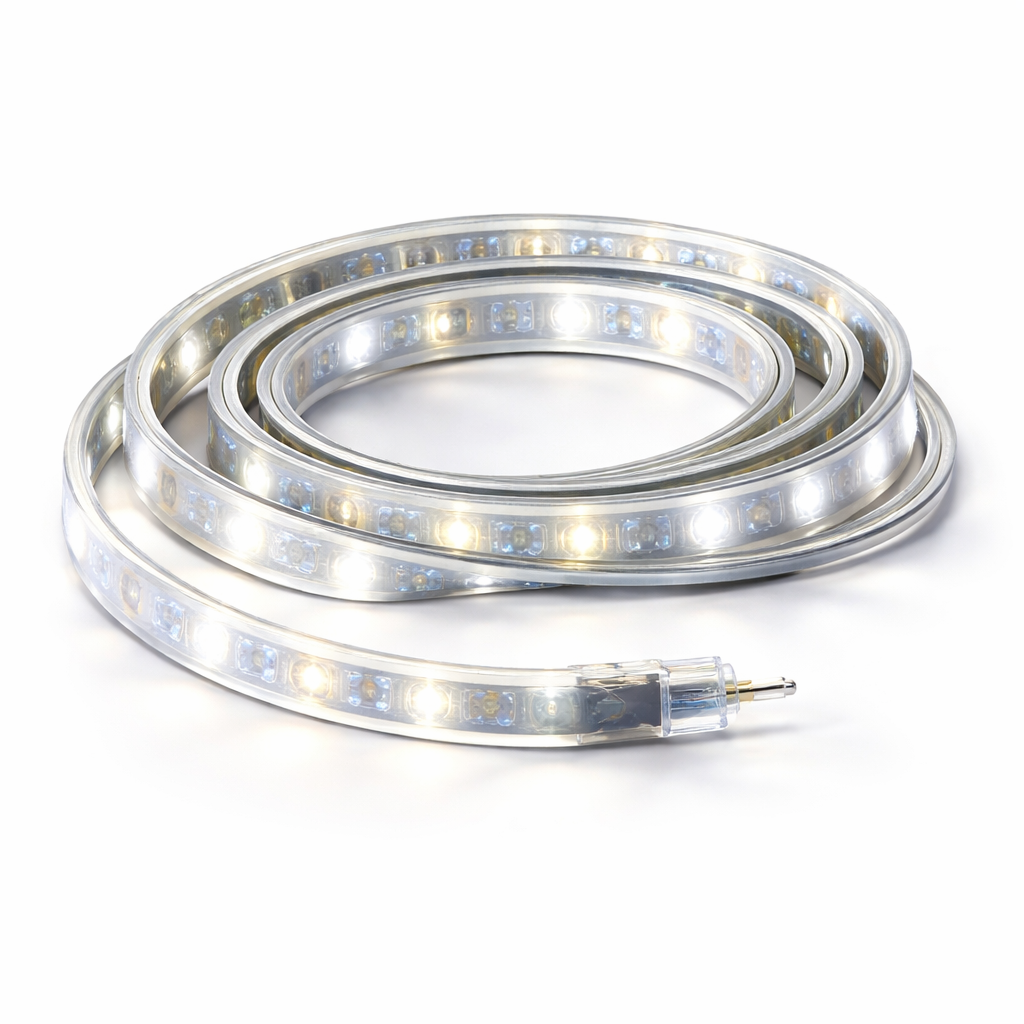
Outdoor LED strip lights bring a clean line of light to decks, railings, soffits, pergolas, signs and façades, in places where an indoor strip would not survive the first storm. Outdoor strips are sealed against moisture and carry an IP rating, typically IP65 or IP67, so rain, snowmelt, sprinkler spray and humidity become part of normal operation. Choose white light for steps and walkways, dot-free COB for visible runs, or RGB colour for patios and seasonal displays.
This page helps homeowners light a backyard, a balcony or a cottage deck, and gives contractors, electricians and sign makers the specs they need for storefronts, commercial exteriors and outdoor signage.
The outdoor white LED strips use SMD chips such as the compact 3528 or the 2835, typically at 60 LEDs per metre with a CRI of 90. They come in warm 2700 K and 3000 K for patios and entrances, neutral 4000 K, and crisp 5000 K for security lighting and signage. The 24 V long-run 2835 outdoor LED tape comes in 10 m (32.8 ft) reels designed for long runs, at 2.6 W/ft (8.4 W/m).
COB (chip-on-board) strips pack hundreds of chips per metre under a continuous phosphor layer, so the light reads as one smooth line with no visible dots, even in plain view along a railing or a step. The outdoor COB LED strips range from 320 to 480 LEDs per metre at 12 V or 24 V. The 24 V outdoor COB tape light in 3000 K delivers 3 W/ft (10 W/m) with a CRI of 90. Slim 8 mm COB tapes rated IP65 and long-run COB strips rated IP67, with 640 lm on 10 m rolls, complete the family.
For colour, the outdoor RGB LED strips mix red, green and blue to create almost any shade, from a soft amber glow on a terrace to holiday themes on a façade. The IP67 RGB COB strip with 630 LEDs per metre gives a seamless colour line on a 10 mm board at 9 W/m, while 24 V RGB tape at 2.2 W/ft (7.2 W/m) suits long accent runs. RGBW versions add a dedicated white chip for clean white light, and a controller or remote is needed to change colours.
For very long outlines, 120V LED strips connect directly to line voltage, without a separate driver. The 120 V outdoor LED strip on a 75 ft (23 m) reel runs at 2.5 W/ft (8 W/m) and produces 280 lm/ft (920 lm/m) with a 140° beam, enough to outline a deck, a fence or a building façade. Line-voltage strips must be installed according to the electrical code.
The IP code tells you how well a strip resists dust and water. IP65 and IP67 are both dust-tight; the difference is how much water they can take.
| Rating | Protection | Where to use it | Examples in this category |
|---|---|---|---|
| IP65 | Dust-tight, resists water jets | Covered patios, soffits, under railings and awnings, signs | 8 mm COB tape, 12 V 3528 tape (11.5 x 4 mm), 110 V SMD strip on a 50 m roll |
| IP67 | Dust-tight, withstands temporary immersion | Exposed decks, garden borders, spots where water can pool | 24 V 3528 tape (10 x 3 mm), RGB COB strip with 630 LEDs/m, long-run COB with 640 lm |
Neither rating is meant for permanent submersion, such as inside a pool or a fountain. Check the cUL or CSA marking and the wet or damp location rating on each product page, and remember that the rating only holds if every cut end and connection is resealed.
| Voltage | Reel lengths | Example | Best for |
|---|---|---|---|
| 12 V DC | 5 m (16.4 ft) | 3528 tape, 1.5 W/ft (4.8 W/m), CRI 90 | Steps, railings, small signs |
| 24 V DC | 5 m or 10 m (32.8 ft) | Long-run 2835 tape, 2.6 W/ft (8.4 W/m) | Decks, soffits, pergolas |
| 120 V AC | 75 ft (23 m) | 2.5 W/ft (8 W/m), CRI 85, no driver | Façades, fences, long outlines |
For step-by-step details, read how to install LED strip lights, and compare COB and SMD, 12 V and 24 V and IP ratings in how to choose LED strip lights.
They are protected to the level of their IP rating. IP65 strips resist rain and water jets, which suits covered or partly exposed areas, while IP67 strips withstand temporary immersion for fully exposed spots. Neither is designed to stay underwater.
No. The difference between an indoor strip and an outdoor LED strip is the protective jacket: an indoor strip has no seal against moisture, so water and condensation can damage the circuit. Choose an IP65 or IP67 strip for exterior use.
Choose 24 V for long runs or when the power supply sits far from the strip, because it loses less voltage over distance. 12 V works well for short accents such as a few steps or a small sign.
Low-voltage 12 V and 24 V strips need a constant-voltage power supply rated for their total wattage, installed in a dry place. 120 V AC strips connect directly to line voltage, without a separate driver.
Outdoor-rated strips are made to handle moisture and temperature swings from winter to summer. Fasten them with clips rather than adhesive alone, keep the power supply sheltered and reseal every cut end.
Yes, at the cut marks printed on the strip. Each cut end must then be resealed with an end cap or a sealant suited to the strip's jacket, otherwise the IP rating no longer applies.
Find the right strip for your project among the outdoor COB LED strips and the white and RGB ranges above, then add the power supply and channel that complete the installation.