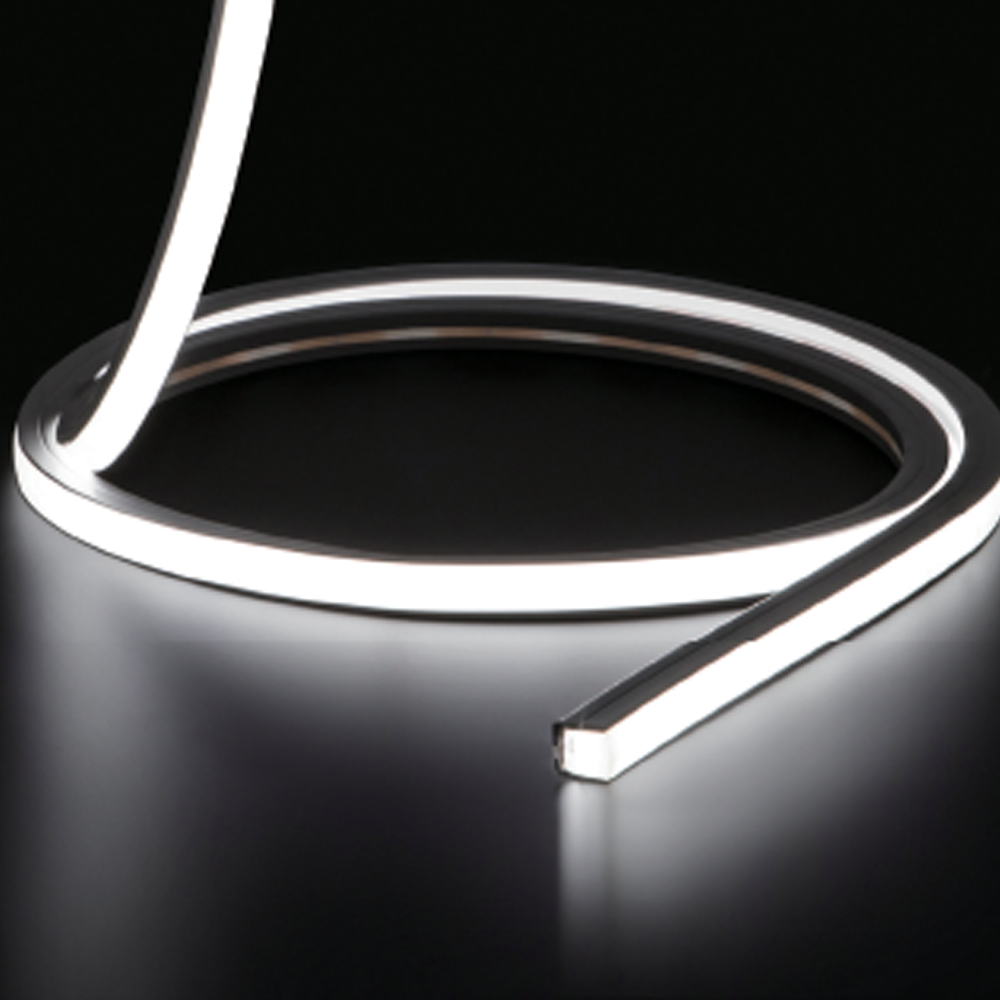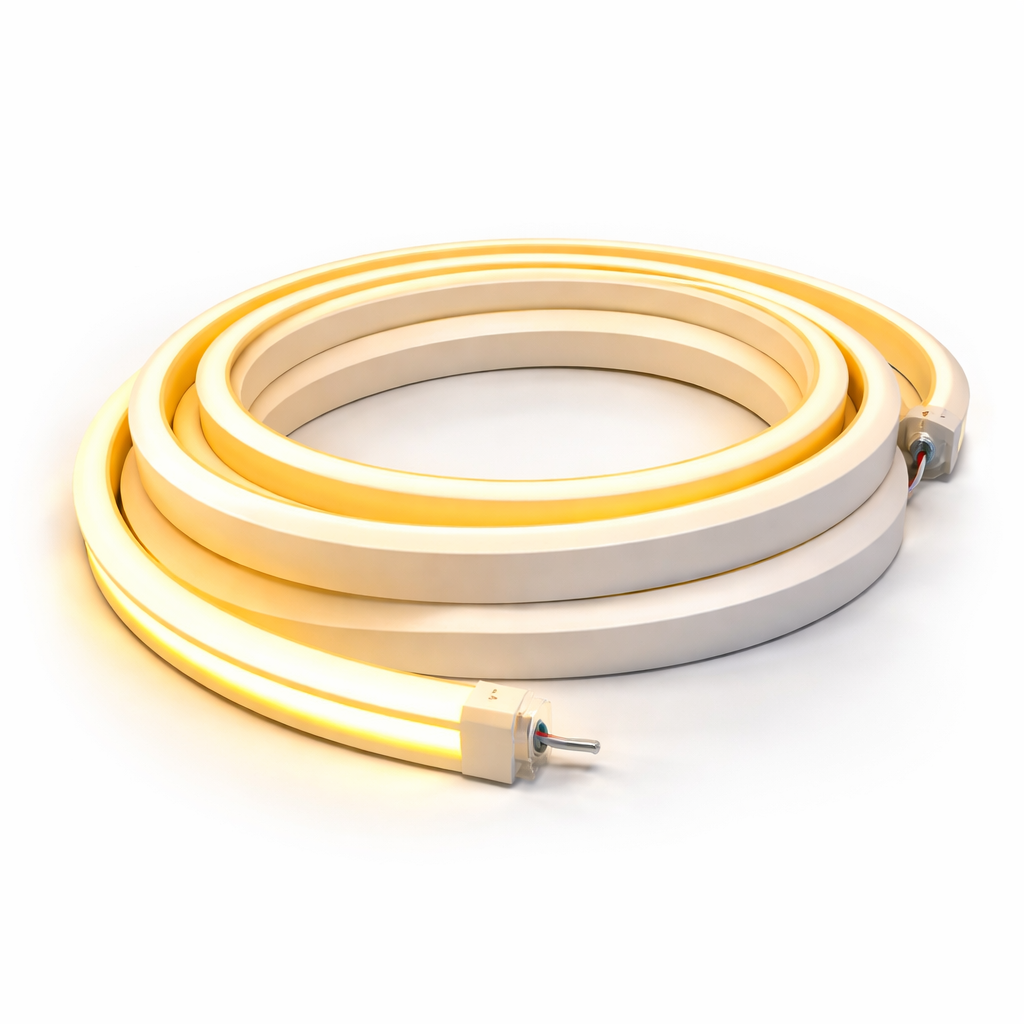
LED neon flex recreates the look of classic glass neon, a continuous glowing line with no visible dots, inside a flexible silicone jacket that bends, cuts and mounts like an LED strip. It runs on safe low voltage, mostly 24 V, uses much less energy than glass neon or incandescent rope lights, and handles rain and sun when the jacket is rated IP66 or IP67. This category groups 68 products: single-colour and RGB neon flex, flexible LED tube and the accessories that finish a clean installation.
It is for homeowners who want a glowing outline on a deck, a staircase or a game room wall, and for sign makers, designers and contractors who build storefront signs, logos, bar lighting and architectural lines.
Single-colour neon gives one steady shade along the whole run: warm white in 2700 K, 3000 K or 3500 K, neutral 4000 K, or a colour such as blue. The commercial-grade 3000 K single-colour neon from LumenstarLED runs on 24 V at 9.6 W/m (2.9 W/ft), comes in 10 m (32.8 ft) rolls, is UL approved and uses an outdoor-rated, UV-protected silicone. Samples of 0.61 m (2 ft) let you check the shade on site before committing to a full roll. NEXLEDS also offers a 10 mm IP67 neon tape with a CRI of 90+ on 10 m rolls.
RGB neon mixes red, green and blue to change colour on command, a favourite for bars, events and colour signs. The Ultraflex RGB neon is a commercial-grade 24 V model at 15 W/m (4.6 W/ft), rated IP66 and dimmable, in 6 m (20 ft) lengths, while a dotless RGB neon flex with 96 LEDs per metre comes on 5 m reels. Pair RGB neon with a controller from the LED strip controllers and remotes; for colour without a neon jacket, see the RGB LED strips.
The bend direction decides what you can draw. Top-bend neon flexes in the direction of its lit face, to follow arches, columns and rounded edges; side-bend neon flexes sideways, so it can trace letters, logos and shapes on a flat surface. The Top Bend Type XA neon in 3000 K is rated IP67, runs at 8 W/m (2.4 W/ft), is dimmable and is cut to a custom length. Profiles range from a slim 3 × 6 mm side-bend neon at 9.6 W/m and a 6 × 6 mm top-bend at 6 W/m to a 6.5 × 11 mm side-view and a 10 × 10 mm top-view at 14.4 W/m, plus an anti-glare 10 × 10 mm version and a cabinet neon at 8 W/m. Round 360° neon glows all the way around, for suspended lines and pendants.
For a round, rope-like look outdoors, the ARANI 24 V LED FlexiTube in 3000 K draws 5 W per foot, is weatherproof and dimmable, and comes in 33 ft rolls (165 W), also in 4000 K and RGB, with matching brackets.
| Criterion | Single-colour neon flex | RGB neon flex |
|---|---|---|
| Light | One fixed shade, 2700 K to 4000 K or a colour | Colour-changing, mixed by a controller |
| Typical power | 6 to 14.4 W/m | 15 W/m |
| Control | Dimmable driver or dimmer | RGB controller and remote |
| Best for | Architectural lines, white accents, one-colour signs | Bars, events, colour signs, seasonal displays |
IP ratings and voltages are explained in more detail in how to choose LED strip lights.
LED neon flex is cut only at its marked cut points. Each cut end then needs an end cap or a seal suited to the jacket, otherwise the IP rating no longer applies. Some models, such as the Top Bend Type XA, are cut to a custom length so the run fits the drawing exactly.
Power enters through a power feed: an end-exit feed sends the cable straight out of the end, a bottom-exit feed routes it down and out of sight behind the run, and a solder-on feed with a silicone end exit gives a permanent, low-resistance connection that helps limit voltage drop.
Size the 24 V power supply by multiplying watts per metre by length: 10 m at 9.6 W/m draws 96 W, and a 33 ft FlexiTube roll at 5 W per foot draws 165 W. Choose a constant-voltage unit rated above that total, keep it in a dry, ventilated spot and feed long runs at more than one point. The guide on how to install LED strip lights covers the wiring basics.
Good hardware keeps neon straight, hides the fixings and holds through heat and humidity. The neon accessories include:
At home, neon flex outlines deck edges, stair nosings and railings, adds a glow to a patio or a pool area, and turns a name, a logo or a simple line into wall art in a game room, a home bar or a child's room. For outdoor ideas, see LED outdoor patio lighting and the outdoor LED strips.
In commercial spaces, it lights storefront signs and logos, bar and restaurant backlighting, retail displays, hotel facades and building outlines, where its continuous line reads clearly from a distance. Sign makers will find more ideas on the LED sign lighting page.
It is an LED strip sealed in a silicone diffuser that spreads the light into a smooth, neon-like line. It looks like glass neon without the fragile tubes, the high energy use or the gas, and it runs on low voltage.
Yes, at the marked cut points only. Reseal every cut end with an end cap or sealant, and add a power feed where the run starts. Some models are sold cut to a custom length.
Yes, if it is rated for it. Look for an IP66 or IP67 jacket and UV-protected silicone, and keep the power supply in a dry, sheltered spot.
Choose single colour for architectural lines, white accents and signs in one shade. Choose RGB to change colours for events, seasons or brand themes, and add an RGB controller.
Many models are, including the Top Bend Type XA, the Ultraflex RGB and the FlexiTube. Use a dimmer or driver compatible with the model, or the RGB controller for colour versions.
Rope light shows individual bulbs or bright spots along its length. Neon flex hides the LEDs behind a thick diffuser, so the line looks continuous, and its silicone jacket is built for outdoor and commercial use.
Compare the LED neon flex in this category by colour, bend direction and IP rating, then complete the run with a 24 V power supply and the right mounting hardware. For a slimmer dot-free line without a silicone jacket, see the COB LED strips.