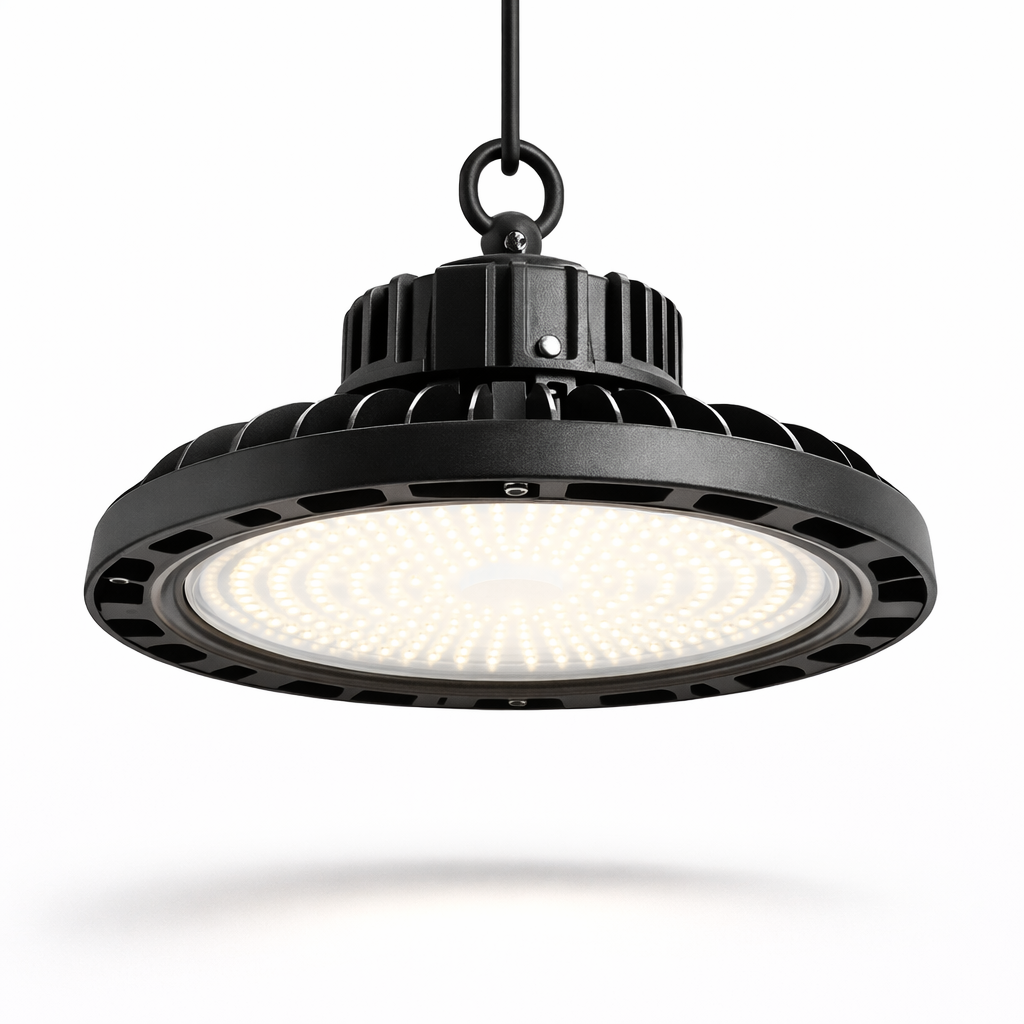
A UFO LED high bay is the round, compact fixture that lights warehouses, factories, garages, arenas and big-box stores from ceilings a regular luminaire cannot reach. This category groups the UFO high bay lights sold across Canada, with the 120-347 V drivers Quebec commercial buildings need, plus matching sensors, optics and mounting hardware. Planning warehouse lighting from scratch or replacing metal halide one fixture at a time, this guide helps you choose the right LED high bay the first time.
UFO round high bay or linear high bay?
The UFO high bay is a disc a little over 10 inches across that hangs from one hook or chain and throws a wide, symmetrical pool of light straight down: the fastest fixture to install over open floors and garage bays. A linear high bay is a long rectangle whose stretched light pattern follows narrow aisles and long rows of shelving. Rule of thumb: UFO for open areas, square bays and one-for-one HID replacement; linear for tall, tight aisles. The 4 ft vapour-tight high bay listed here (105 W to 180 W, 24,300 lumens) is the sealed linear option for wet areas.
Choosing the wattage by mounting height
Almost every high bay here is wattage selectable: a switch on the driver sets the output on site, with ranges from 75-100-150 W up to 240-270-300 W plus fixed 100 W, 200 W and 300 W models. The general rule of thumb used in the trade ties wattage to height: the low tier of selectable fixtures (about 100 to 150 W) for ceilings of 15 to 20 ft, the middle tier (150 to 240 W) for 20 to 30 ft, and the top tier (240 to 300 W) above 30 ft. That is a starting point, not a lighting design: aisle width, spacing, reflectance and the task underneath all move the answer; order the tier that matches the height, then fine-tune on site.
Lumens and efficacy
Light output is what you actually buy. A 90-120-150 W UFO here delivers 13,800, 18,400 or 23,000 lumens by setting; a 180-200-240 W model runs from 23,700 to 37,000 lumens; the largest 240-270-300 W round high bays reach 43,800 lumens. Efficacy ranges from 135 lm/W and 140 lm/W up to 150 lm/W or better, with a CRI of 80 or higher so labels and colour-coded parts read correctly; DLC Premium models are flagged in the title.
Colour temperature: 4000 K or 5000 K
Most models are CCT selectable. Two-setting fixtures offer 4000 K (neutral white) and 5000 K (crisp daylight white); three-setting fixtures add 3000 K or 3500 K for showrooms and arenas. For warehouses, shops and production floors, 5000 K is the usual choice for brightness and contrast; 4000 K is the compromise when offices or a sales area share the view.
Beam angle, lenses and reflectors
A bare UFO spreads light at roughly 90 degrees. A 60 degree optic lens tightens the beam for taller ceilings and narrow aisles; a 120 degree lens widens it for lower ceilings and cuts the fixture count. Reflectors control glare, frosted lenses soften the view of the diodes, and wire guards protect the fixture in gymnasiums and arenas.
120-277 V or 347 V: the Quebec question
Many commercial and industrial buildings in Quebec and across Canada run their lighting at 347 V, and a fixture rated 120-277 V will not work on that circuit. Most high bays here are 120-347 V with an auto-sensing driver, so one model covers a 120 V garage, a 277 V plant and a 347 V warehouse; several CSC LED models and the Light Efficient Design retrofit lamps also come in 277-480 V. Confirm the voltage at the panel before choosing a high bay 347V or 120-277 V model.
0-10 V dimming
Most high bays here ship with 0-10 V dimming drivers, the standard interface for building controls, daylight harvesting and bi-level occupancy sensors: one low-voltage pair sets the output from full to stand-by.
Motion sensors and daylight sensors
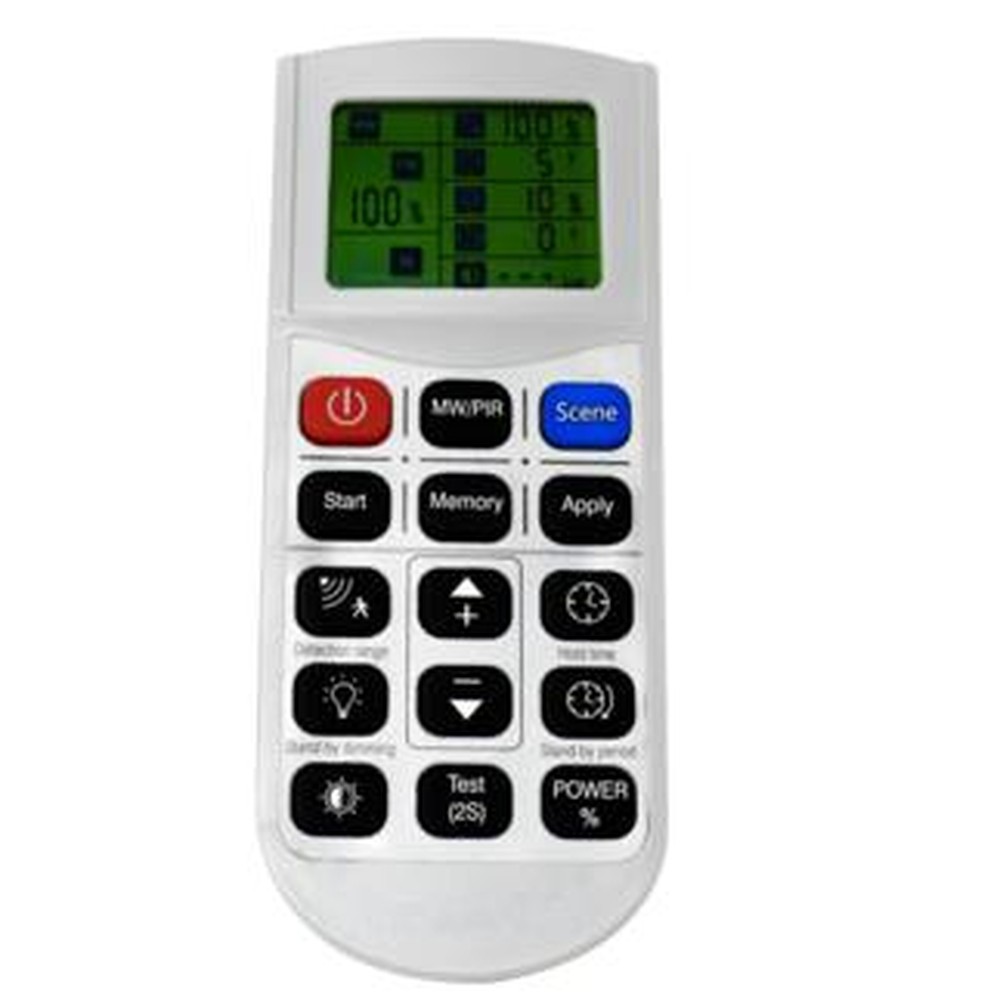
Empty aisles do not need full light. A plug-in PIR or microwave occupancy sensor brings the high bay to 100 % when someone enters, dims it to stand-by when the area empties and switches it off after a set hold time; the daylight function keeps it off when skylights give enough light. The TUROLIGHT PIR1 sensor mounts in the fixture, is rated IP65 and -20 °C to +60 °C, and works at mounting heights up to 40 ft, with radius, hold time and daylight threshold set by wireless remote. Three-pin microwave and infrared sensors, photocells and remotes for the other families are listed next to the fixtures they fit.
Replacing metal halide or high-pressure sodium
Two paths. The first is a new UFO on the existing hook and circuit, which also adds dimming. The second is a high bay retrofit lamp from Light Efficient Design with an EX39 mogul base, screwed into the existing HID housing once the ballast is bypassed or, for the ballast-compatible model, left in place. Published equivalences: 90 W and 95 W retrofits replace up to a 250 W HID lamp, 135 W to 150 W replace up to 400 W, and 270 W replaces up to 1000 W, in open-rated and enclosed-rated versions.
Mounting: hook, chain, pendant, yoke
A UFO comes with a hook or eye bolt for a chain or pendant drop, and most include a power cord, some 10 ft long. Yoke mounts tilt the fixture for sloped ceilings, surface brackets fasten it to a joist, and a safety cable is the recommended second point of attachment over work areas. Accessories are sorted by model and wattage, including 40 W emergency drivers for 200-240 W high bays.
Ambient temperature and IP rating
The UFO high bays here are rated IP65, with die-cast aluminum housings that pull heat away from the diodes, and are specified for -20 °C to +50 °C. Several carry NEMA 4X and NSF marks for washdown and food facilities, and the published rated life is 50,000 to 54,000 hours.
Brands in this category
Ready to light the building?
Start with the ceiling height, confirm the voltage, pick the CCT, then browse the UFO LED high bay list by wattage range; each product page lists lumens per setting, certifications and matching accessories for a complete bill of materials.
FAQ
What wattage high bay for a 20 ft ceiling?
By the general rule of thumb, 20 ft sits at the boundary between the low and middle tiers of selectable fixtures. A 100-150 W UFO set to 150 W, about 23,000 lumens, is the usual starting point; a 150-240 W model leaves room to raise output over work areas.
Do I need a 347 V high bay?
Only if the lighting circuit is 347 V, common in Quebec commercial and industrial buildings. Check the panel. A 120-347 V fixture works on either service.
UFO or linear high bay: which is better?
UFO for open floors, square bays and one-for-one HID replacement; linear for narrow, tall aisles.
How many high bays do I need?
It depends on floor area, ceiling height, target light level and lumens per fixture: divide the lumens the space requires by the lumens of the chosen fixture, then adjust for spacing-to-height ratio. A layout calculator for this category is planned.
Can I add a motion sensor to a UFO high bay?
Yes. Fixtures with a sensor receptacle accept a plug-in PIR or microwave sensor, and any 0-10 V dimmable high bay can be driven by a fixture-mounted or ceiling occupancy sensor. Match the sensor family to the fixture series.
What replaces a 400 W metal halide high bay?
Either a UFO LED high bay in the 150 W range, or a 135 W to 150 W EX39 retrofit lamp from Light Efficient Design in the existing housing.
Tool: LED high bay calculator – how many fixtures and what spacing for your warehouse or shop.