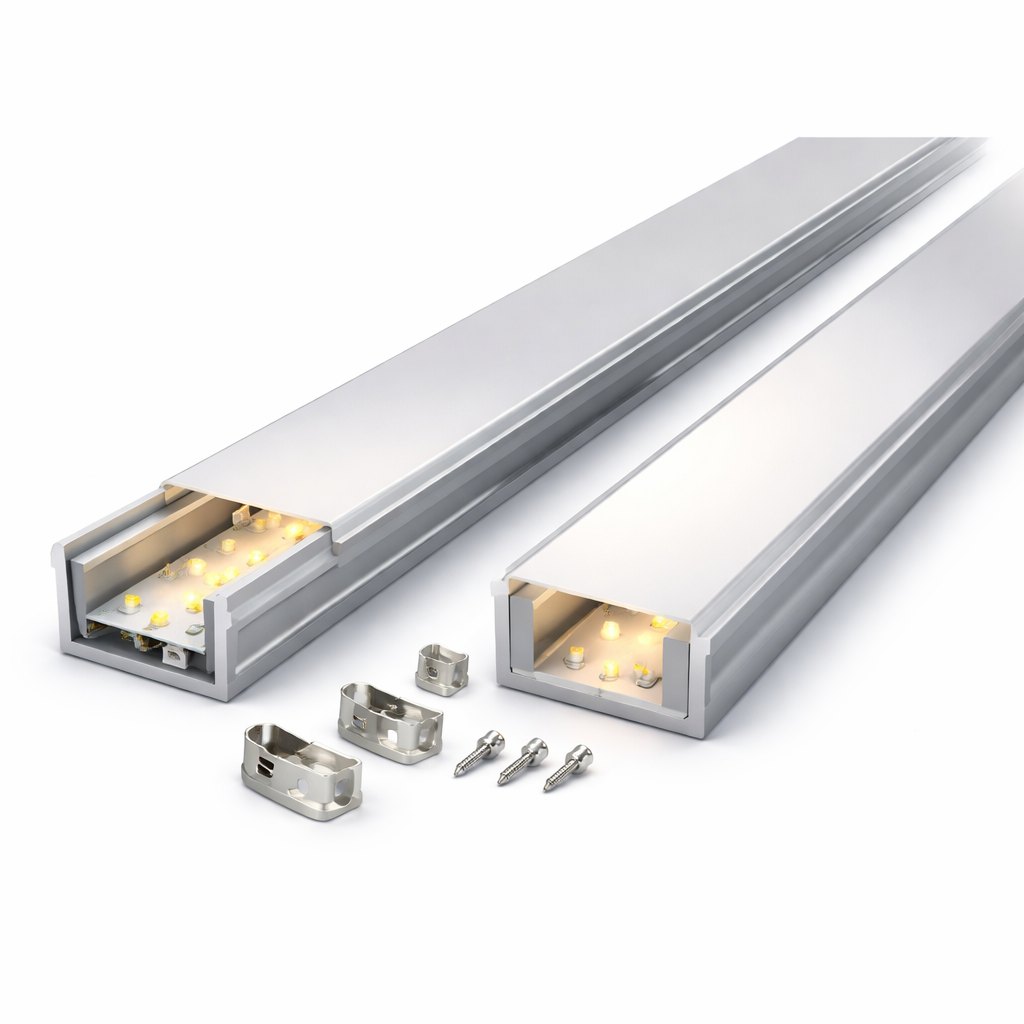
LED aluminium profiles turn a bare LED strip into a finished fixture. The extruded aluminum channel holds the tape straight, draws heat away from the diodes and hides the individual dots behind a diffuser, so the result looks like a continuous line of light rather than tape stuck under a cabinet. With the right channel, a strip becomes a slim LED light bar for a ceiling, a shelf, a staircase or a storefront.
This page is for homeowners finishing a kitchen, basement or condo, for contractors and electricians who need profiles that fit drywall and millwork, and for designers planning cove, display or corridor lighting in commercial spaces.
The LED aluminum profiles range includes surface, recessed, trimless, corner, baseboard, bendable, pendant and in-ground shapes. Full-size profiles often come in 10 ft or 8 ft lengths, while metric channels are offered in 1 m (3.28 ft), 2 m (6.56 ft) or 3 m (9.84 ft) sections. All of them can be cut to the length of your run.
Surface profiles screw or clip onto a cabinet, shelf, wall or ceiling. Super slim models such as the 0809 (about 8 x 9 mm in section) disappear under a cabinet lip, and low-profile channels like the 15.5 x 6.6 mm extrusion or the LL11 suit tight spaces where a bulky fixture would show. Wider channels, such as the 5020 or the 613 with its PC cover, accept wider strips and give a softer line.
Recessed channels sit flush in a routed groove or a drywall cut-out, held by spring clips. Trimless profiles go further: they are finished with joint compound so only the light line remains, a detail often called drywall trims and reveals. The Knife Edge 7330 aluminum profile reduces the visible flange to a sliver, and its straight, L, T, Y, cross, 120-degree and 135-degree connectors let you draw geometric patterns across a ceiling. Mud-in channels such as the LL23 are set before the joints are taped, while "after drywall" models like the 6114 or 3515 go in once the boards are up.
Corner profiles sit in a 90-degree inside corner and aim the light diagonally, which is ideal under wall cabinets, along a ceiling-to-wall joint or inside a showcase. Options include the 90-degree surface profile 601, the angled 16 x 16 mm extrusion, the LL8 corner mount aluminum channel and the larger LL28. In drywall, trimless corner profiles (5324, 4625) and inside or outside angle drywall profiles keep the light flush with the paint.
Bendable channels (the LL14, the up-and-down 640, the 1513 that bends in every direction) follow curved walls, arches and bulkheads. A pendant kit turns a channel into a suspended linear fixture; the kit for the 5020 includes 3 metres of wire. In floors and outdoors, in-ground profiles carry a sealed cover: the 2952 in-ground profile with IP67 acrylic enclosure comes with silicone and aluminum end caps, and the waterproof 1217 profiles use an IP65 polycarbonate enclosure.
LED baseboard lighting places a soft line of light at floor level. It guides the way along a hallway or stairwell at night, makes a wall seem to float and adds a hotel-style touch to a bedroom, home theatre or condo corridor. Because the light sits low, it brightens the floor without glare at eye level.
The 10015 surface-mounted baseboard aluminum profile comes in 10 ft lengths with a polycarbonate cover, in white, black or champagne to match the trim or the flooring. Its aluminum body works as a heat sink, and the frosted cover softens the diodes into an even glow. For night-time path lighting, pair it with a warm 2700 K or 3000 K strip on a dimmer; in an office or hotel corridor, 3500 K or 4000 K keeps the light crisp. For steps and landings, see the ideas on the LED staircase lighting page.
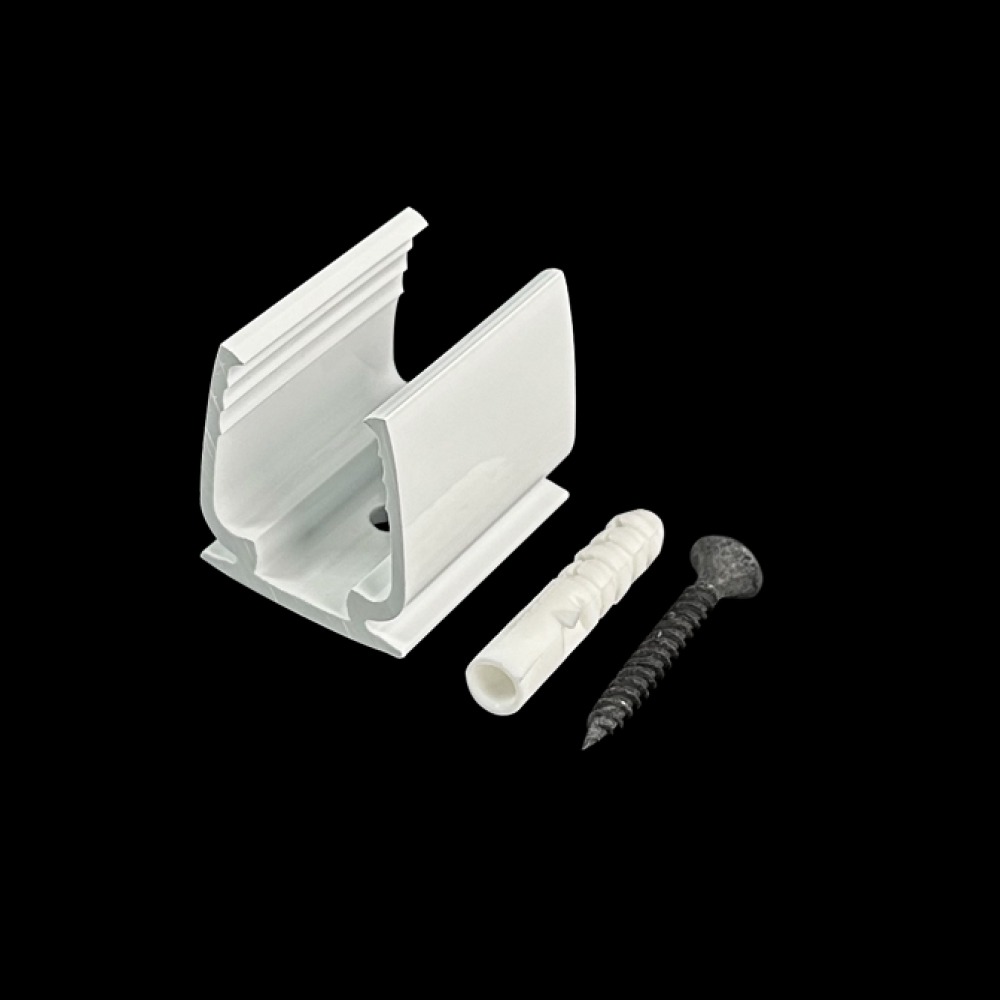
The end caps, lenses and accessories section groups frosted lenses and replacement covers in 1 m, 2 m, 2.44 m and 3 m lengths, end caps sold in pairs with and without a wire hole, linear connectors that join two channels, and clips for neon channels. A focus lens, like the one made for the adjustable LL9D channel, concentrates the beam on shelves or artwork.
Under mounts and brackets, you will find standard and swivel installation brackets, bracket springs and mounting hardware. A swivel bracket lets you tilt a surface profile toward a wall or display, while springs and clips hold recessed channels firmly in their cut-out.
| Profile type | Example | Section or length | Best for |
|---|---|---|---|
| Super slim surface | 0809 | 3000 x 8 x 9 mm | Cabinets, shelves |
| Low-profile surface | 15.5 x 6.6 mm extrusion | 3000 x 15.5 x 6.6 mm | Tight spaces, light bars |
| Angled corner | 601 | 3000 x 16 x 16 mm | Inside corners, showcases |
| Flexible drywall | 56 x 15 mm drywall profile | 3000 x 56 x 15 mm | Curved walls and ceilings |
| Wide flat drywall | 61.45 x 14 mm drywall profile | 3000 x 61.45 x 14 mm | Trimless ceiling lines |
| Baseboard | 10015 | 10 ft | Hallways, stairs, bedrooms |
| Waterproof | 1217 | 8 ft, IP65 | Damp areas, covered patios |
| In-ground | 2952 | 10 ft, IP67 | Walkways, entrances, floors |
The aluminum LED profile guide details each profile family, and the LED strip installation guide covers cutting, wiring and power supply sizing.
The channel is only part of the fixture: choose the strip among indoor LED strips, or outdoor LED strips for wet locations.
An LED aluminium profile, also called an LED channel or LED extrusion, is a length of extruded aluminum that houses an LED strip. It protects the strip, acts as a heat sink and holds a diffuser that blends the diodes into one smooth line of light.
It is not mandatory, but it is strongly recommended. On a bare surface, heat stays around the diodes, which can shorten their life and reduce output, and every dot remains visible. A channel also protects the strip from dust and knocks.
For a 90-degree inside corner, use a corner profile such as the 601 or the LL8, which aims the light diagonally. In drywall, trimless corner profiles and angle drywall profiles keep the light line flush with the finished surface.
A trimless profile is fastened to the drywall or framing, then covered with joint compound so only a narrow slot remains. After sanding and painting, the strip and diffuser clip in, leaving a light line with no visible frame.
It is an LED strip housed in a baseboard-style aluminum profile at the bottom of the wall. It gives soft path lighting in hallways, stairs and bedrooms. The 10015 baseboard profile, in white, black or champagne, is a simple place to start.
Yes, when the whole system is rated for it: an in-ground profile with an IP67 enclosure for walkways, or an IP65 waterproof profile in covered areas, with an outdoor-rated strip and a power supply mounted in a protected spot.
Ready to plan your project? Browse all LED aluminum profiles, then add the end caps, lenses and brackets that complete the installation.