LED power supplies and drivers turn line voltage into the low-voltage power that LED strips, puck lights, landscape fixtures and many recessed lights need. A well-matched supply keeps the light steady and free of flicker; an undersized or wrong-voltage one shortens LED life or simply will not work. This category covers 12 V and 24 V constant voltage power supplies, constant current LED drivers, TRIAC and 0-10 V dimmable models, outdoor and landscape units, and step-down transformers for 347 V buildings.
Homeowners use them for under-cabinet lighting, coves, stairs and patios. Electricians and installers will find plug-in, hardwire and junction box formats, Class 2 outputs, wet location ratings and cUL, CSA, UL or ETL listings. Start with the voltage of your lights, then size the supply and choose how you want to dim.
All of these products convert power, but they do not do the same job. Match the type to what is printed on your light or strip.
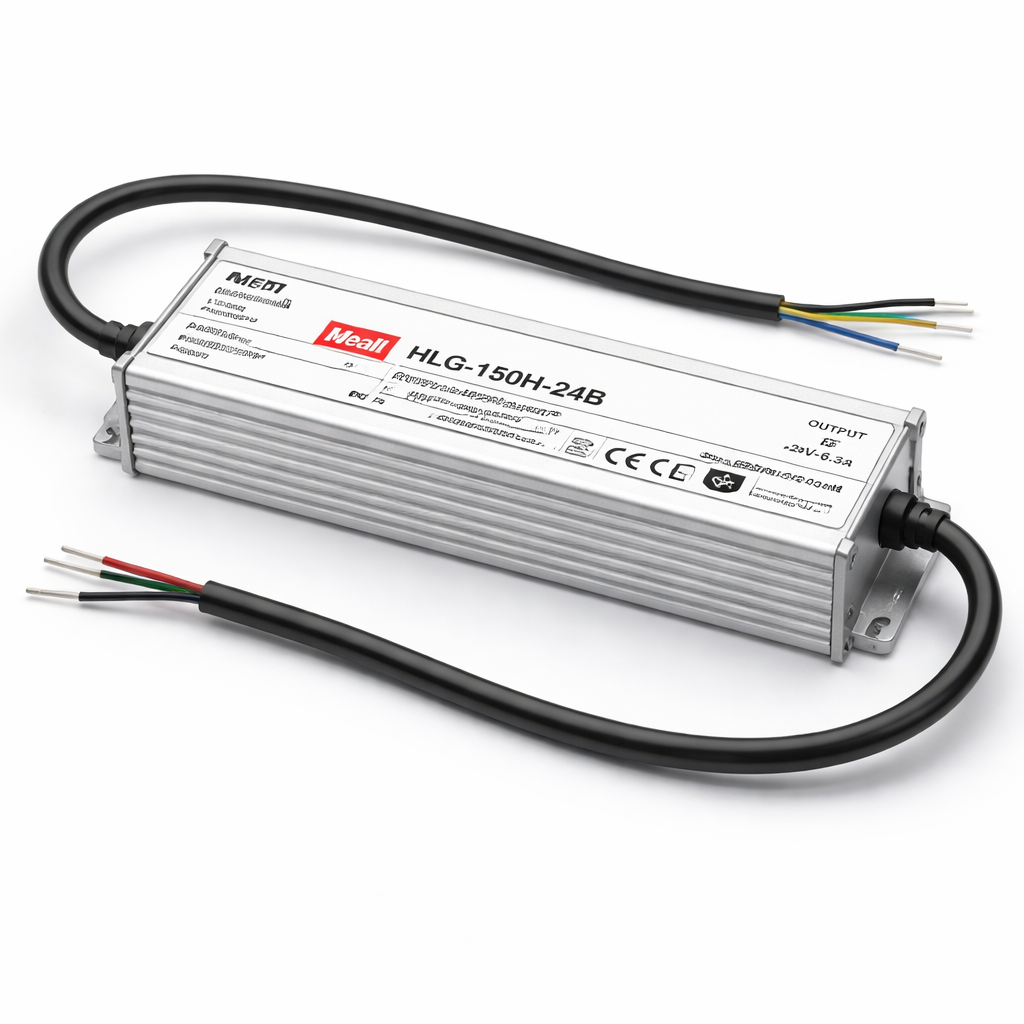
Most LED strips, pucks and under-cabinet bars run on a fixed 12 V or 24 V DC, and a constant voltage LED power supply holds that voltage while the load changes. Lumenstarled offers indoor units starting at 6 W and wet location units up to 320 W at 24 V. For a kitchen or a display cabinet, the Lumenstarled 30 W 12 V plug style power supply with its 6 ft cord is the simplest option.
Some fixtures and modules are rated in milliamps rather than volts and need a constant current LED driver. The Lumenstarled 40 W constant current driver sets its output from 300 mA to 1400 mA with DIP switches and dims with 0-10 V or 1-10 V. Ortech's drivers come housed in their own junction box, from 8 W to 96 W, in dimmable and non-dimmable versions, and Ortech also makes 0-10 V drivers up to 347 V input for its SLIM recessed fixtures.
For a patio, a deck or a garden, choose a wet location or IP-rated unit: IP67 is the most common rating in this category, and Canolight's outdoor drivers reach IP68. Landscape fixtures often run on 12 V AC instead: Canolight's 100 W and 300 W outdoor transformers and Lumenstarled's 200 W landscape power supply include a photocell and a timer, while Nexleds makes 120 W and 300 W IP65 landscape drivers. See LED landscape lighting for matching fixtures.
Buildings wired at 347 V need a step-down transformer to feed 120 V fixtures. Arani makes 347 V to 120 V models (25 W and 60 W) and 347 V to 240 V models (50 W and 100 W), and Light Efficient Design offers step-down transformers for up to 45, 140 or 400 W. Lumenstarled also has a 36 W converter that turns 24 V DC into 12 V DC. Emergency LED drivers from Speclite are rated 90 minutes and cUL listed.
The output of the supply must match the lights: a 12 V strip on a 24 V supply burns out, and a 24 V strip on a 12 V supply barely glows. When you have the choice, the table below shows the trade-off.
| 12 V DC | 24 V DC | |
|---|---|---|
| Current for the same wattage | Twice as high | Half as high |
| Voltage drop on long runs | More noticeable | Less noticeable, longer runs per feed |
| Typical uses | Short runs, cabinets, displays, existing 12 V systems | Long runs, coves, commercial projects |
| Examples in this category | Lumenstarled 30 W plug style; Ortech 150, 200 and 300 W dimmable drivers | Lumenstarled 96 W 5-in-1; Canolight 60 W ultra slim driver |
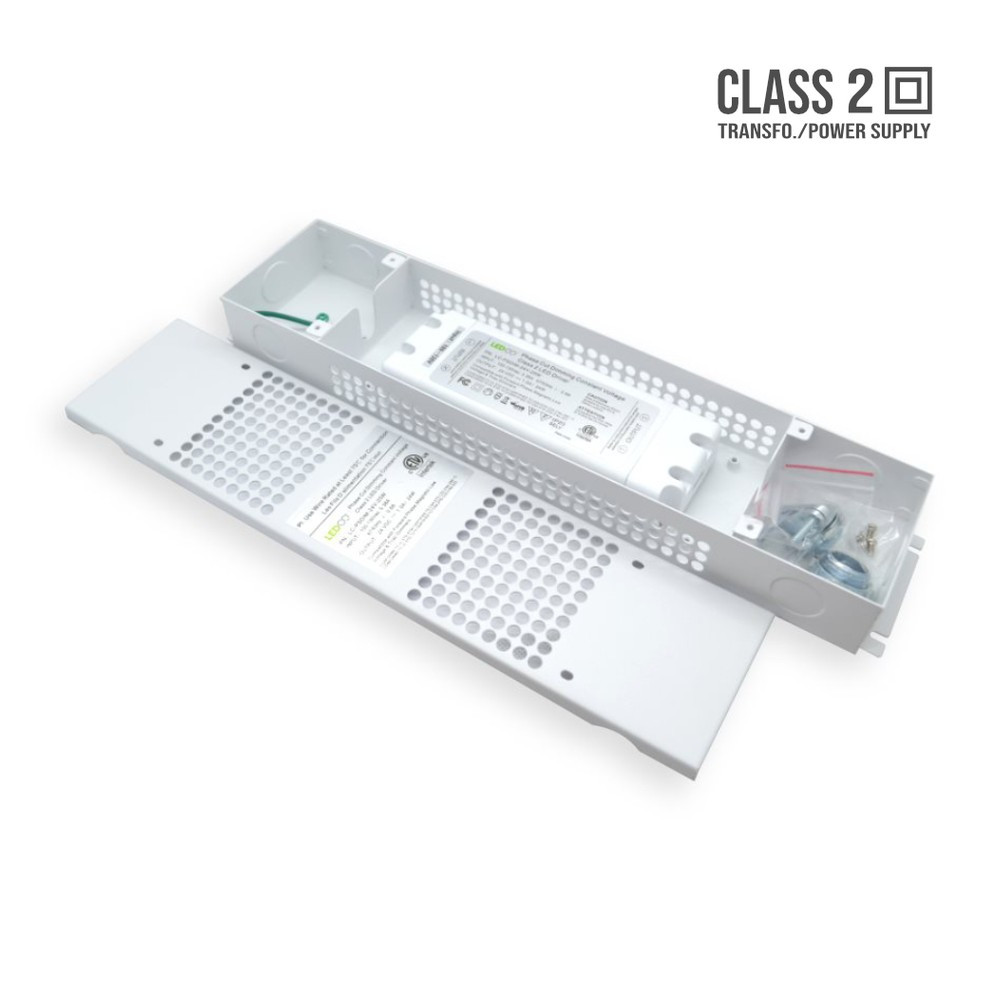
A Class 2 power supply limits its output energy to a level considered safe against fire and electric shock, which simplifies the low-voltage wiring. Higher-wattage Class 2 units split their output into channels: the Canolight 300 W 5-in-1 driver provides 3 channels of 99.12 W, and Lumenstarled's 288 W junction box unit has 3 outputs of 96 W. Wire each channel as a separate circuit.
Add up the wattage of everything on the circuit: watts per foot or per metre times the length for strips, plus each puck or fixture. Then choose a supply rated above that total, with a margin, so it runs cool and lasts: if your lights draw 60 W, step up to a 96 W unit rather than a 60 W one. On long runs, feed the strip in sections or from both ends to limit voltage drop. The guide on how to choose LED strip lights explains 12 V versus 24 V and power supply sizing in detail.
A non-dimmable supply is the simplest choice when the lights only switch on and off. To dim, the supply and the dimmer must use the same method:
For example, the Lumenstarled 96 W 24 V 5-in-1 power supply takes 100-277 V AC, is wet location rated and comes in a junction box. Then pick a compatible control from the LED dimmers.
Install the supply where it stays dry, ventilated and accessible, unless it is rated for damp or wet locations. Plug-in units suit cabinets and displays; hardwire and junction box units belong on a permanent circuit installed to code. Keep the low-voltage run short and follow the steps in the guide on how to install LED strip lights.
In a kitchen, one 24 V supply hidden in a cabinet often feeds every under-cabinet strip on the wall: see LED kitchen lighting. Outdoors, an IP67 or IP68 unit protects strips on a deck or a pergola. In stores, offices and restaurants, multi-channel Class 2 drivers and 0-10 V supplies simplify long cove runs, signs and display cases lit with indoor LED strips.
A constant voltage power supply holds a fixed 12 V or 24 V for strips and pucks. A constant current driver holds a fixed current, in milliamps, for fixtures and modules that require it. Both are often called drivers, so match the type printed on your light.
Use the voltage of your strip or fixture; never mix them. If you are buying both, 24 V draws half the current for the same wattage, which allows longer runs with less voltage drop.
Add the wattage of every strip and fixture on the circuit, then choose a supply rated above the total with a margin. If the lights draw 60 W, a 96 W supply runs cooler and lasts longer than a 60 W one.
It is a driver that varies the light output in response to a dimmer. TRIAC models work with residential wall dimmers, 0-10 V models with commercial controls, and 5-in-1 models accept several signals.
Read the label of the old driver and match its output type (constant voltage or current), its voltage or current range, its wattage and its dimming method. Check the input voltage too: 120 V, 100-277 V or 347 V.
Yes, if it is wet location rated or IP67 or IP68, like the Canolight outdoor drivers. An indoor unit must stay inside or in a weatherproof enclosure.
Ready to power your project? Browse the LED power supplies by voltage and wattage, or the LED drivers for constant current fixtures and junction box installs.