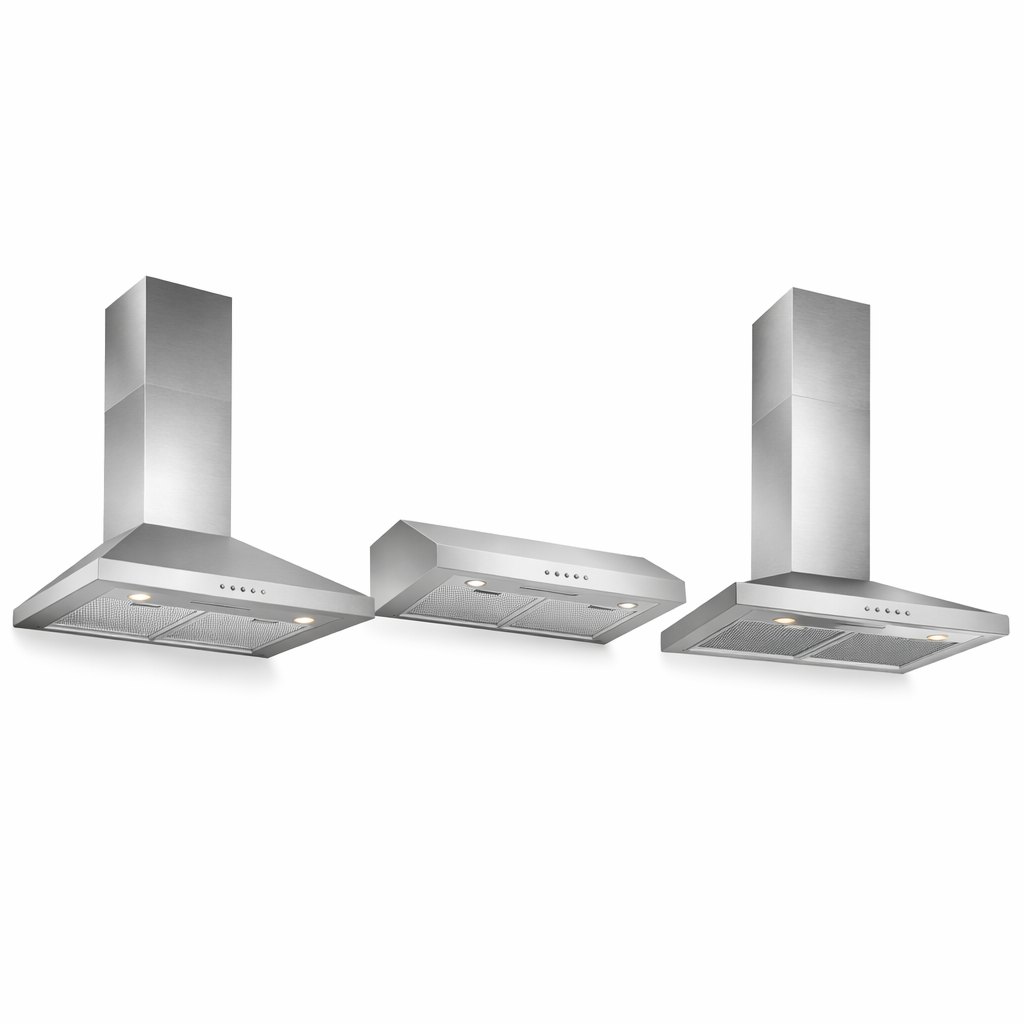
A good kitchen range hood clears smoke, grease, steam and cooking odours before they settle on cabinets, walls and ceilings. It also protects the air quality of an open-concept home, where the kitchen shares space with the living and dining areas. Choosing one comes down to three things: the format that fits your kitchen, the airflow your cooking calls for, and the noise level you can live with.
This category brings together 24 Lumifaro range hoods: wall mount chimney hoods, under-cabinet hoods and built-in inserts for custom enclosures, in stainless steel or black, from 280 to 860 CFM. It serves homeowners replacing an old hood fan, kitchen designers and cabinetmakers planning a custom hood, and contractors and electricians outfitting new builds and renovations. Here is how the formats compare, what the specs mean and how to choose and install the right model.
A wall mount hood, or chimney hood, fastens to the wall above a range that has no upper cabinet. The canopy and chimney cover become a design feature of the kitchen. Our wall mount range hoods include the Rainbow series at 390 and 480 CFM, the Rainbow-Pro at 600 CFM and stainless models up to 860 CFM, in stainless steel or black. The Rainbow 480 CFM stainless range hood (24530-480-S) and the Rainbow-Pro 600 CFM black range hood (24430-600-BK) are two popular choices. Slim models, at 390, 480 and 600 CFM, keep a lower profile.
The most common format in Canadian homes. The hood fastens directly under the upper cabinet above the range, so it saves space and is a straightforward upgrade when an old hood has become noisy or weak. Browse the under-cabinet range hoods, including the Baby-Pro I 24231 under-cabinet hood: 30", 390 CFM, 3-speed controls, 0.7 sones on low and 9.0 sones on high. The Baby-Pro II 24232 adds a 3-speed electronic control panel with an LCD clock.
A built-in hood, or insert, is mounted inside a cabinet or a custom hood enclosure. Only the stainless steel underside, the filters and the controls remain visible, so the cabinetry carries the style. The Elite 24122 (22") and 24128 (28") deliver 490 CFM with 3-speed soft-touch controls. The Elite-Pro 24030 (30") brings 600 CFM, and the Elite-Pro 24036 built-in hood reaches 860 CFM with baffle filters for wide ranges and gas cooktops.
| Format | Series or model | Width | Airflow |
|---|---|---|---|
| Under-cabinet | Baby-Pro I 24231, Baby-Pro II 24232 | 30" | 390 CFM |
| Built-in insert | Elite 24122, 24128 | 22", 28" | 490 CFM |
| Built-in insert | Elite-Pro 24030 | 30" | 600 CFM |
| Built-in insert | Elite-Pro 24036 | 36" | 860 CFM |
| Wall mount | Rainbow 24530 | see product page | 390 or 480 CFM |
| Wall mount | Rainbow-Pro 24430 | see product page | 600 CFM |
| Slim | 24900, 24930 | see product page | 390, 480 or 600 CFM |
| High airflow | 24936, 24436, 24539 | see product page | 860 CFM |
Upper cabinet above the range? Choose an under-cabinet hood or, for a built-in look, an insert inside a cabinet. Open wall with no cabinet? A wall mount chimney hood is the natural choice. Custom millwork or a plaster canopy? An Elite or Elite-Pro insert lets the cabinetmaker design the enclosure.
Think about how you cook, not only the size of the kitchen. Occasional simmering and boiling need far less airflow than daily wok cooking or searing steaks on a gas range. When in doubt between two models, the higher CFM with several speeds gives you room to run it quietly most of the time.
A short, straight duct run to the outside performs best. Every elbow and extra length reduces real-world airflow. In condos, check the building rules and the existing duct before choosing a high-airflow model.
A hood lights the cooktop, but the counters around it need their own task light. Add LED puck and under-cabinet lights along the counters and decorative pendants over the island. Our LED kitchen lighting guide shows how to layer it all.
Mount the hood at the height recommended by the manufacturer above the cooking surface: too low gets in the way, too high lets smoke escape. Fasten wall mount models to studs or solid blocking, and confirm the cabinet bottom is strong enough for under-cabinet and insert models. Use rigid metal duct of the size specified on the product page, seal the joints and finish with an exterior wall or roof cap with a damper.
The electrical connection should be done by a licensed electrician, in line with the local code. For the full checklist on formats, CFM, filters and noise, read our range hood buying guide, and see the LED kitchen lighting page for the rest of the room.
For everyday family cooking, 280 to 390 CFM is usually enough. For frequent high-heat cooking or a gas range, look at 480 to 600 CFM. For wide ranges and heavy use, models at 860 CFM give the most capacity.
An under-cabinet hood fastens beneath an upper cabinet and saves space. A wall mount hood hangs on an open wall with a visible chimney cover and becomes a design feature.
Many models can be set up as recirculating units that filter the air and return it to the kitchen. A ducted installation removes heat and moisture more effectively, so choose it when possible.
At least 30" wide, such as the Baby-Pro I 24231 or the Elite-Pro 24030 insert. For a 36" range, choose a 36" model like the Elite-Pro 24036.
Noise depends on the speed. On the Baby-Pro models, low speed runs at 0.7 sones, quiet enough for evening simmering, and high speed reaches 9.0 sones for heavy smoke.
An insert is a built-in blower unit that mounts inside a cabinet or custom hood enclosure. Only the stainless steel underside, filters and controls show, so the enclosure can match the kitchen design.
Compare formats, finishes and airflow in our full selection of range hoods, from compact under-cabinet units to built-in inserts and wall mount chimney hoods.