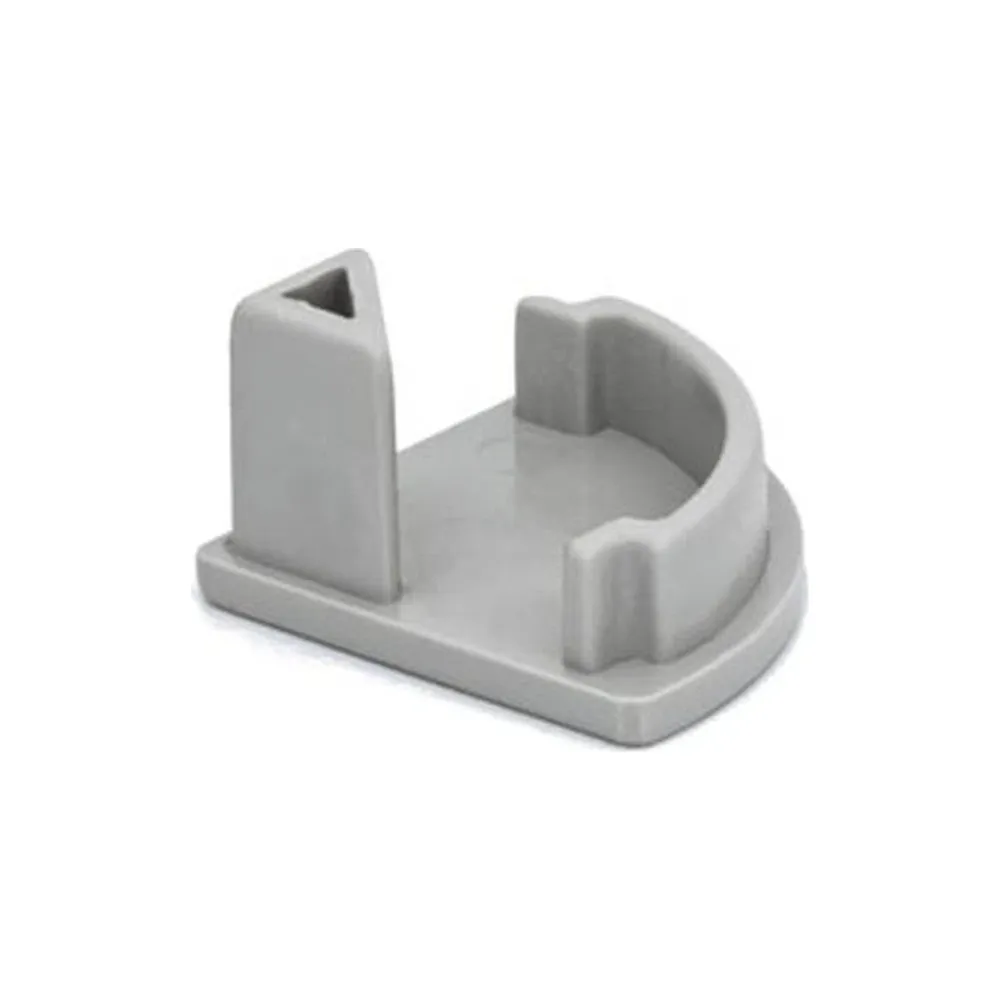
What this end cap is forAn aluminum LED channel is only half a fixture until both ends are closed. This
finishing end cap #91 is the solid, no-hole model that caps the terminating end of a run — the end where nothing enters and nothing exits. It hides the cut edge of the extrusion, holds the diffuser lens in line, keeps dust and debris out of the channel and turns a raw profile into something that looks like a manufactured linear fixture. It is supplied as 1 unit, so you order exactly as many as your layout needs rather than a fixed kit.
No hole vs. with holeThe logic is simple. The
no-hole cap goes at the dead end of the run. The cap with a hole goes at the powered end, where the feed wire from the strip exits the channel toward the driver or connector. Using both on the same profile gives you a fully enclosed run with no exposed strip edges and no visible wiring gap. On longer installations made of several channel sections, you typically only need caps at the two extremities, while the intermediate joints stay butted together.
Fit and compatibilityEnd caps are
profile-specific: the cap must match the shape and size of the channel it is going into. This one corresponds to the #91 profile. A correct cap sits flush with the extrusion and with the diffuser without being forced — if you have to fight it, it is the wrong profile. Many channel styles circulate on the market with similar-looking cross-sections, so the safest habit is to keep the same profile family for every run in a project: same extrusion, same lens, same caps. For rounded flexible
neon-style runs instead of rigid aluminum, the matching parts are different again, such as the
Flex neon endcap 3x6 (without hole) and the
Flex neon endcap 6x6 (with hole).
Installation tipsWork in order: cut and mount the channel first, insert the
LED strip and slide in the diffuser, then press the cap into the open end. A light press fit is usually enough to hold it. In a busy or high-traffic area — a shop counter, a stair nosing, a workshop bench — a small dab of adhesive keeps the cap securely in place and prevents it from popping off when someone brushes against it. Wipe the channel edges and the inside lip before fitting so no sawdust, adhesive residue or drywall dust blocks the seat. If the cap seems slightly proud, re-check that the diffuser is fully seated first; nine times out of ten that is the culprit.
Where it earns its keepUnder-cabinet and cove lighting,
display cases and retail shelving, closet interiors, staircases, reception desks, headboards and workshop benches — anywhere indoor linear lighting is visible, capped ends are what separate a tidy install from a DIY look. Kitchen renovations in particular show every detail at eye level, and a sealed profile end reads as custom millwork. Contractors and cabinet shops often keep a small stock of both versions on the truck, since a single missing cap can hold up a final walkthrough. No documentation is listed for this accessory: choose it by profile shape, and match the SKU
LCENDCAP-STAND-91 to the channel already in your project.