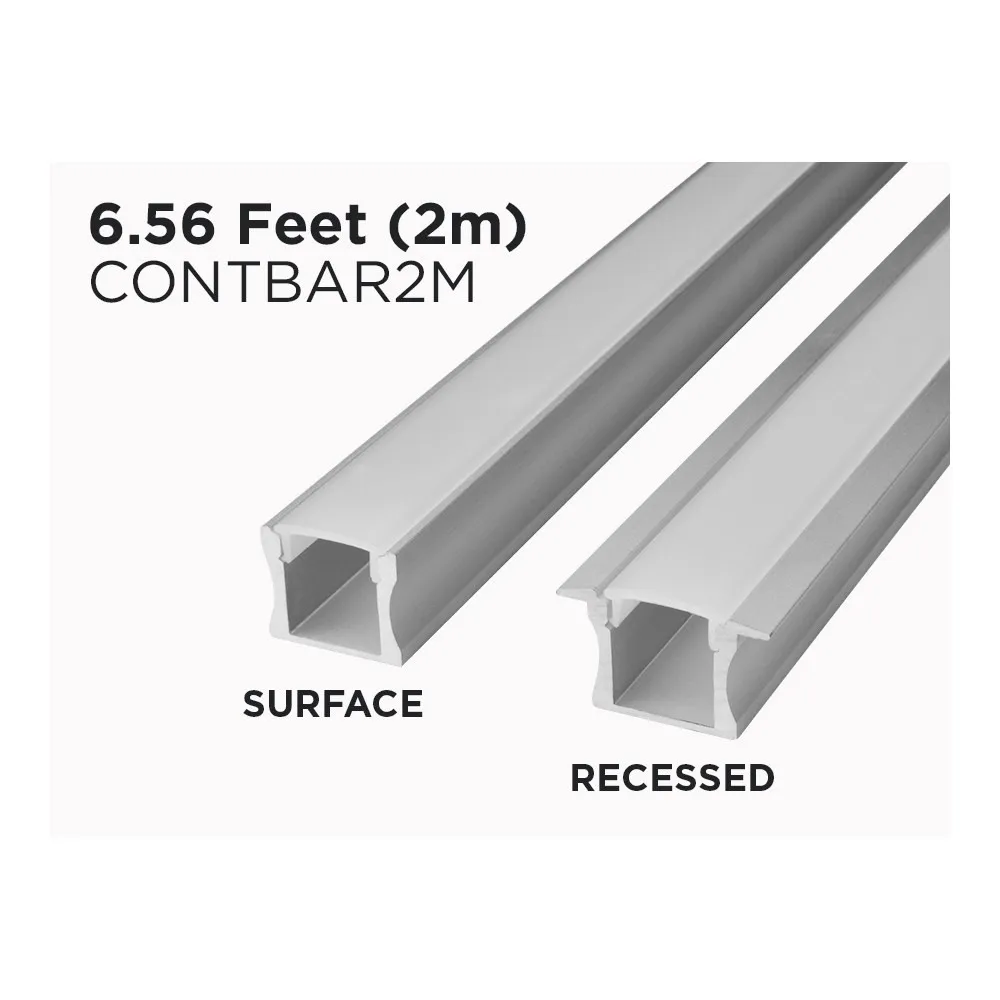
Built for a seamless line of light
The idea behind this profile is simple: no one wants to see the dots. A standard channel sits too close to the diffuser, so every diode shows through as a bright pixel with a shadow between. The continuous lighting aluminum profile from LED Montreal is shaped differently — its body is narrower at the base and opens up toward the top, giving the light a mixing chamber before it passes through the diffuser. Combined with a high-output, high-density LED strip, the result reads as one uninterrupted band, very close to the look of a classic neon tube but with modern LED efficiency, instant start and full electronic control.
Aluminum construction and thermal performance
Aluminum is the right material for LED strip lighting for two reasons. First, rigidity: a 2 m extrusion keeps a tape run perfectly straight over a cabinet, a shelf or a stair wall, with no sag and no waves in the light line. Second, heat. LEDs dislike heat more than anything else, and an aluminum extrusion acts as a heat sink that draws warmth away from the strip. Cooler operation means better lumen maintenance, more stable colour over the years, and adhesive tape that stays put instead of letting go a season later. The profile also protects the strip from dust, fingers and accidental knocks — a real advantage in a busy kitchen or a retail display that gets restocked every week.
Technical specifications
SKU: CONTBAR2M-SURFACE
Brand: LED Montreal
Mounting: Surface
Length: 2 m
Height: 15 mm
Exterior width: 17.5 mm
Exterior width bottom: 17.5 mm
Exterior width top: 25 mm
Interior width: 12.2 mm
Installation and compatibility
Plan your layout first, then cut the profile to length with a mitre saw and a fine-tooth blade for aluminum; deburr the cut ends so the diffuser slides in cleanly. The interior width of 12.2 mm tells you which LED tape will fit — measure your strip before ordering, and choose a high-density strip if you want the smoothest continuous effect. Clean the mounting surface, fix the channel with the appropriate screws or clips for your substrate, press the strip into the channel, then snap the diffuser in place. Leave yourself an exit point for the lead wires at one end, and keep the driver or power supply accessible in a cabinet, a soffit or a service panel — never sealed permanently behind finished millwork. On long runs, feed power from both ends or split the run to avoid voltage drop and keep brightness even.
Where it earns its keep, and documentation
In homes, this surface-mount LED channel is the go-to for under-cabinet lighting above reflective quartz or glass counters, island overhangs, floating shelves, pantries, walk-in closets, basement bars and stairwell accents. In commercial work it belongs in jewellery and bakery showcases, retail gondolas, wine displays, restaurant bar fronts, reception desks and boutique window installations, where a dotted line of LEDs immediately cheapens the look of the merchandise. A recessed version of the same continuous lighting profile exists for flush installations in millwork and drywall. The technical PDF for this profile is available in the Documentation tab of this page with the full dimensional data — worth downloading before you draw your millwork shop drawings.