A control made for strip lighting, not borrowed from it
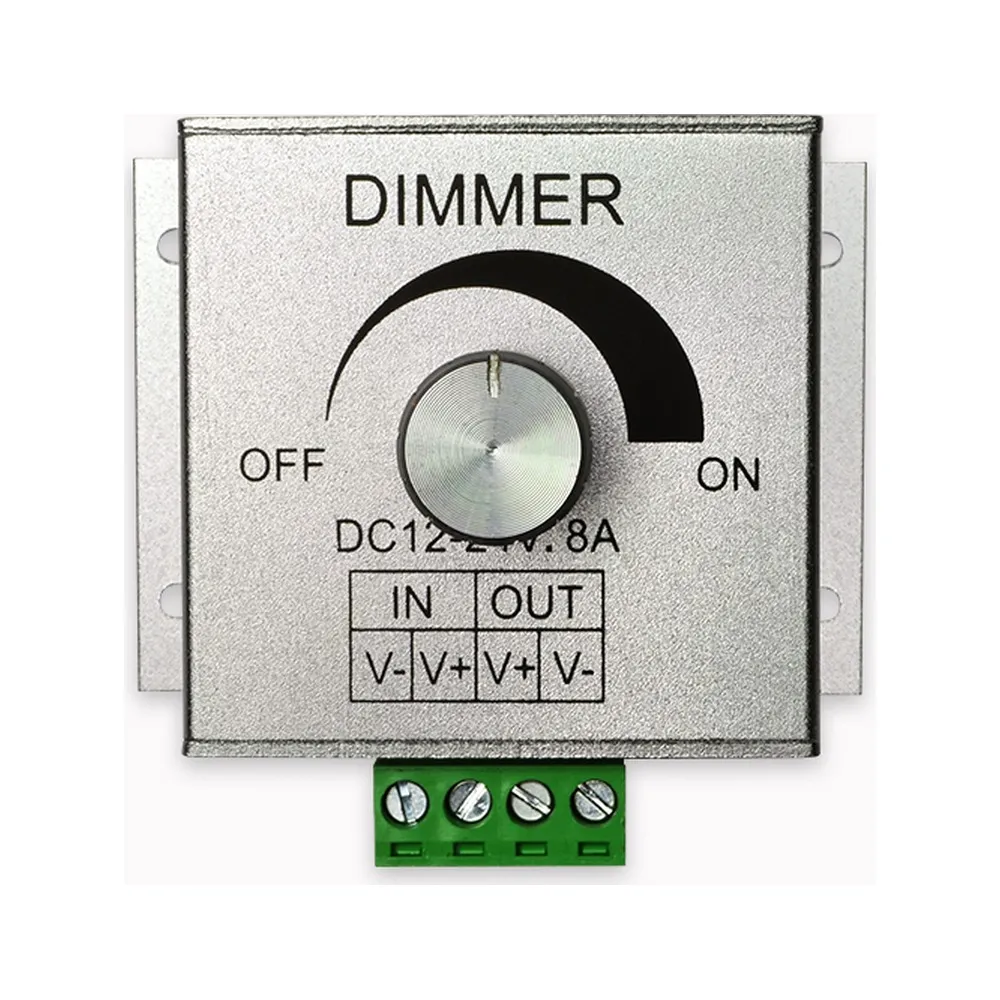
Standard household dimmers are built for line-voltage fixtures, which is exactly why so many LED strip installations end up stuck at full brightness. This wall mounted LED strip dimmer sits on the low-voltage DC side of the system, between your power supply and your tape, so it dims the strip directly and cleanly. The body is sturdy and made to live in the wall for the long haul, and the rotary knob doubles as the on/off control — one movement turns the lighting on, one turn sets the level. There is no remote to lose, no receiver to hide in a ceiling and no app to keep updated, which is a real advantage in rental units, commercial spaces and any project where several people will be using the same control.
Technical specifications
SKU: WDIM
Brand: LED MONTREAL
Type: Wall mounted dimmer for single colour LED strip
DC input: 12V to 24V
Maximum current: 8A
Control: Manual rotary knob, on/off and brightness
Connections: Input port (black wire V-, red wire V+) and OUT port
Compatibility: All single colour LED strips, 12V and 24V
Use: Residential and commercial projects
Wiring and installation
The wiring logic is about as simple as low-voltage gets. Your 12V or 24V power supply connects to the input port — black wire into V-, red wire into V+ — and the LED strip connects to the OUT port. Respect that polarity and the dimmer is ready to use immediately; reverse it and the strip simply will not light, so it is worth double-checking before you close up the wall box. Because the unit handles up to 8A, plan your run so the total current draw of the strip stays within that limit, and split longer installations across more than one dimmer or feed them from separate circuits when needed. Contractors often rough in the low-voltage cable to the wall box first, mount the driver in an accessible spot such as a cabinet, closet or service ceiling, then land the dimmer last.
Light quality and dimming behaviour
Turning the knob gives you progressive manual control over brightness, which is what makes a single strip run useful morning, afternoon and late evening. At the very bottom of the range the light may flicker: this is expected behaviour, because LEDs need a minimum amount of current before they conduct properly. Backing the knob up slightly settles the output. For the smoothest results, match the dimmer to a single colour LED strip and a power supply of the same voltage, and keep the connection runs tidy and well terminated — loose low-voltage joints are the usual culprit behind inconsistent dimming.
Where it earns its place
Kitchens are the classic case: bright under-cabinet lighting while cooking, a low glow for late-night coffee. Beyond that, think cove and ceiling strip runs in living rooms and hallways, headboard and closet lighting in bedrooms, basement and stair accents, and on the commercial side retail shelving, reception desks, bar backs and restaurant booths where staff need to set the mood at different hours without touching a control panel. Since it is compatible with all single colour strips at 12V or 24V, it drops just as easily into a fresh build as into an existing installation that was wired without dimming. If you are specifying a strip light controller for a Canadian home renovation or a small commercial fit-out, the WDIM keeps the hardware count low and the operation obvious for whoever uses the room next.