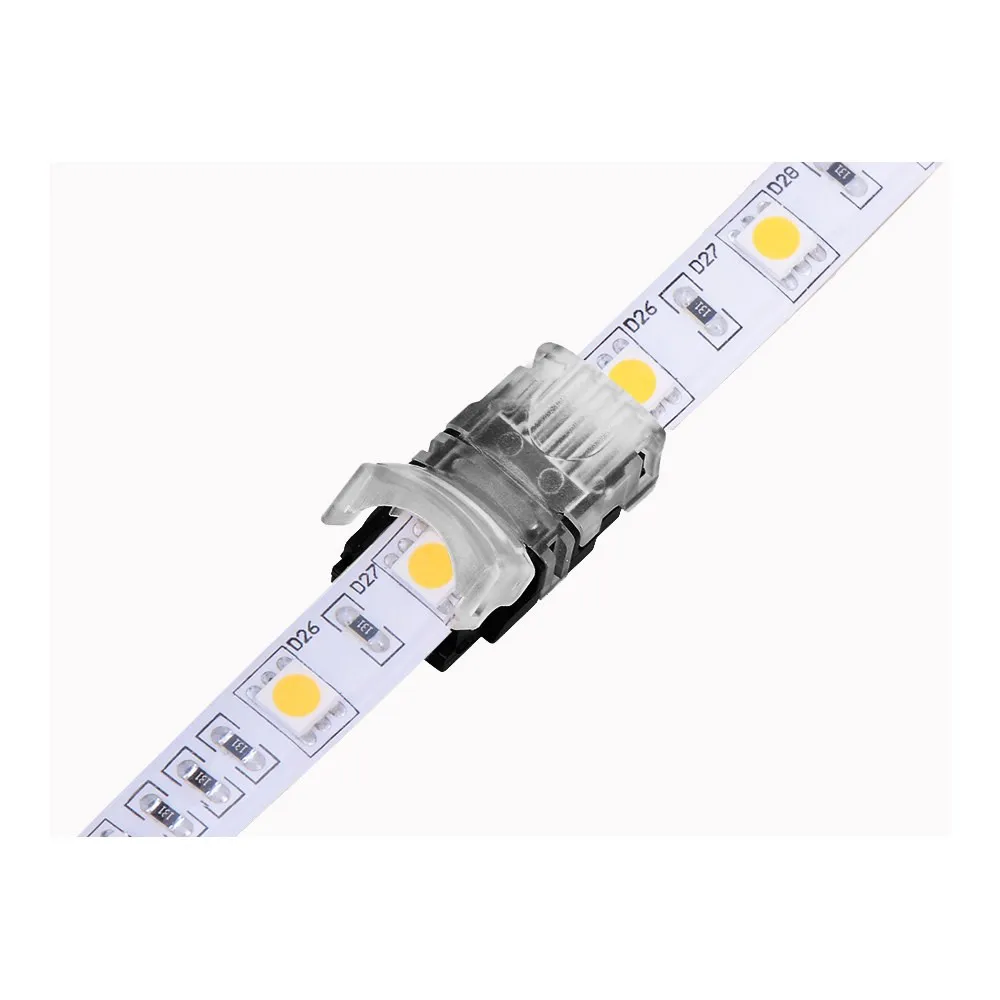
What this connector actually does
The Grip & Clip is a mechanical, solderless splice for LED strip lighting. Inside the plastic housing are spring-loaded metal contacts that press against the copper solder pads at the cut end of your tape. When the clip closes, those contacts hold the strip in place and complete the circuit at the same time — one action, both jobs. Because nothing is melted or glued, the connection is reversible: open the clip, pull the strip out, reposition it, close it again. That makes it ideal for temporary layouts, display setups that change, and anyone who would rather not own a soldering station for a single weekend project.
Compatibility — read this first
This model is designed for 3528 or 5050 single colour strips only. It will not work with silicone coated strips (IP65, IP65+, IP67 and IP68) because the coating physically blocks the contacts from touching the copper pads. It also will not work with any strip that has more than 60 LEDs per metre, including high density types such as 3014 with 120 LEDs per metre, RGB 3535 and others of that family — those strips have pads that are too narrow or too closely spaced for a clip contact to grip reliably. And because it is a strip-to-strip connector, it accepts tape on both ends: you cannot feed a bare wire into it. If you need to bring power in from a driver, plan on a wire-to-strip solution or a soldered lead at that point in the run.
Technical specifications
SKU: GRPCLPSC
Brand: LED MONTREAL
Type: strip-to-strip solderless connector
Compatible strips: 3528 or 5050 single colour
Protection rating: IP20
Not compatible with: silicone coated strips (IP65, IP65+, IP67, IP68), strips over 60 LEDs per metre (3014 with 120 LEDs/m, RGB 3535, other high density strips)
Applications: residential and commercial projects
Installation tips that save headaches
Always cut your LED tape exactly on the marked cut line so you get a full, clean pair of copper pads — a cut that clips a pad in half is the number one cause of a dead section. Peel back the adhesive backing paper at the end of each strip before inserting, wipe the pads clean, and watch polarity: the positive pad of one strip must line up with the positive side of the connector, and the same for negative. If the section doesn't light up, open the clip and check that the strip is pushed in far enough and sitting flat rather than at an angle. Also remember the physical size: these connectors are wider than the strip, so they will not slide inside an aluminum channel. Plan your joints to fall between profile sections, behind a cabinet edge or above a valance where the extra width is hidden — or solder directly to the strip if the run must stay inside the extrusion for its full length.
Where it earns its keep
Kitchen under-cabinet runs that need to jump a sink, staircase nosing lighting, retail shelving and display cases, bar backs and restaurant coves, closets, home theatres, garages and workshops — anywhere single colour LED strip lights need to be extended, shortened, repaired or carried around an obstacle. Contractors like having a handful on hand because job-site dimensions rarely match the drawing, and a clip means no cord reel, no iron, no smoke detector going off in a finished room. For homeowners, it turns a frustrating "my roll is two feet short" moment into a two-minute fix. Documentation: no spec sheet or IES file is provided for this accessory — the compatibility rules above are the specification you need.