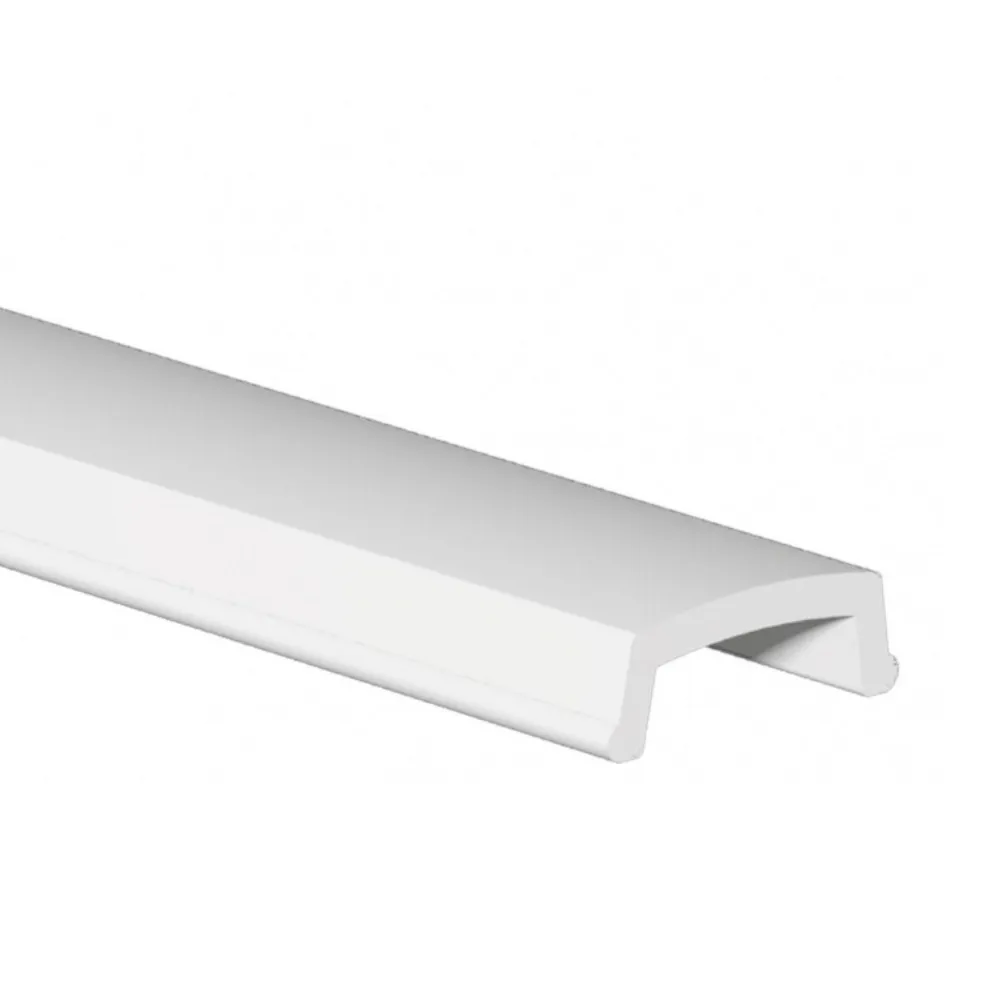
What this lens isThis is a
16FT opal diffuser lens made specifically for
LED profile #44, sold under SKU
LCLENS-OPAQ44-16FT. It is the snap-in cover that closes the top channel of the extrusion once your LED tape is installed inside. In the catalogue it lives under End Caps, Lenses & Acc., alongside the end caps, connectors and mounting hardware that complete an
aluminum profile for LED strip lighting. The opal grade is the diffusing version — a milky, light-spreading cover rather than a clear one — and it is the finish most installers choose when the fixture will be seen at eye level or when the strip is close to the lens.
Light quality and why diffusion mattersAn LED strip is a row of separate light points. Left bare or under a clear cover, that row reads as a string of dots, and every reflective surface nearby repeats them. An
opal (opaque) diffuser scatters the output so the eye sees one continuous line instead. The trade-off is a small loss of raw output compared to a clear lens, which is exactly the trade you want in kitchens, showrooms and offices where glare and visible diodes are the real problem. The diffusion also hides what's inside the channel: the tape, its copper pads, the solder joints and any wire transitions all disappear behind the lens, off or on. The result is a cleaner architectural line, which is why cabinetmakers and millwork shops specify diffused covers as standard.
Installation and handlingWork in this order: mount the profile, run and test the LED tape inside it, then fit the lens last so it never gets scratched during wiring. The lens flexes into the channel's retaining grooves and is held mechanically — no adhesive, no screws. Cut to length with a fine-tooth blade or a mitre saw with a plastic-cutting blade, supporting the piece fully to avoid chipping, then deburr the cut edge lightly so it slides in cleanly. On long runs, plan your joints so they fall at a corner, a cabinet division or a ceiling break, where a seam reads as part of the design. The
16FT length is the one to order when you want to minimize those joints. Keep the protective film on until the last moment, and clean only with a soft damp cloth — no solvents, no abrasive pads.
Compatibility — read this before orderingLenses are not universal. This one is cut for
LED profile #44 and will not snap into a channel of a different width or groove design. If you are covering another extrusion, order its matching lens: the
16FT opal diffuser lens – LED profile #80, the
8' opaque lens #545, or the
8' frosted lens #84 #85 #86 #88 for that family of profiles. For a shorter run or a repair on a single cabinet, the
8FT opal diffuser lens – LED profile #44 is the same cover in a shorter length. When in doubt, match the profile number stamped on your extrusion — that number, not the length, is what determines the fit.
Where it gets usedResidential: under-cabinet and over-cabinet kitchen lighting, pantry and closet shelving, bathroom vanity and mirror surrounds, stair nosings, cove and tray ceilings, basement bulkheads. Commercial: retail display cases and shelving, reception desks, restaurant bars and banquettes, corridor accent lines, gym and studio mirrors, office millwork and signage backers. In Canadian renovation work it is also a common replacement part — a cover cracked during a cabinet move, cut short by a previous installer or yellowed by a job-site accident. This product page lists no spec sheet or IES file; if you need confirmation that your channel is a
#44 profile, compare it to the profile page for that model before ordering.