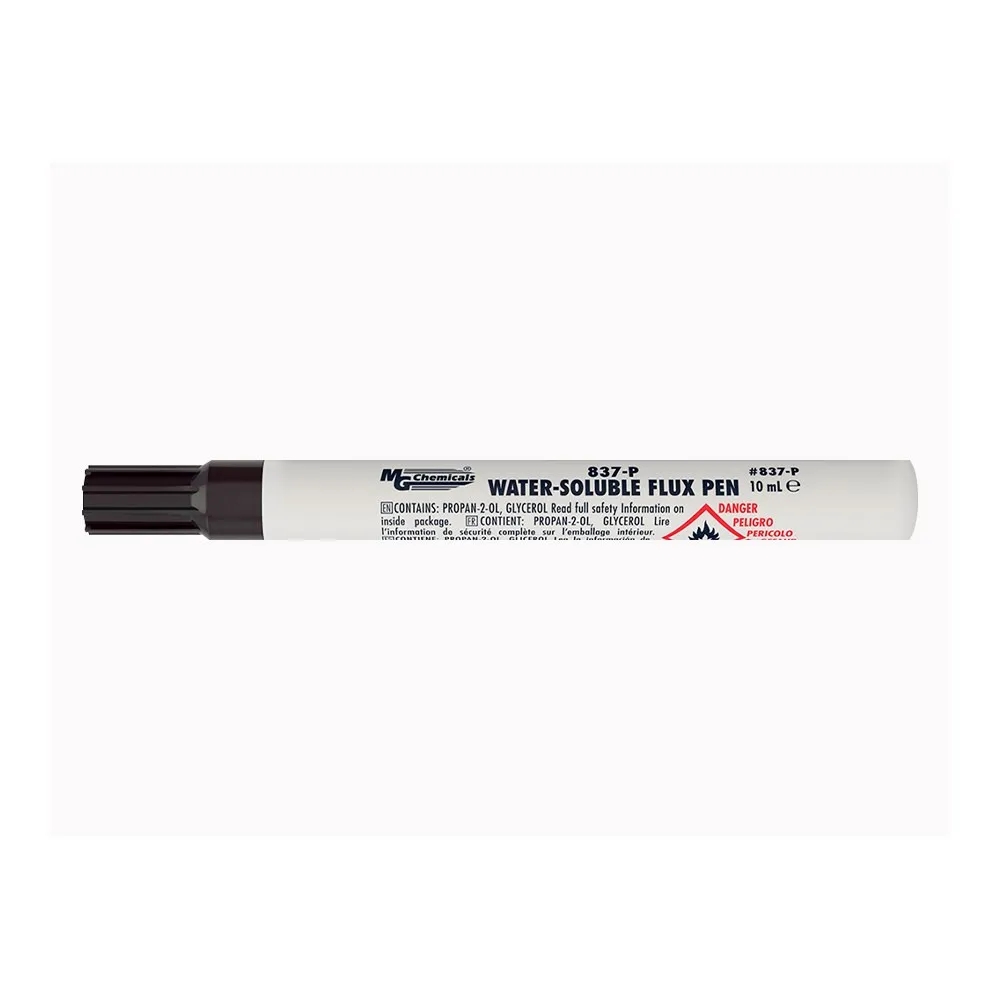
What's in the pen
The 837-P is a pen-style applicator filled with a water-soluble soldering flux. The chemistry is deliberately mild while you work: the flux carries a neutral pH at room temperature and only becomes highly activated once it reaches soldering temperatures. That means it isn't aggressively attacking your pads while the pen sits on the bench, but it strips oxides and lets solder wet the copper the instant heat arrives. It is rosin/resin free and halogen-free, so it leaves behind no sticky amber crust to chase around a board, and it is RoHS compliant.
Technical specifications
Model: 837-P
SKU: FLUX
Brand: LED MONTREAL
Type: water-soluble soldering flux pen
Standard: meets IPC J-STD-004B, type ORH1
Solder compatibility: leaded and lead-free solders
Composition: rosin/resin free, halogen-free, RoHS compliant
Tip: chiseled felt tip for precise application
Net volume: 10 mL (0.33 fl oz)
Net weight: 8.46 g (0.29 oz)
How to use it properly
Start by depressing the tip against a hard surface until the felt tip gets wet, but not flooding — that priming step is what keeps the pen from dumping flux on your first pad. Then gently brush the wet tip onto the soldering area to apply. To keep the tip saturated and control the flow, only press the tip in as needed. Because it's a chisel tip flux pen, you can lay a thin line along a row of SMT pads or drop a precise dab on a single LED strip solder pad without wicking flux under nearby components. One important habit: post-soldering flux residues must be cleaned. They come off easily with water, but don't skip the step — water-soluble residues are meant to be washed away, not left on the assembly.
Where it earns its keep
The 837-P is designed for prototyping, rework and repair on both conventional through-hole and surface mount circuit boards. In a lighting context, that covers almost everything you do by hand: tinning the copper pads of a cut LED tape before soldering lead wires, joining two strip segments around a corner instead of using a connector, repairing a strip that lost a section, re-soldering a loose wire at a driver terminal, or fixing a controller board. Sign shops, AV integrators, cabinet makers, prop builders and repair benches all reach for the same pen. It suits residential renovations as much as commercial fit-outs, and it's small enough to live in a tool pouch on site.
Good to know before you solder
For clean LED strip joints, use a fine chisel or conical iron tip, pre-tin both the strip pad and the wire, apply flux with the 837-P, then bring the two together with a quick touch of heat — long dwell times are what lift pads and cook LEDs, not the flux. Keep the pen capped between uses so the felt stays saturated. Since the flux works with leaded and lead-free solder, you can use the same pen across an older repair and a new RoHS build without swapping products. There is no separate spec sheet or IES file for this item in the Documentation tab; the product information and application instructions above are everything you need to get going.