Description and specifications – RGBCCTWR1M
RGBCCT Wire for LED Strips (1 meter), SKU RGBCCTWR1M, is the wiring solution built to solve one very specific headache: how do you keep an RGBCCT LED strip circuit fully functional when the physical strip itself has to stop for a few inches or a few feet? Instead of running a lit section where you don't need light — over a range hood, a stove fan, a window trim, or a structural gap — you simply splice in this wire and carry the signal through to the next run.
Construction and design
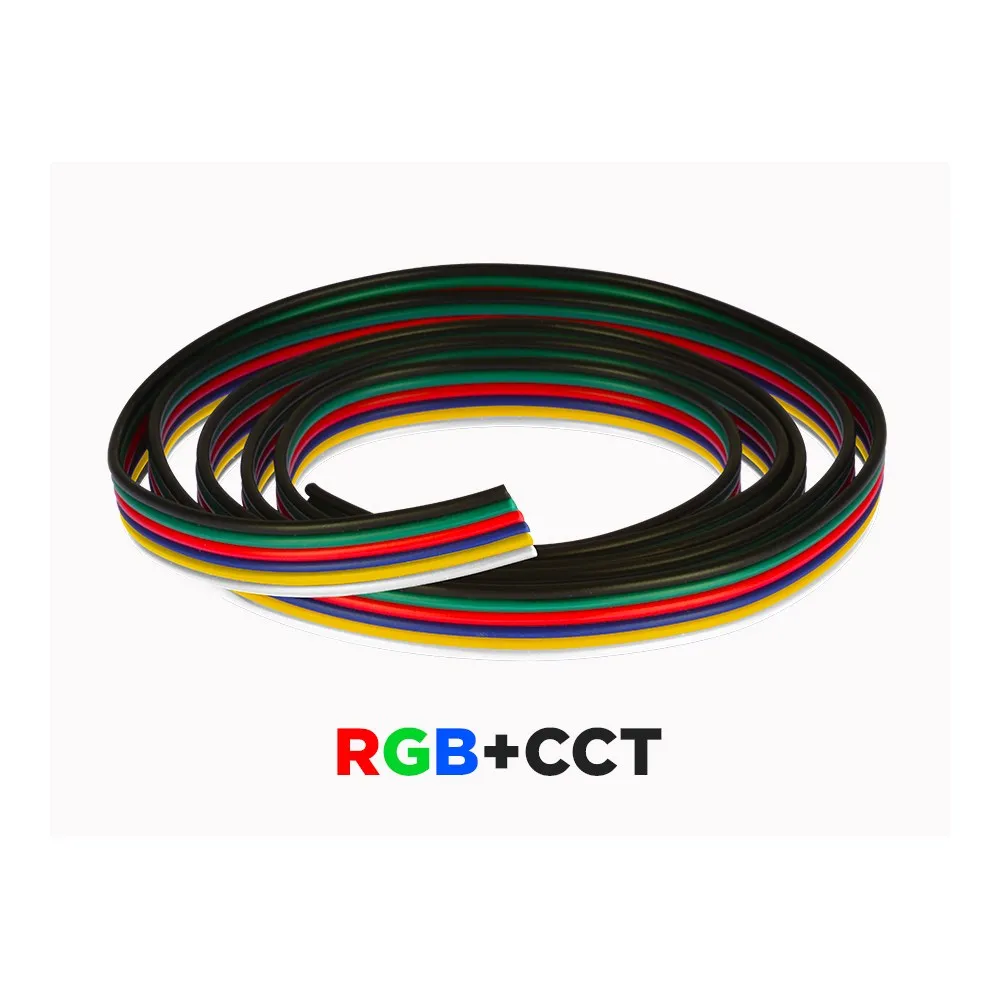
The cable is made of six individual wires — black, green, red, blue, white and yellow — bonded together into a single flat run, matching the conductor colours used on standard RGBCCT LED strips. Each colour carries its own channel (red, green, blue, and the white/warm-white CCT channels) plus the common line, so your controller keeps independent command of colour and colour temperature across the gap exactly as if the strip were continuous.
Sold by continuous length
This wire is sold in 1 meter units but shipped as one continuous piece: order five units and you'll receive a single uninterrupted 5 meter length rather than five separate 1 meter pieces. This makes it easy to size the exact bridge you need for a particular cabinet run, hallway, or architectural feature without wasting material or adding unnecessary splice points.
Installation and compatibility
Because the wire mirrors the conductor layout of RGBCCT strips, it's meant to be connected between two RGBCCT LED strip sections (or between a strip and its RGBCCT controller/amplifier) using standard soldering or connector methods for six-conductor strips. It is not intended for single-colour or simple two-wire strips — make sure your strip and controller are RGBCCT before ordering. This is the kind of detail worth double-checking on your project plans, especially on larger commercial installs where multiple runs need to stay perfectly colour-matched.
Applications
Use it under kitchen cabinets where a hood or exhaust fan breaks up the run, in coves and soffits with gaps for structural beams, behind bar fronts, in retail display cases, or anywhere a continuous RGBCCT lighting effect needs to cross a space where strip can't physically sit. It works equally well in residential kitchens and in commercial storefront or hospitality lighting projects.