Nov 06, 2026 / By the Lumibox team / in LED Guides
LED sign lighting comes down to three parts: a light source that fits inside the sign (LED sign modules for channel letters and light boxes), a way to light the sign from outside (wall washers and grazers), and a power supply sized for the whole run. Get those three right and LED signs glow evenly, with no hot spots, dark corners or flicker.
This guide is for sign shops, electricians, store owners and anyone refreshing an old fluorescent light box or building a backlit logo. You will learn how to choose LED sign modules, when a wall washer is the better tool, how to size the driver and how to plan an outdoor sign that lasts through a Canadian winter. When you are ready, compare the options in our LED modules collection.
Every lit sign uses one of three approaches, and many projects mix them.
The right approach depends on the sign itself: a hollow letter or a box calls for modules, a solid surface calls for a wall washer, and a line drawing calls for neon flex.
An LED sign module is a small sealed pod holding one, two or three LEDs behind a lens. Dozens of them are linked by wire into a string, so you can spread them across the back of a cabinet, follow the curve of a letter or cut the run to length. Compared with a continuous strip, modules light a deep box or a thick letter more evenly, because each pod throws a wide cone of light toward the face.
Here are real examples from the catalogue, so you can see how the specs differ:
For white acrylic faces and saturated vinyl films, 6000K cool white gives crisp contrast and reads well from the street. 3000K warm white suits restaurants, boutiques and wood-toned brands. RGB modules, such as the LUMENSTARLED LS-LM-RGB (0.75W and 75 lumens per module), or RGB-W modules that add a white chip, let one sign switch from brand colours to a seasonal theme. Colour modules need a compatible RGB or DMX controller.
The goal is a uniform face with no visible dots. Three general rules apply:
Always check the manufacturer's spacing chart for the exact module and face material, and test a few modules on the actual face before mounting the full run.
Most sign modules run on 12V DC constant voltage, but you will also find 24V and line-voltage versions. The table below compares the three options with examples from the catalogue.
| Voltage | Example | Real specs | Best for |
|---|---|---|---|
| 12V DC | Set of 50 IP68 5050 RGB modules (RGBMODUR) | 3 SMD5050 LEDs, 0.72W (0.9W recommended), 60 mA, 160° | Channel letters, small and medium light boxes |
| 24V DC | LED modules 24V 0.8W 6000K (bag of 50) | 0.8W per module, 6000K | Longer runs with less voltage drop |
| 110V/220V AC | Set of 100 triple 2835 Epistar modules (110VMOD3W-CW) | 3W and 300 lumens per module, 175°, up to 100 modules in one row (19 m) | Large boxes and light tables with no driver box |
Low-voltage modules are safer to handle inside a sign and are the most common choice. The 110V AC module set skips the separate driver entirely, which helps when there is no room for one, but its wiring must be treated as line voltage and installed by a qualified electrician.
A 12V or 24V module string needs a constant-voltage power supply of the same voltage. Sizing is simple arithmetic: multiply the watts per module by the number of modules, then pick a supply rated comfortably above that total. Never run a supply at its full rating, especially inside a closed, warm sign cabinet.
Browse 12V and 24V units in our power supplies collection. Our guide on how to choose LED strip lights explains constant voltage, voltage drop and driver sizing in more detail, and the same rules apply to modules.
When the sign is a flat panel, painted lettering or a façade, an LED wall washer is the cleaner solution. It throws an even sheet of light across a vertical surface from a fixture hidden above or below it. Explore the full range in our wall washer collection.
The 112 cm 36W outdoor white LED wall washer bar from LED MONTREAL is 7.8 cm wide and carries 36 LEDs of 1W each in a solid aluminum IP65 housing, in 3000K or 6000K. It is built for storefront signage, columns and brick walls. For colour, the LUMENSTARLED RGBWW linear wall washer bar is 48 inches long, connects to 120V AC, is outdoor rated and DMX capable, so it can join a programmed light show on a façade.
A tighter beam reaches taller walls. The LED MONTREAL 40W RGB wall washer spotlight uses 36 LEDs (12 red, 12 green, 12 blue) behind a 20° beam on 24V DC: a good way to throw colour onto a tall sign or a distant architectural feature.
Indoors, a 24W per metre wall washer strip on 24V DC, rated IP22 for dry locations, hides in a cove or above a feature wall behind the reception desk. A 24V flexible neon wall washer, built on SMD 5050 LEDs in a silicone body, bends along curves and letters while washing the surface with an asymmetric beam. Place strips in an aluminum channel to aim and cool them; our aluminum LED profile guide covers the choices.
Outdoor LED signs face rain, snow, road salt and deep cold. Three checks make the difference:
Replacing tubes with LED modules is one of the most common sign jobs. The basic steps:
The modular format also simplifies repairs: you replace one string instead of rebuilding the whole sign.
For channel letters and light boxes, LED sign modules are the standard: they light a deep cavity evenly and mount quickly. Choose 12V modules with a wide beam (140° to 175° in the catalogue) and a colour temperature that suits the face. For flat signs and façades, a wall washer is better.
It depends on the face area, the cabinet depth and the module output. Brighter modules, such as 3-LED models, can be spaced farther apart than 2-LED models. Use the manufacturer's spacing chart, then test on the actual face before installing the full run.
Yes, 12V and 24V DC modules need a constant-voltage power supply of the same voltage. Add up the wattage of all the modules, using the recommended figure when it is listed, and choose a supply with a comfortable margin. Line-voltage 110V modules connect without a separate supply.
In a shallow cabinet or a thin backlit panel, a strip or a flexible LED panel can work well. In a deep box or a thick channel letter, modules spread the light more evenly. Flex neon is the right tool for outline lighting.
A wall washer lights a sign from outside: it washes a flat panel, painted letters, a mural or a façade with an even sheet of light from a fixture hidden above or below. RGB and DMX models add colour and programmed effects.
No. Exit signs and running man signs are life-safety equipment with their own rules. See our exit signs and running man collection and our guide to emergency lighting and exit signs.
Start with the light source that matches the sign: LED modules for channel letters and light boxes, a wall washer for flat signs and façades, then size the driver from our power supplies. For ideas by project, browse our LED sign lighting page.
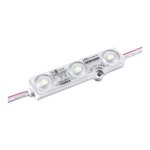 MODULE (5000K) | 3 LED | 12VDC | 1.2W 165 LUMENS | 50 PACK
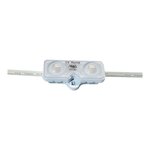 LED SIGN MODS - 2 LED - 12V DC - 25 MODS/STRING (12.5') - 0.66W/MOD - 55 LUMENS/MOD - 3000...
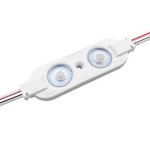 LED MODULES 24V 0.8W 6000K (BAG OF 50 MODULES)
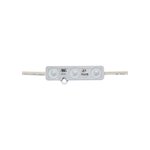 LED SIGN MODS - 3 LED - 12V DC - 25 MODS/STRING (12.5') - 1.02W/MOD - 75 LUMENS/MOD - 6000...
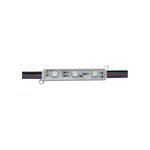 LED SIGN MODS - 3 RGB - 12V DC - 25 MODS/STRING (12.5') - 0.75W/MOD - 75 LUMENS/MOD - RGB
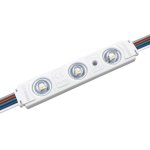 LED MODULES 12V - 1W - RGB-W - 6500K - (BAG OF 50 UNITS)
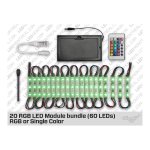 BATTERY POWERED 20 LED MODULE KIT (60 LEDS) RGB
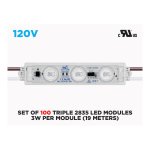 AC 110V/220V - SET OF 100 TRIPLE 2835 EPISTAR LED MODULES ( 3W PER MODULE )