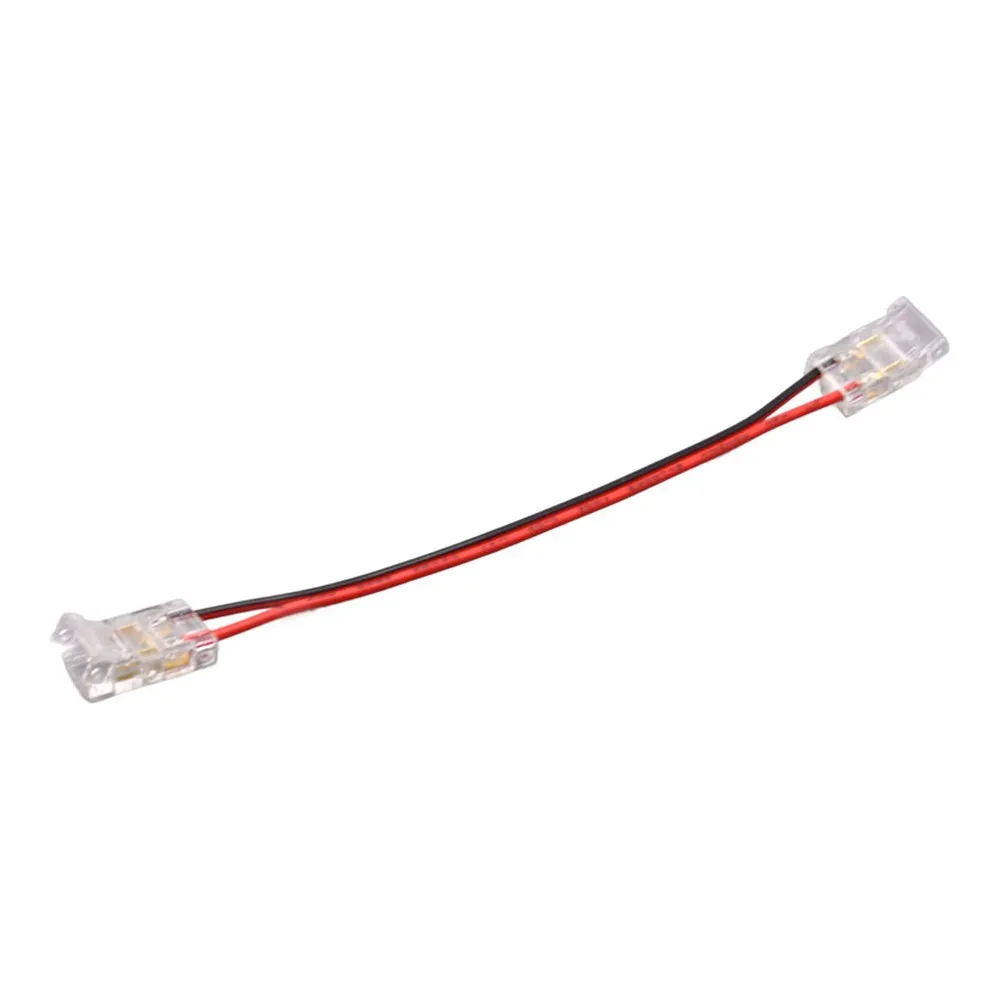
Built for 8mm COB strip, not "close enough"
Strip connectors are only as good as their fit, and this one is dimensioned for a 8mm PCB width COB board. The two clamp housings close over the copper pads at the cut line and hold them under constant pressure, which is what keeps resistance low and light output even from segment to segment. Between the two housings sits a flexible wire, so the connector behaves like a short jumper cable rather than a rigid bridge. That means you decide where the second strip lands — around a return, on the next shelf, on the other side of a stud — instead of letting the hardware dictate your layout.
Why COB changes the connection game
COB (Chip-on-Board) LED strip puts the diodes in a continuous line directly on the circuit board, giving you a seamless band of light with no visible dots or shadows. That uniformity is exactly why joints matter so much: any dimming, flicker or colour shift at a connection is immediately visible in a smooth run. A firm, full-contact clamp on both conductors keeps the light consistent across the splice, so a two-piece run reads as one continuous line of light to the eye.
Installation and electrical notes
Always cut the strip on the marked cut line so both copper pads are fully exposed. Power down, open the clamp, slide the PCB in until the pads sit under the contacts, and close the housing — polarity matters, so match the + and − markings on both strips before you energize. No soldering is required, which means no heat near the phosphor and no risk of cooking a chip during assembly, and it makes this connector just as friendly for a skilled DIY installer as it is for an electrician on a deadline. Because it is intended for low-voltage LED strip systems, plan your runs from the driver outward and keep feeds balanced so each segment gets clean power. Tuck the wire section neatly inside the channel or behind the millwork so nothing pulls on the clamps over time.
Where it gets used
Kitchen and bathroom cabinetry is the classic case: a run under the uppers, a jump across the sink window, then a second run continuing to the end wall. Cabinet shops use it to link segments inside display cases and shelving units built in sections. Retailers use it in under-shelf lighting and product displays where the strip has to follow an L or a U. It also works for coves, bulkheads, stair lighting, reception desks and vanity mirrors — anywhere a continuous COB look has to survive a corner, an obstacle or a panel seam.
Documentation and ordering
The CL-AST-C8BBW-LV spec sheet is available in the Documentation tab of this page — worth a quick look before you order so you confirm the connector matches the PCB width of the strip already on your job. Pair it with your COB LED strip, aluminum channel, low-voltage driver and compatible dimmer to build a complete, tidy system, and keep a few spares in the van: on site, the connector you do not have is always the one you need.