Nov 06, 2026 / By the Lumibox team / in LED Guides
Good outdoor LED lighting for a home does three jobs at once: it welcomes visitors at the door, it makes steps and the porch safe after dark, and it makes the deck a place you want to stay in the evening. The recipe is simple: a sconce on each side of the entrance, a low light on every step, soft hidden light around the deck, and a floodlight only where you need to see far, all controlled by a motion sensor or a photocell.
This guide is for homeowners renovating a facade or building a deck, and for electricians and contractors planning residential work in Canada. It focuses on the house itself: facade, front entrance, porch, balcony and patio. For the yard and garden (paths, trees, in-ground lights), read our LED landscape lighting guide.
Before choosing a fixture, split the exterior into zones. Each zone has its own job, and therefore its own type of light.
| Zone | Job | Typical fixture | Recommended control |
|---|---|---|---|
| Facade | Show off the architecture, mark the house | Up/down sconces, wall washers | Photocell or timer |
| Entrance and door | Welcome guests, light the lock and the visitor's face | A pair of outdoor wall sconces | Photocell, with a sensor as a backup |
| Porch, balcony and steps | Make every change in level safe | Recessed step lights | On all evening, or motion sensor |
| Deck and patio | Set the mood, stretch the evening | Outdoor LED strips, deck lights | Dimmer or remote |
| Side yard, driveway, backyard | See far, deter intruders | LED floodlights | Motion sensor |
The most common mistake is to rely on a single large floodlight above the garage door. The result is a glaring facade, harsh shadows and unhappy neighbours. Several small, well-placed sources light better, with fewer watts.
The wall sconce is the foundation of facade lighting. Outdoor wall sconces go on both sides of the front door, the garage door or the patio door. Two sconces frame the entrance and light a visitor's face without shadows, something a single off-centre sconce cannot do.
A sconce that sends light both up and down draws two beams on the siding: the architectural look you see on contemporary homes. The TUROLIGHT SSL-ESC up/down cylinder sconce is a good example: selectable colour temperature of 3000K, 4000K or 5000K, adjustable wattage (up to 40 W up/down, or 20 W in a single direction) and 120-347V input. A downward-only sconce lights the ground and the threshold, with no light wasted toward the sky: the best choice near a neighbour's bedroom or in a neighbourhood that cares about dark skies.
A common rule of thumb: mount an entrance sconce at about eye level, or slightly above, so nobody looks straight into the source. A sconce that is too small disappears on a large facade; when in doubt, go with the larger size. On a double garage, one sconce on each side and one in the centre makes a balanced set.
Soffit pot lights, in white or black to match the trim, wash the facade from above with no visible fixture. They pair well with sconces on a house with a deep roof overhang. Check that they are rated for damp locations.
For an apartment building, a shop or a parking wall, LED wall packs take over: more output, often in 120-347V.
In Canada, porches and front steps are wet, icy or snowy for a good part of the year. Lighting every step is not a luxury: it is the first safety measure. The deck and step lights category groups recessed fixtures that fit in a riser, a deck rim or a railing post.
A step light should light the tread without dazzling the person climbing. Place it in the riser or the side wall, never at eye level. Every other step is often enough on a long staircase; every step is safer on a short, steep one.
On the deck and patio, you want warm, low and indirect light. Three families work together:
For a ready-to-shop selection, see our LED outdoor patio lighting page. For deck lighting, stay at 2700K or 3000K: cool light makes the evening feel clinical and draws more attention from the neighbours. A compatible dimmer lets you go from a well-lit dinner to a soft late evening.
A floodlight is for places sconces cannot cover: the side of the house, the driveway, a deep backyard, a parking area. The LED floodlights category runs from the residential mini flood to powerful sports field models. For a house, a compact model is almost always enough. The CSC LED FLM02 mini flood light, for example, offers selectable 20 W, 30 W or 50 W, three colour temperatures (3000K, 4000K, 5000K), 120-347V input and a DLC listing.
Three rules for a floodlight that bothers nobody:
The control matters as much as the fixture. Two tools do the job:
The winning combination: entrance sconces on a photocell, at reduced output all evening, and side floodlights on a sensor. Our smart switches and motion sensors guide covers wiring and Wi-Fi models.
An outdoor fixture must be built for the water it will see. Two terms come up on spec sheets:
The IP rating spells out the protection. As a common benchmark, IP65 resists water jets and IP67 handles temporary immersion. For an LED strip under an exposed handrail, aim for at least IP65. All the details are in our IP ratings and wet location guide.
Low voltage fixtures are often a DIY job. Anything involving 120 V, a new box, a new circuit or buried cable is work for a licensed electrician. Outdoor wiring rules and some municipal rules about light trespass vary: check with your electrician or your municipality before starting.
A combination rather than one fixture: two sconces at the entrance, step lights on the porch, warm accent light on the deck and a sensor-controlled floodlight on the sides. Each zone gets the light it needs, without glare.
For a home, 2700K or 3000K gives warm, welcoming light that flatters brick and wood. 4000K suits a driveway or a yard you want to see clearly. 5000K is mostly for parking lots and commercial uses.
Keep sources low and hidden: lights recessed in posts and rims, LED strip under the handrail, downward light on the house wall. Avoid a floodlight aimed at the deck.
Yes. A photocell follows the length of the day on its own, so you never reprogram a timer when the clocks change. It is a great fit for facade sconces.
For a residential yard, a mini floodlight with selectable wattage is almost always enough; set the output you need instead of installing too much. Large models are made for parking lots and sports fields.
Low voltage 12 V or 24 V systems, yes, in most cases. 120 V and any new circuit are work for a licensed electrician.
Ready to light up your home? Start with outdoor wall sconces for the entrance, add deck and step lights for the porch, then finish with outdoor LED strips and LED floodlights.
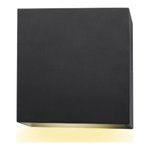 LED SQUARE WALL SCONCE 120V-277V - 5CCT (2700K - 3000K - 3500K - 4000K - 5000K) 15W - 1000...
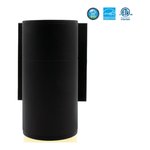 LED CYLINDRICAL WALL SCONCE 120V-277V - 5CCT (2700K - 3000K - 3500K - 4000K - 5000K) 10W -...
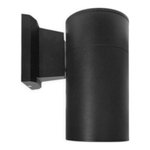 8'' OUTDOOR LED WALL LIGHT FIXTURE
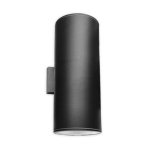 10'' OUTDOOR LED WALL LIGHT FIXTURE (BIDIRECTIONAL)
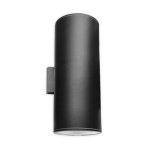 18'' OUTDOOR LED WALL LIGHT FIXTURE (BIDIRECTIONAL)
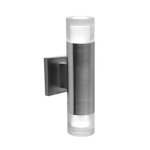 LUVIA OUTDOOR LED WALL LIGHT FIXTURE - STAINLESS STEEL - LCMUR-LUVIA-SS-B
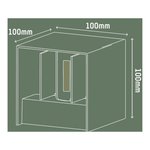 ADJUSTABLE OUTDOOR LED WALL LIGHT FIXTURE
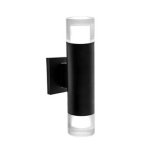 LUVIA OUTDOOR LED WALL LIGHT FIXTURE - BLACK - LCMUR-LUVIA-BK-B