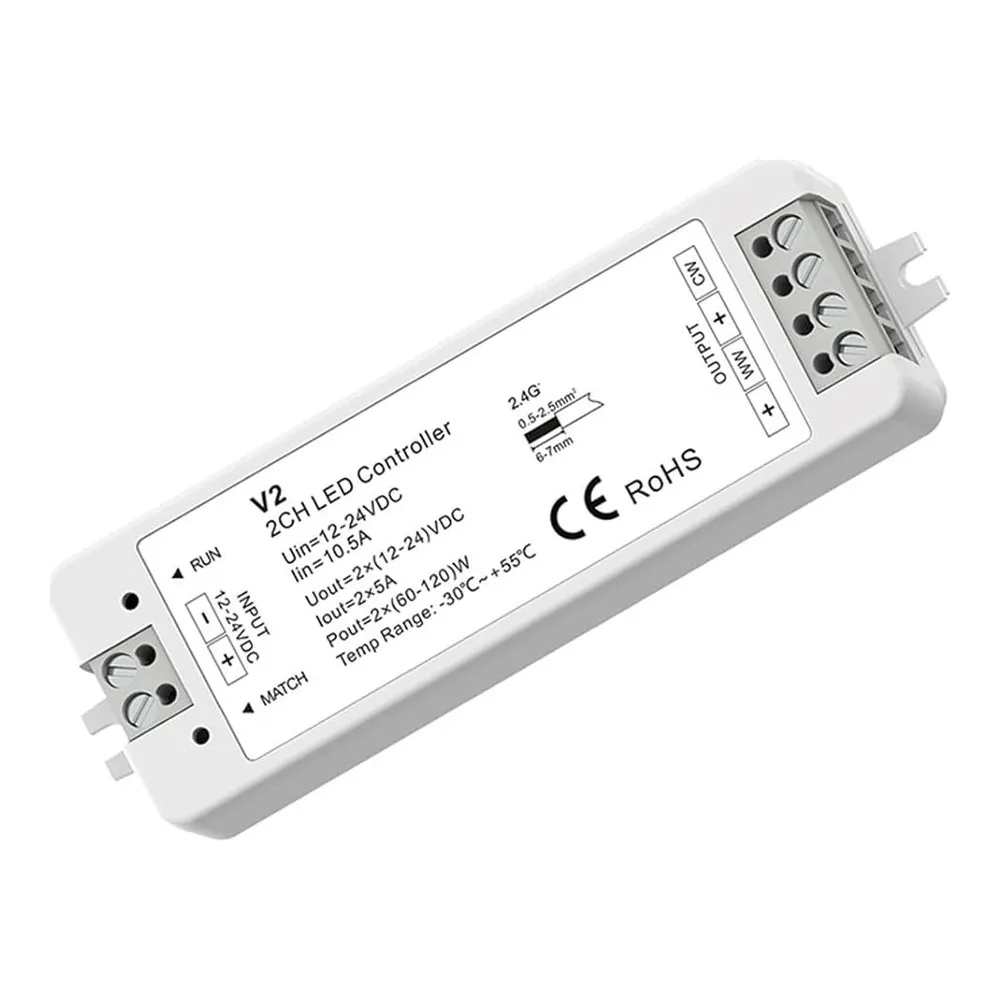
What a CCT receiver actually doesIn a tunable white installation, the LED strip carries two sets of diodes — a warm channel and a cool channel — and the light you see is the blend of the two. The receiver is what performs that blend. It sits between your low-voltage power supply and the strip, takes the instruction coming from your remote or control unit, and adjusts the output of each channel accordingly. Without it, a CCT strip is just a strip you can turn on and off. With it, you get a smooth slide from warm to cool and dimming on top, all from one control point.
Where it fits in the wiringThe order is always the same: line voltage feeds a low-voltage LED driver, the driver feeds the receiver, and the receiver feeds the LED tape. Keep the receiver close to the run it serves — long low-voltage leads between receiver and strip are where voltage drop and dull ends come from. Mount it somewhere you can reach again: inside a cabinet gable, above a dropped ceiling access panel, in a service cavity behind the millwork. Respect polarity and channel order at every solder joint or connector, and give the receiver a dry, ventilated spot rather than burying it in insulation. If several strip runs are involved, it's usually cleaner to feed each run from its own receiver than to daisy-chain everything through one.
Technical specificationsSKU: LCLP-REC10A-CCT
Type: CCT receiver for food-grade LED strip
Application: residential and commercial projects
Category: LED strip remotes and controllers
Real-world applicationsThink of a kitchen renovation where the homeowner wants bright neutral light for chopping and a warm, restaurant-like glow once dinner is served — same under-cabinet
LED strip lighting, two very different moods, one button. Think of a bakery display where warm light flatters breads and pastries in the morning, or a deli counter where a cooler setting makes products look fresher. Contractors use CCT receivers in clinics and treatment rooms, in salons where colour accuracy matters at the chair, in offices where staff want cooler light in the morning and softer light late in the day, and in hospitality millwork where the lighting has to change with the room's use. Because this model is intended for
food-grade LED strip, it's a natural choice for prep areas, pantries, walk-in shelving and commercial casework.
Building the rest of the systemA receiver is one component of a small ecosystem: strip, driver, connectors, aluminum profile and control. Aluminum channel is worth specifying on any run mounted against wood or drywall — it keeps the tape straight, helps manage heat and gives a finished look through its diffuser. On the control side, when a project grows past one room, the multi-zone units in the same family are the logical companions: the
4 zone controller 12A universal for indoor work and the
4 zone exterior controller 20A universal IP67 for patios, soffits and landscape runs exposed to Canadian weather. There is no spec sheet posted for this receiver; if you need confirmation on wiring details or pairing with a specific strip before you order, reach out with your project details and we'll point you to the right combination.