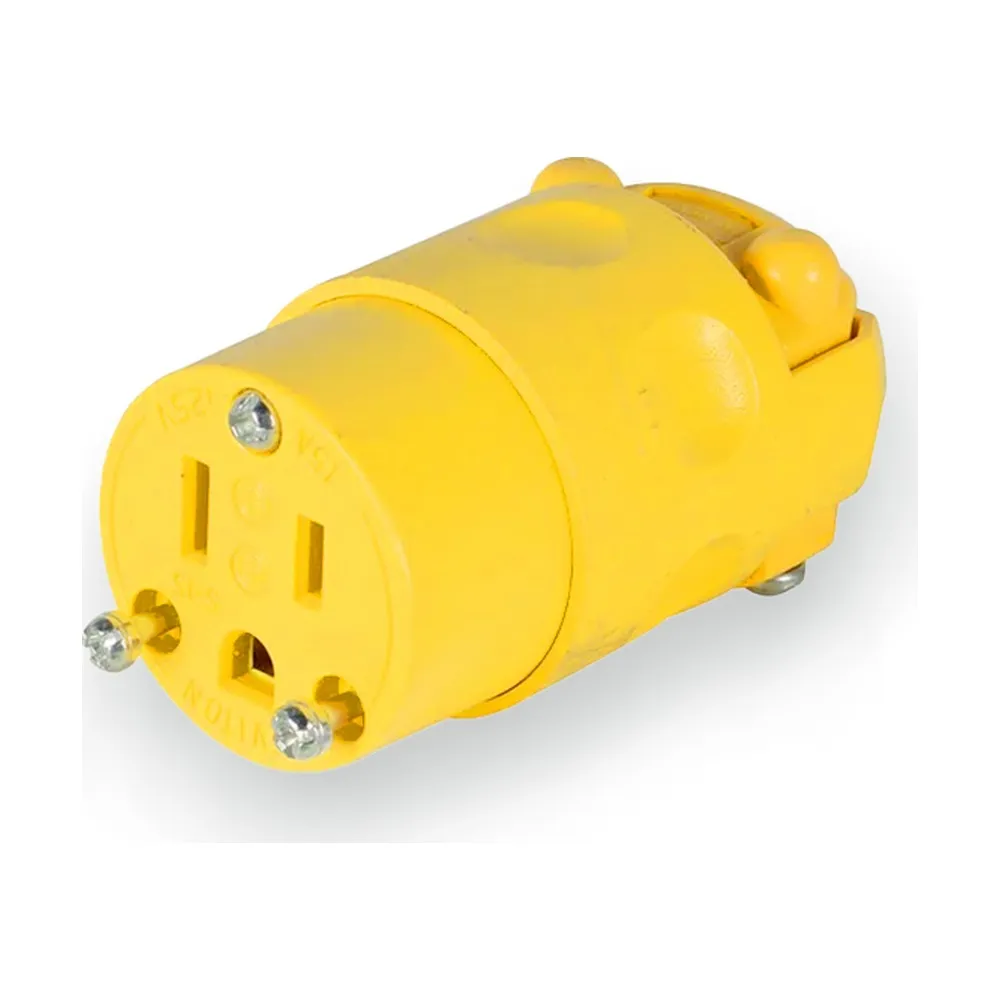
What it is and what it doesA female electrical plug is the receiving end of a cord assembly: it accepts a male plug and delivers power to whatever is connected downstream. In everyday shop language you will hear it called a female connector, a cord-end receptacle or a replacement cord end. Its job is simple but critical — it has to hold a solid electrical contact while surviving being yanked, dropped and re-plugged hundreds of times. That is why it belongs in every toolbox: it is what lets you build a custom-length
extension cord, salvage a cable with a broken end, or terminate a lead running to a lamp, a portable fixture, a pump or a power tool on a standard household circuit.
Construction and performanceThe housing is
moulded for durability and offers good resistance to impact — an important detail in busy workshops and garages where cord ends get walked on and dropped on concrete. Inside,
clamping screw terminals hold the conductors firmly so the copper stays fully seated and the contact stays stable over time, which is what keeps the connection cool and the conductivity dependable. The integrated
cord grip clamps the outer jacket so that any pull on the cable is absorbed by the housing rather than by the terminal screws. Strain relief is the single biggest factor in how long a field-assembled cord end lasts, and this one is built around it.
Installation, step by stepAlways disconnect power before working. Slide the housing onto the cable before you strip anything, then strip the conductors carefully without nicking the copper strands. Match each wire to its proper terminal, keep the copper fully seated under the screws and tighten them down firmly. Tighten the
cord grip so no tension reaches the terminals, close the housing squarely — no pinched insulation, no crossed conductors — and test the assembly before putting the cord into service. If anything about the wire identification or the circuit is unclear, have a qualified electrician complete the connection. It is a ten-minute job done right, and a hazard done wrong.
Compatibility and companion partsThis
female cord end is the natural partner to the
15A 125V male plug (NEMA 5-15P): one at each end of a run of
120V power cable gives you a finished cord in whatever length your bench, display or equipment actually needs — no more coiling twenty feet of slack behind a shelf. On a lighting lead, adding a
120V photocell (fixed thread 1/2) lets a plug-in fixture switch itself on at dusk and off at dawn. Several styles and configurations of cord ends are available for different cord types and applications, so match the connector to the gauge and jacket of the cable you are using.
Where it shines and documentationThink of every place a cord takes abuse: home workshops, garages and basements under renovation, rental equipment fleets, retail and seasonal displays, restaurant kitchens and patios, farms, barns and small industrial shops. Contractors keep a few on the truck to rescue a jobsite cord instead of losing a day to it; small business owners use them to make tidy, right-length leads for signage, coolers and display lighting. No spec sheet or IES file is published for this accessory — it is a straightforward wiring component, and the guidance above covers what you need for a clean, safe assembly. Add SKU LCACC120V-FICHE-FEM to your order along with the cable and male plug, and build the cord you actually want.