Nov 06, 2026 / By the Lumibox team / in LED Guides
Good LED kitchen lighting is built in three layers: general light from the ceiling, task light under the cabinets for the countertop, and a decorative touch over the island or table. The short answer: install LED pot lights for the whole room, puck lights or an LED light bar under the cabinets to get rid of shadows on the work surface, and one or more pendants over the island, all in the same colour temperature, most often 3000K or 4000K. Add dimmers, and the same kitchen goes from making dinner to a relaxed late-evening glow.
This guide is for homeowners renovating a kitchen in Canada, and for cabinet makers, contractors and electricians who want a clear plan: which fixtures to choose, where to put them, which voltage to use under the cabinets and which specs to read on the spec sheet before buying. The same principles apply to a café kitchen, a service counter or an office kitchenette.
Most poorly lit kitchens share the same flaw: a single ceiling fixture in the middle of the room. When you work at the counter, your body and the upper cabinets sit between the light and the cutting board, so you end up chopping vegetables in your own shadow. The fix is not a brighter ceiling light. It is more light sources, in the right places.
Each layer works best on its own switch or dimmer. For a quick look at the fixture families designed for this room, the LED kitchen lighting page groups them together. As for the range hood, it usually has its own light over the stove; if yours needs replacing, range hoods have their own section.
The question that comes up most is simple: what should go under kitchen cabinets? Three formats share the job, and the puck and under cabinet lighting category brings them all together. The right pick depends on the effect you want: decorative pools of light, or an even wash across the whole counter.
LED puck lights are small discs that mount on the surface or recess into the underside of a cabinet. They create regular circles of light that look great in a glass-front cabinet, on an open shelf or in a pantry. Under a counter cabinet, space them evenly to avoid a spotty look on the backsplash. Some have an adjustable gimbal head: ORTECH gimbal pucks in 2 in (2W, 180 lumens) and 3 in (3W, 300 lumens) let you aim the beam at the counter or at an object you want to highlight.
An under cabinet LED light bar is a linear fixture that lights the counter along its length, without hot spots. It is the best choice for true task light. The LUMENSTARLED LL50 6 in (15 cm) cabinet light, for example, is a surface mount linear fixture with an aluminum housing, running on 24V, plug and play, in 3000K warm white. At the other end of the range, the TUROLIGHT 120V 15W LED cabinet light connects directly to household wiring with no transformer, offers selectable colour temperature (5CCT) and is cUL approved.
LED strip mounted in an aluminum profile with a diffuser gives a continuous line of light, cut to length, ideal for long cabinet runs, the top of the cabinets or the toe kick. The profile helps dissipate heat, protects the strip and hides the individual LED dots, so you see a smooth line instead of a row of points.
Under cabinet fixtures fall into two families. Low voltage models (12V or 24V DC) run through a power supply; they are thin, discreet and easy to link together. 120V models connect directly to the household circuit, which keeps things simple when you want a permanently wired fixture with no visible plug or power supply.
A common rule of thumb: 24V handles long runs better than 12V, with less brightness drop at the end of the line. 12V remains very common for puck lights and small installations. Either way, choose a power supply that matches the fixtures' voltage and is rated above the total load it feeds, with some headroom. A dimmer that is not compatible with the power supply is a frequent cause of flicker.
For a clean finish, two accessories make a difference: the BAZZ universal conversion box lets you hardwire under cabinet lighting directly, with no plug hanging below the cabinet, and the ARANI 3.3 ft extension cable (V2 series) adds the length you need between two distant puck lights. For any connection to household wiring, hire a master electrician.
Puck lights all look alike in photos, but their spec sheets tell very different stories. Here are a few real models, with values taken from their product pages.
| Model | Wattage | Lumens | Voltage | CRI | Worth knowing |
|---|---|---|---|---|---|
| ORTECH PUK 1.5-3CCT | 1.5W | 120 lm | 12V DC | 90+ | Dimmable, 3CCT, indoor use |
| ORTECH PUK 3.0-3CCT | 3W | 240 lm | 12V DC | 90+ | Dimmable, 3CCT, white, black or satin nickel trim |
| ORTECH Superslim | 2.2W | 150 lm | 12V DC | not listed | Very thin, dimmable, 3000K |
| CANOLIGHT CL-PUCK300F | 3W | 220 lm | 24V DC | 80+ | 3CCT, dimmable, aluminum ring and housing, cETL |
| Puck #600R | 1W | 85 lm | 24V | 80+ | Tight 15° beam, 3000K, stainless finish |
| ORTECH 3 in gimbal | 3W | 300 lm | not listed | not listed | Adjustable head, 3000K or 5000K |
For task light, go for the brightest models with CRI 90+, such as the ORTECH 3W puck light with white trim. For a glass-front cabinet, a small puck with a tight beam, like the #600R, puts a crisp accent on the dishes. And if you want to play with colour, the NEXLEDS smart RGBCW puck light is controlled from your phone over Wi-Fi, while its 5CCT version, in white, black or brushed nickel, lets you pick the shade of white at installation.
For general lighting, recessed fixtures remain the cleanest option: they disappear into the ceiling and spread light evenly. In a kitchen, 3 to 4 inch LED downlights are very popular, because they stay discreet in a ceiling crowded with cabinets and a range hood.
The classic mistake is to line them up down the middle of the room. Instead, place a row above the front edge of the counters, so the light falls in front of you rather than behind you. For the number and spacing, the recessed lighting calculator works it out from the room's dimensions, and the guide how many lumens per room gives benchmarks for the kitchen and the rest of the house.
Over an island or a table, a pendant is as much a piece of furniture as a light fixture. One large statement piece suits a short island; a long island works better with a row of two or three decorative pendant lights spaced evenly. Hang them low enough to light the counter, but high enough not to block the view of someone sitting on the other side.
Put the pendants on their own dimmer: full brightness for homework or baking, soft light for dinner with friends. Choose a colour temperature close to that of the pot lights, so the room looks consistent from one end to the other.
Colour temperature is measured in kelvins. In kitchens, two shades lead the way:
5000K often feels too cold at home, but it has its place in a commercial kitchen or a prep area. The other number to check is CRI (colour rendering index): CRI 90+ shows the true colour of fruit, vegetables and meat, while CRI 80+ is fine for general lighting. If you are unsure, a 3CCT or 5CCT fixture lets you choose the shade at installation. The colour temperature and CRI guide covers it in detail.
For even task light, an under cabinet light bar or LED strip in an aluminum channel is the best choice. For a decorative effect, in a glass-front cabinet or on an open shelf, puck lights look better. Many kitchens combine both.
A light bar lights the counter along its length without hot spots; puck lights create spaced circles of light. If you cook a lot, choose the bar. If the cabinet is mostly a display, choose pucks.
Both work. 12V is very common for puck lights and short runs. 24V is more comfortable on long runs of fixtures or strip. What matters is that the power supply and the dimmer match the fixtures' voltage.
Yes. A permanently wired 120V fixture, or a conversion box for direct wiring, avoids a plug hanging under the cabinet. This work should be done by a master electrician.
3000K for a warm atmosphere, 4000K for crisp task light. Keep the same shade throughout the room, or choose 3CCT fixtures to set it at installation.
Many are: several ORTECH and CANOLIGHT models are dimmable. Check the spec sheet, then make sure the dimmer and power supply are compatible with each other.
Ready to get started? Begin with task light from the puck and under cabinet lights, add a bar or strip to suit the length of your cabinets, then finish with pot lights in the ceiling and pendants over the island.
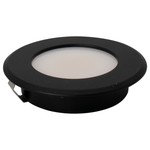 LED PUCK LIGHT 3W - 240LUMENS - CRI 90+ - 12V DC - DIMMABLE - BLACK TRIM. FOR INDOOR USE O...
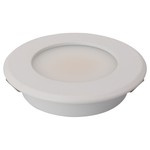 LED PUCK LIGHT 1.5W - 120LUMENS - CRI 90+ - 12V DC - DIMMABLE - WHITE TRIM. FOR INDOOR USE...
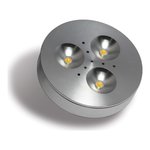 RD15 LED PUCK LIGHT 12V DC 3W - SURFACE/RECESSED MOUNT - BRUSHED CHROME - WARM WHITE 3000K
 LED PUCK #200 24V 30K
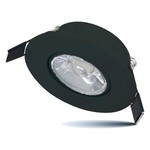 3" LED GIMBAL PUCK LIGHT 3W 300LMN, BLACK - 3000K
 UNIVERSAL CONVERSION BOX DIRECT WIRE UNDER-CABINET
 LED PUCK #600R 24V 30K
 LED PUCK #150R 24V RGBW 40K