What it is and how it works
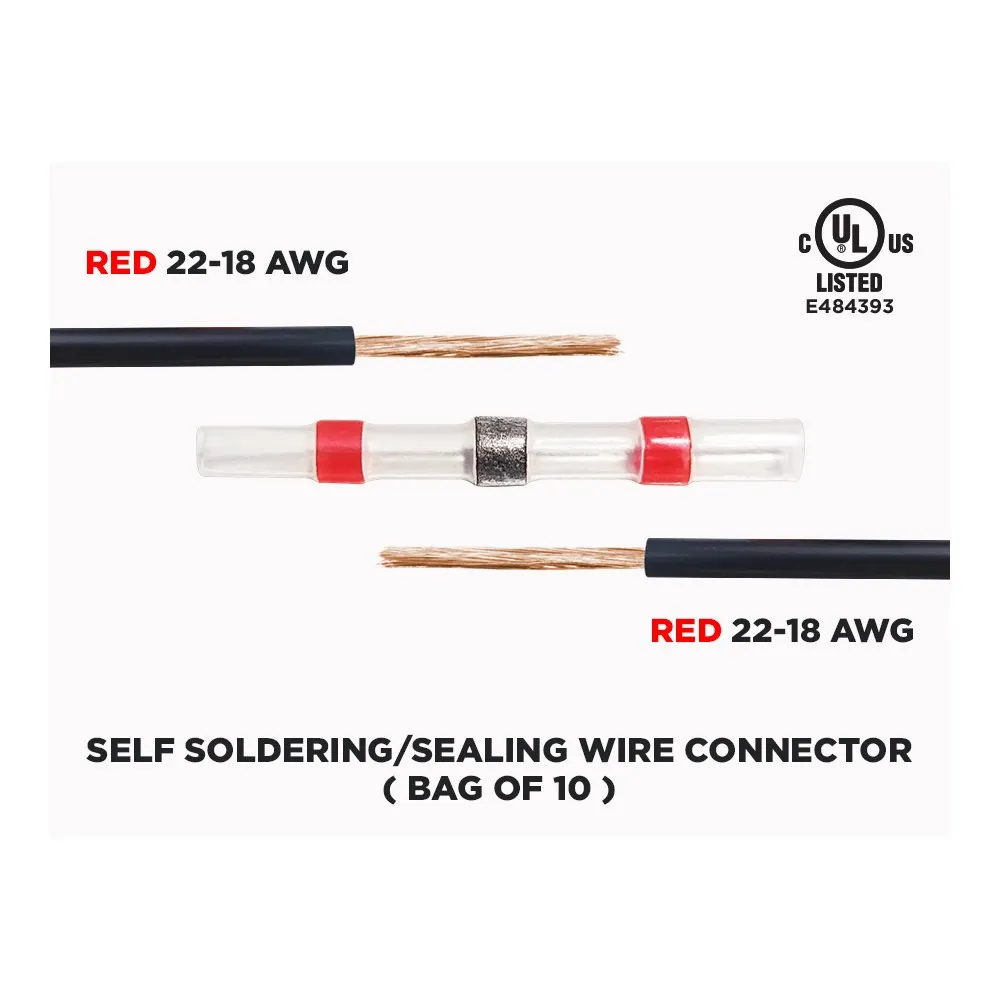
The HP-SST is a one-piece self soldering and self sealing wire connector: a clear sleeve with a ring of solder at the centre. You strip both wire ends, insert one from each side so the conductors overlap inside the solder ring, then apply heat evenly with a heat gun. The solder melts and flows into the strands while the sleeve shrinks around the joint and seals it. The result is a single mechanical and electrical connection — no soldering iron, no separate heat-shrink tube, no electrical tape, no wire nut hanging loose inside a channel. Because the body is transparent, you get visual confirmation that the solder has flowed all the way around before you tuck the wire away for good.
Colour coding and models
LED MONTREAL keeps identification simple with a colour-coded system. Red connectors are ideal for AWG 22-18 wires and blue connectors are best suited for AWG 16-14 wires. Three models cover the usual needs: both ends blue for joining two AWG 16-14 wires, both ends red for connecting two AWG 22-18 wires, and a mixed version for stepping between gauges. The bag you are looking at is the both ends red version, so it is dedicated to AWG 22-18 to AWG 22-18 splices — the fine stranded and solid wires typical of LED strip leads, jumper wires and small accessory circuits.
Technical specifications
SKU: HP-SST-RR
Brand: LED MONTREAL
Type: Self soldering / self sealing wire connector
Quantity: Bag of 10
Configuration: Both ends red
Wire gauge (red): AWG 22-18
Wire gauge (blue): AWG 16-14
Current type: AC and DC
Voltage: All voltages up to 110 volts AC
Body: Transparent
Certification: UL Listed for Canada and the USA
Installation tips
Cut power before you splice. Strip just enough insulation that the bare conductors sit under the solder ring, and twist stranded ends lightly so no whisker escapes. Slide the connector on, centre the ring over the overlap, then heat with a heat gun moving constantly around the sleeve — start at the centre until the solder ring collapses and turns shiny, then work outward so both sealing rings shrink tight against the jacket. Avoid an open flame, which scorches the sleeve before the solder flows. Let the joint cool untouched for a few seconds; pulling on it while the solder is still soft is the classic rookie mistake. A quick tug test afterwards tells you the splice is sound.
Applications and documentation
These connectors earn their keep on LED strip light and LED tape light installations: joining a strip lead to an extension wire under kitchen cabinets, feeding a cove or crown-moulding run, wiring display cases and retail shelving, or repairing a cut lead in a finished ceiling detail. They are equally at home in low voltage accent and signal wiring for offices, restaurants, workshops and basement renovations — anywhere a splice has to disappear inside an aluminum channel, a millwork cavity or a junction box and never be touched again. Since they are rated for AC and DC up to 110 volts AC and UL Listed for Canada and the USA, contractors can standardize on them across residential and commercial jobs. The technical PDF for the HP-SST is available in the Documentation tab of this page for gauge selection and reference.