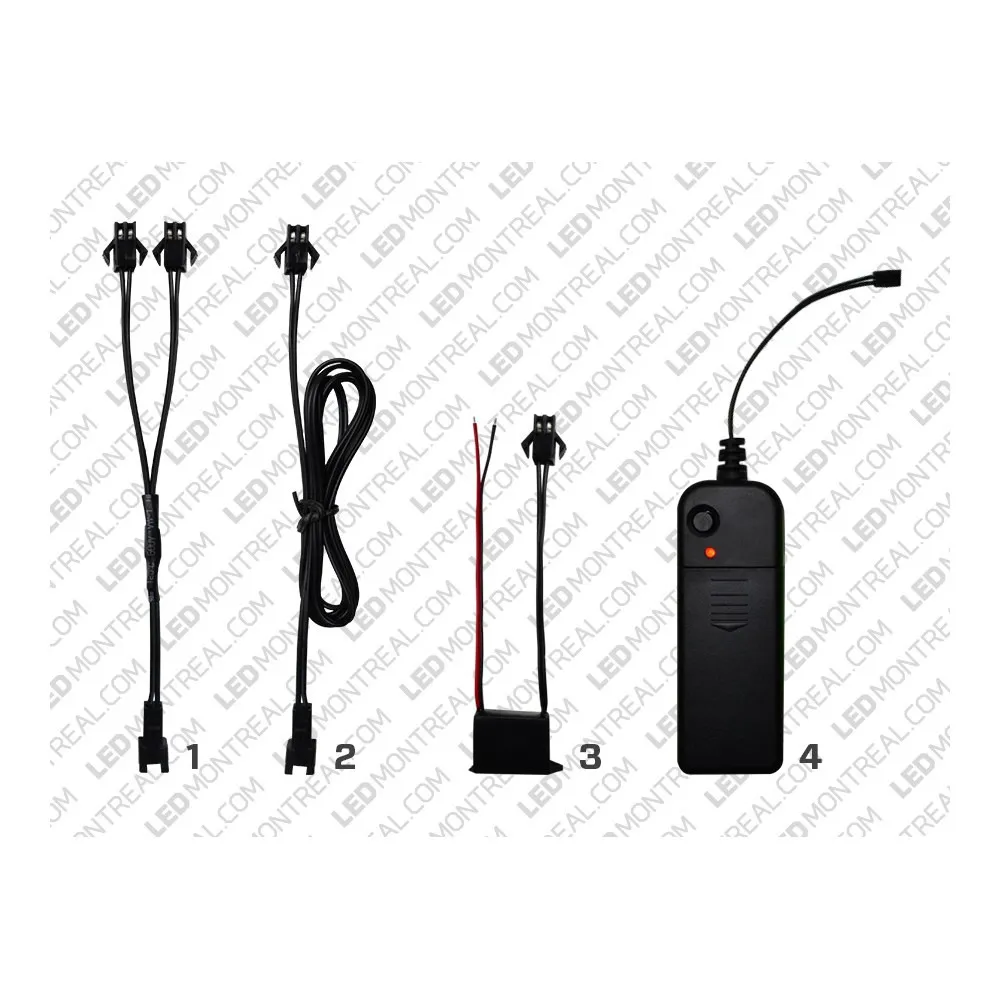
What is in the accessory line
The EL wire accessories family from LED MONTREAL covers the two pieces most projects end up needing: a 1 m extension cable and splitters that feed 2 or 3 EL wires from one power supply. Electro luminescent wire is a thin, flexible glowing strand that bends around corners and shapes where a rigid fixture never could, and these parts are what let you route power discreetly and branch it out. Everything uses the same quick connector system as the wire and the power packs, so building a layout is a matter of clicking parts together rather than splicing anything.
Technical specifications
SKU: ELACC
Brand: LED MONTREAL
Accessories available: 1 m EL wire extension, 2-way EL wire splitter, 3-way EL wire splitter
Extension length: 1 m
Connection: quick connectors, tool-free
Position in circuit: between the power supply and the EL wire only
Applications: residential and commercial projects
Installation and wiring logic
Think of your EL wire circuit as a one-way street: the power supply feeds the wire, and the wire has a connection on one end only. That single detail drives every installation rule here. The 1 m extension goes between the power supply and the start of the wire, which is how you hide an inverter behind a display panel, inside a cabinet, under a bar top or in a pocket while the glow starts a metre away. The splitter also goes between the power supply and the wires, branching one output into 2 or 3 strands. What you cannot do is attach an extension or a splitter at the far end of a lit strand to make the run longer — there is simply no connection point there. Plan your runs from the power supply outward and you will never be caught short.
Getting the brightest result
Every strand connected to a splitter draws from the same power supply, so the more wires you hang off one source, the more you divide what it can deliver. For the brightest, most even look, keep the number of strands per supply conservative and split a large design across more than one power pack rather than loading a single one. Group short strands together on a splitter, and give long feature runs their own supply. It is the same common-sense approach you would use with any led strip lighting install, and it pays off in colour consistency across the whole piece.
Where people use them
Retailers outline shelving, counters and window graphics; restaurants and bars trace menu boards, booth edges and stair nosings; homeowners light home theatre risers, gaming desks, headboards and basement bar fronts. Event crews reach for splitters when a booth needs several matching accents from one discreet power pack, and costume and prop builders love the 1 m extension because the inverter can ride in a pocket while the wire does the work. If your project calls for continuous linear light along a ceiling cove or under cabinets instead of a fine glowing line, a traditional LED strip is the better tool — but for shapes, lettering and tight curves, EL wire plus the right accessories is hard to beat. No additional documentation is listed for this item; if you are unsure how many strands your supply can comfortably feed, start small, test the brightness, and add from there.