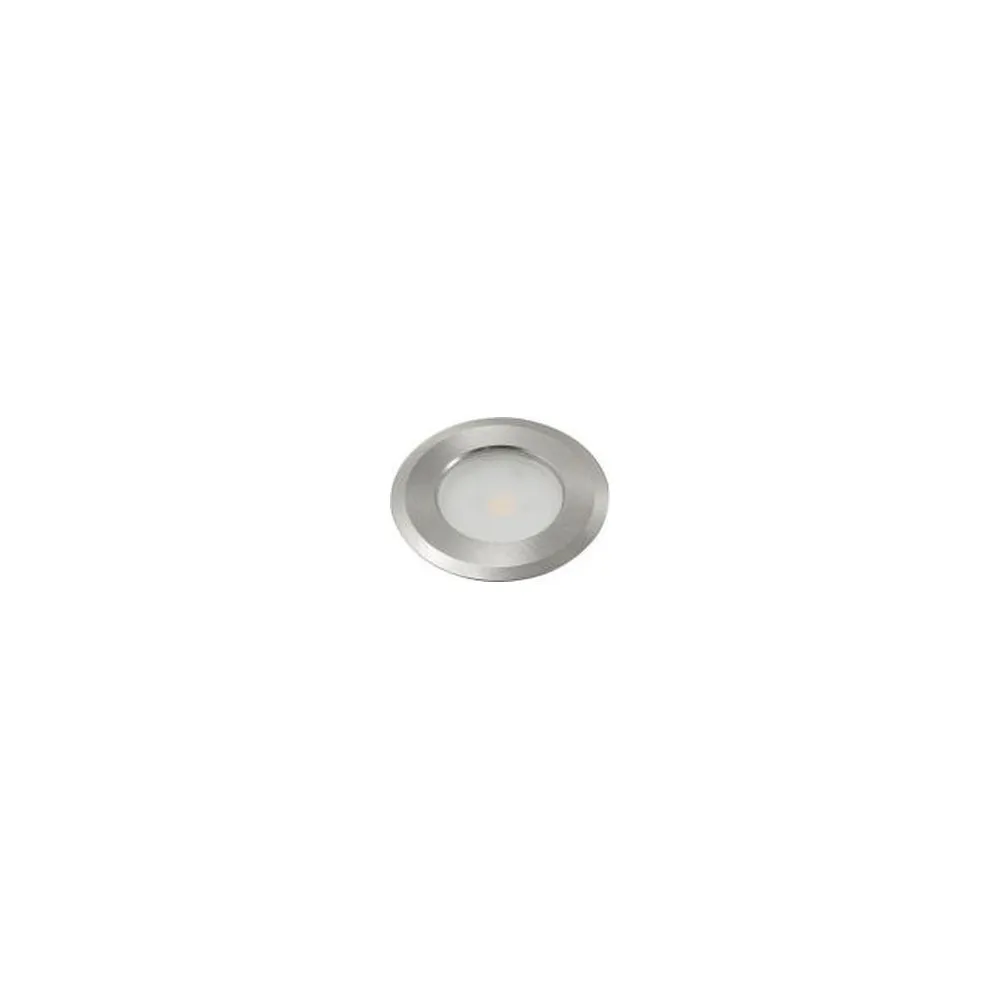
Built to be embedded
The RD10 is a professional-grade LED light engine — a component, not a finished fixture — designed to be built into whatever you're creating. Its compact form factor lets it sit discreetly inside a custom downlight, an architectural niche, a cove detail or an OEM product while still throwing a broad, controllable wash of RGBW light. The metal housing is the structural and thermal backbone: it pulls heat away from the diodes passively, holding the LED junction temperature inside safe operating limits. That matters because heat is what erodes LED output over time; keep it in check and the engine holds its brightness through thousands of hours of operation. For permanent installs where reliability is non-negotiable, that's the difference between a fixture you forget about and one you revisit.
Colour quality you can actually use
Conventional RGB engines struggle the moment you ask them for white. Mixing red, green and blue to fake a neutral tone produces visible colour artifacts and inconsistent results from unit to unit. The RD10 solves this with a dedicated white channel alongside the red, green and blue emitters — that's the RGBW in the name. You get true whites from warm to cool, better CRI in white-mode operation, and a much wider palette for saturated colour work. Designers get real flexibility: a clean warm white for everyday task or display lighting, a saturated scene for an event, or a slow dynamic sequence that moves through both without looking washed out.
Technical specifications
SKU: LS-RD10-4W-RGBW
Brand: LumenstarLED
Type: LED light engine / module
Colour: RGBW (red, green, blue + dedicated white channel)
Power: 4W
Input voltage: 12V DC
Housing: metal, passive thermal dissipation
Control: standard 12V RGBW controllers and DMX drivers
Wiring, control and compatibility
Because the RD10 operates on 12V DC, it belongs to the same low-voltage family as most cabinet, cove and display lighting, which makes system design straightforward: a 12V power supply sized for the total connected load, an RGBW controller or DMX driver, then your run of engines. It accepts standard 12V RGBW controllers and DMX drivers, so integrators can commission it with the gear and protocols they already use — no proprietary ecosystem to learn. Keep polarity and channel order consistent across the run, mount the metal body against a surface that helps it shed heat, and give yourself a little slack in the low-voltage leads so a fixture can be serviced without rewiring the whole zone.
Where it earns its keep
In homes, the RD10 hides under upper cabinets and inside glass display units, lights a bar back or a headboard cove, and turns a stair detail into a design feature. In business, it's a natural for retail vitrines, museum and gallery cases, restaurant and hotel millwork, reception desks and branded feature walls where the colour has to match a palette exactly. Canadian contractors and lighting designers also lean on it for OEM and custom-fixture builds, where a small, metal-bodied, colour-changing source is hard to replace. Pair a group of engines with a single controller to run a whole room as one scene, or split them across zones for layered effects. No spec sheet or IES file is posted for this model at the moment; for project-specific control and power-supply questions, plan your system around the 12V RGBW gear you intend to use.