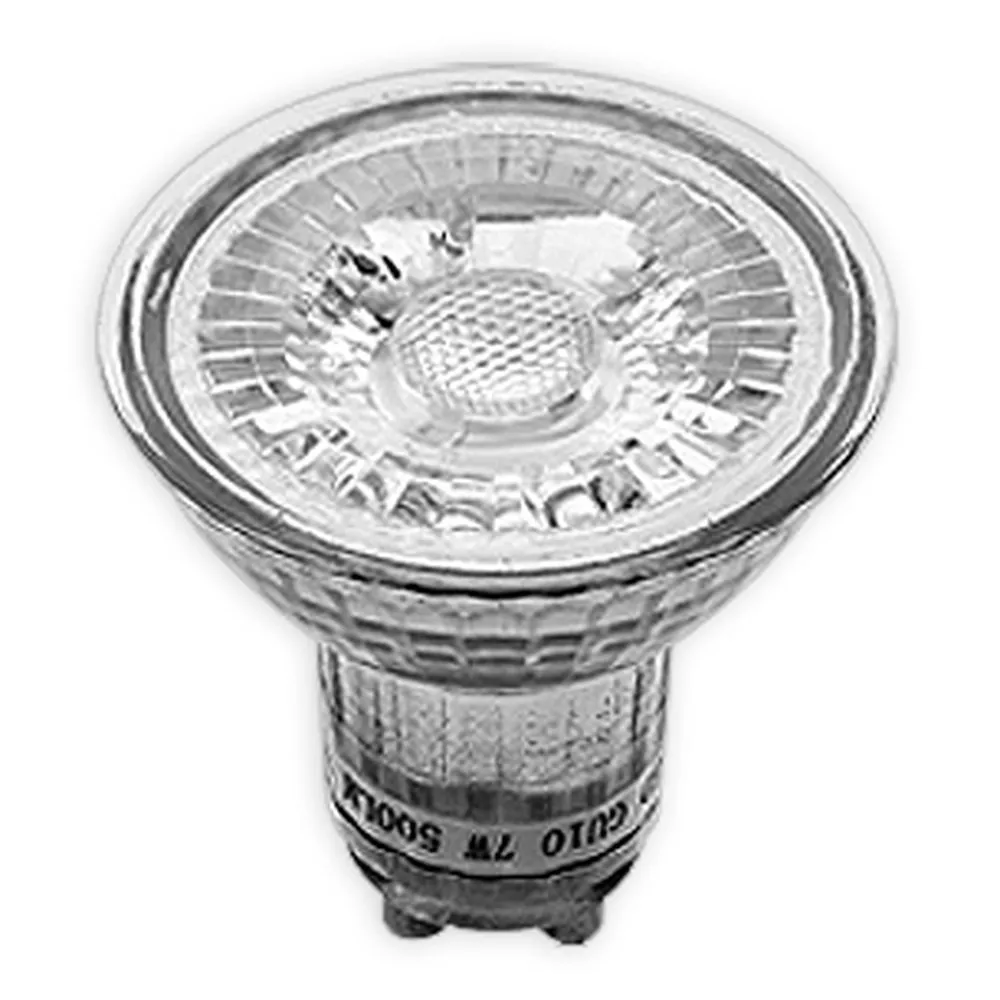
Built around a single COB LED
Instead of a cluster of small diodes, this GU-10 lamp uses one COB (chip-on-board) LED. That matters visually: a single emitting surface behind the lens creates one clean shadow and one crisp beam edge, the way a halogen reflector used to look, rather than the multi-shadow effect you get from multi-chip lamps. The body is an all-glass bulb, and the whole lamp is compact at 50 mm across and 54 mm long, so it seats properly in tight recessed housings, small track heads and shallow cabinet fixtures where a longer lamp would stick out past the trim.
Light quality and beam control
Output is 500 lumens for 7 watts of draw, the light you would expect from a 50 W halogen — the same punch, a fraction of the energy and far less radiant heat on your ceiling. The 38° beam angle (measured average beam angle at 50%: 39.0°, with 38.5° on the C0/180 plane and 39.5° on C90/270) is a true accent-to-general beam: wide enough to light a countertop section, tight enough to frame artwork or a product display. A CRI of 80 keeps skin tones, food and finishes looking honest. Two colour temperatures are offered in this series: 3000K for a warm, residential feel and 4000K for a cooler, more commercial white.
Technical specifications
Model: LEDGU107WG30K
Brand: LUMIFARO
Base: GU-10
Wattage: 7 W (equivalent to 50 W)
Voltage: 120 V
Lumens: 500
Colour temperature: 3000K / 4000K
CRI: 80
Beam angle: 38° (average beam angle at 50%: 39.0°)
LED: 1 COB
Bulb: all glass
Dimensions: 50 mm x 54 mm
Dimmable: yes
Warranty: 3 years
Installation, dimming and compatibility
Installation is the easy part: cut the power, push the two pins into the socket, twist a quarter turn to lock, done. It runs on 120 volts line voltage, so it works in any standard GU-10 socket — recessed pot lights, track heads, monopoints, gimbal trims, display and shelf fixtures — with no transformer and no external driver. On the dimming side, the manufacturer notes that these dimmable LED bulbs work with most dimmers, that dimmers are generally rated for a maximum of 150 watts with LED lamps, and that you should not exceed 80% of that capacity to avoid flicker at the lowest setting; their own example is a maximum of 15 8-watt PAR20 bulbs, for a total of 120 watts. Load your circuits accordingly and test one dimmer before relamping an entire floor.
Where it earns its keep — and the documentation
Think kitchen islands and backsplashes, hallway and stairwell pot lights, a row of track heads washing a feature wall, reading spots in a living room, and in commercial spaces: boutique display walls, jewellery and bakery cases, café and restaurant tables, reception desks, salon stations and small office corridors. For Canadian relamping jobs, it is the simplest upgrade there is — existing 120 V halogen GU10 fixtures stay in place and only the lamp changes, which keeps ceilings intact and job time short. The photometric data, the luminous intensity distribution diagram and the illuminance table by distance are all in the technical PDF available in the Documentation tab, handy when you need to justify spacing and light levels on a plan.