Nov 06, 2026 / By the Lumibox team / in LED Guides
Colour temperature, or CCT, tells you whether an LED looks warm and golden or crisp and blue-white, and a 3CCT or 5CCT fixture lets you choose that shade with a small switch instead of guessing at the store. The short answer: pick 2700K to 3000K for living rooms, bedrooms and dining rooms, 3500K to 4000K for kitchens, bathrooms, offices and most shops, and 5000K or higher for garages, workshops, warehouses and parking areas. Then look for a high colour rendering index (CRI), ideally CRI 90+, wherever colours, skin tones or food really matter.
This guide explains the kelvin scale in plain words, what 3CCT and 5CCT mean on a pot light or panel, why CRI is a separate spec, and which colour of light suits each room of a Canadian home or business. It is written for homeowners planning a renovation, but also for electricians, designers and property managers who need every fixture on a job to match.
Colour temperature is measured in kelvin (K). The lower the number, the warmer and more amber the light; the higher the number, the cooler and bluer it looks. It does not describe heat: a 5000K LED is not hotter than a 2700K LED, it simply looks whiter.
Packaging often uses names instead of numbers. "Warm white" and "soft white" usually point to the 2700K to 3000K range, "neutral" or "natural white" to 3500K to 4000K, and "daylight" or "cool white" to 5000K and above. Because these names are not used the same way by every brand, the kelvin number is always the safer guide.
| Colour temperature | How it looks | Where it works best |
|---|---|---|
| 2700K | Warm white, close to a classic incandescent bulb | Living room, bedroom, dining room, decorative fixtures |
| 3000K | Warm white, slightly cleaner | Whole-home pot lights, hallways, restaurants, outdoor accent lighting |
| 3500K | Neutral warm | Kitchens, bathrooms, boutiques, lobbies |
| 4000K | Neutral white, bright and balanced | Kitchens, laundry rooms, offices, retail stores, classrooms |
| 5000K | Cool white, daylight-like | Garages, workshops, warehouses, parking structures |
| 6500K | Very cool, bluish white | Some industrial and inspection tasks; rarely used at home |
A 3CCT or 5CCT fixture has three or five colour temperatures built in. You set the one you want with a switch on the fixture or its driver, usually before the light goes into the ceiling. That is why so many product codes end in "-3CCT" or "-5CCT": one model replaces three or five separate versions, and you decide on site.
The CANOLIGHT 3-inch modular LED downlight is a good example: 9 W, 800 lm, a 40° beam, CRI 90+ and five settings from 2700K through 3000K, 3500K and 4000K to 5000K. Its bigger sibling, the 3.5-inch version, delivers 12 W and 1000 lm with the same five choices. You will find many more selectable models among our 3-4 inch downlights.
Commercial fixtures follow the same idea, often with selectable wattage as well. The CSC LED PLS standard panel switches between 30 W, 40 W and 50 W and between 3500K, 4000K and 5000K, so one stocked item fits an office, a classroom or a storage room. Other panel sizes follow the same logic.
Selectable CCT is a one-time choice made with a switch. Tunable white, common on CCT LED strips, lets you shift the colour from warm to cool at any time with a remote or controller. If you want warm light in the evening and cooler light during the day, look at CCT LED strips with a compatible controller.
CRI, the colour rendering index, measures how faithfully a light source shows the real colours of objects compared with a reference light, on a scale that tops out at 100. CCT tells you the colour of the light itself; CRI tells you what that light does to the paint, wood, fabric, food and faces it falls on. Two lamps can share the same 3000K rating and still look very different if one has a much better CRI.
As a common reference, CRI 90+ is considered high quality for homes and shops. A higher CRI keeps reds richer, skin tones more natural and wood grain warmer. The CANOLIGHT five-head recessed blade light is one example: 10 W, 600 lm, 38° beams, CRI 90, a 0.9 power factor and a damp location rating, in 3000K, which suits kitchens, hallways and bathrooms.
Stay warm: 2700K or 3000K creates a calm, inviting space and pairs well with dimmers. Decorative bulbs such as the 2700K S11 E26 LED (1 W, clear glass globe) bring a soft glow to wall sconces and string lights.
Kitchens are where most people hesitate. 3000K keeps the room cozy and blends with an open living area; 3500K or 4000K makes counters look brighter and cleaner. A common approach is 3000K or 3500K for the pot lights and the same value under the cabinets. Ideas and fixtures are grouped on our LED kitchen lighting page.
Choose 3000K to 4000K with CRI 90+ at the mirror, so skin tones look natural. Keep the ceiling lights and the mirror on the same colour temperature. Our LED mirror buying guide covers CCT options on lighted mirrors.
4000K keeps you alert and shows colours clearly for reading, sorting laundry or hobby work. In a finished basement used as a family room, 3000K or 3500K feels more like the rest of the house.
Garages and workshops benefit from 4000K to 5000K for visibility and detail. Outdoors, warm 2700K to 3000K looks best on landscaping, decks and stairs and draws less attention than a harsh white; security areas often move to 4000K or 5000K.
In business settings, colour temperature shapes how customers feel and how staff work.
The most common mistake is a room where every light is a slightly different white. Pick one colour temperature per space, or per open area, and stick to it across pot lights, pendants, under-cabinet lights and bulbs. Buy bulbs from the same series when you can, since two brands rated 3000K may still look a little different.
Our LED bulbs often come in matching pairs. The ORTECH A19 9 W bulb gives 800 lm at 3000K with a 220° beam, and the same model exists in 5000K for a garage or utility room. Remember that colour temperature and brightness are separate choices: our guide on how many lumens per room helps size the output, and the LED dimmer switch guide explains how to dim LEDs smoothly once the colour is right.
Both work. 3000K feels warmer and blends with a living area; 4000K looks brighter and crisper on counters. If you cannot decide, a 3CCT or 5CCT downlight lets you test both settings before closing the ceiling, or settle on 3500K in between.
It means the fixture has three or five built-in colour temperatures, chosen with a switch. A 5CCT downlight typically offers 2700K, 3000K, 3500K, 4000K and 5000K, like the 3-inch and 3.5-inch modular models described above.
5000K is often sold as "daylight" because it looks close to bright midday light. It is excellent for garages and work areas but can feel cold in a bedroom or living room.
CRI 90+ is the usual mark of high colour quality. It matters most in kitchens, bathrooms, retail displays, restaurants and anywhere colours must look true.
Warm white and soft white usually mean 2700K to 3000K, neutral or natural white means 3500K to 4000K, and daylight or cool white means 5000K and above. Always check the kelvin number on the product.
With a selectable fixture, yes, but you usually need access to the switch on the fixture or driver. To change colour freely every day, choose tunable white products such as CCT LED strips with a controller.
Ready to choose? Compare selectable 3CCT and 5CCT models in recessed lighting, and plan offices, basements and larger areas with LED panels set to the same colour temperature.
 6" RETROFIT RECESSED LED DOWNLIGHT, 15W, 1000LMN, 5CCT (2700K,3000K,3500K,4000K,5000K) WHI...
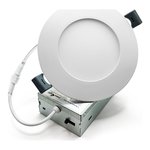 4 INCHES SMD DOWNLIGHT 9W - 90-130 V AC - IP20 - UP TO 800LM - CRI 85+ - 5CCT - 120° - WHI...
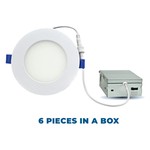 4" SLIM DISC LED FIXTURE. 5CCT (2700/3000/3500/4000/5000K) , 10WATTS, 900LMN, CRI 90, FT6...
 3.5 INCHES RECESSED LED GIMBAL MULTI DIRECTION 8W - 90-130 V AC - WET LOCATION IC-RATED -...
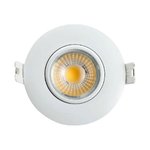 120V AC - 8W - 5CCT - 27K / 3K / 35K / 4K / 5K - 3" GIMBAL DOWNLIGHT - WET LOCATION RATE -...
 3-INCH MODULAR LED DOWNLIGHT - 9W - 5CCT(2700K-3000K-3500K-4000K-5000K) - BEAM ANGLE 40°...
 3.5-INCH MODULAR LED RECESSED FIXTURE - 12W - 5CCT (2700K-3000K-3500K-4000K-5000K) BEAM AN...
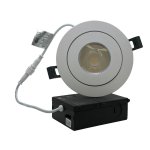 4 INCHES RECESSED LED GIMBAL MULTI DIRECTION 9W - 90-130 V AC - WET LOCATION - IC-RATED -...