LED grow lights give plants the light they need when a window is not enough. This category focuses on LED grow bulbs that screw into lamps and fixtures you already own: an A19 9W LED grow light and a BR30 10W LED grow light, both built around LED sources made for horticulture. No rack to assemble, no ballast and no special fixture: you thread the bulb into a socket, aim it at the plants and let it run on a timer.
The page is written for home gardeners starting seedlings in a basement, condo owners growing herbs in the kitchen, plant lovers keeping houseplants healthy through a Canadian winter, and businesses that want to keep plant displays looking fresh. Below, you will find what makes a grow bulb different from a regular LED bulb, the specs worth checking and practical tips to place and use these lights.
A regular LED bulb is engineered for human eyes. Its output is measured in lumens, which describe how bright the light looks to people, and its colour is chosen for comfort in a room. A grow bulb is engineered for plants. Plants do not use every colour of light equally: they absorb the most energy in the blue and red parts of the spectrum.
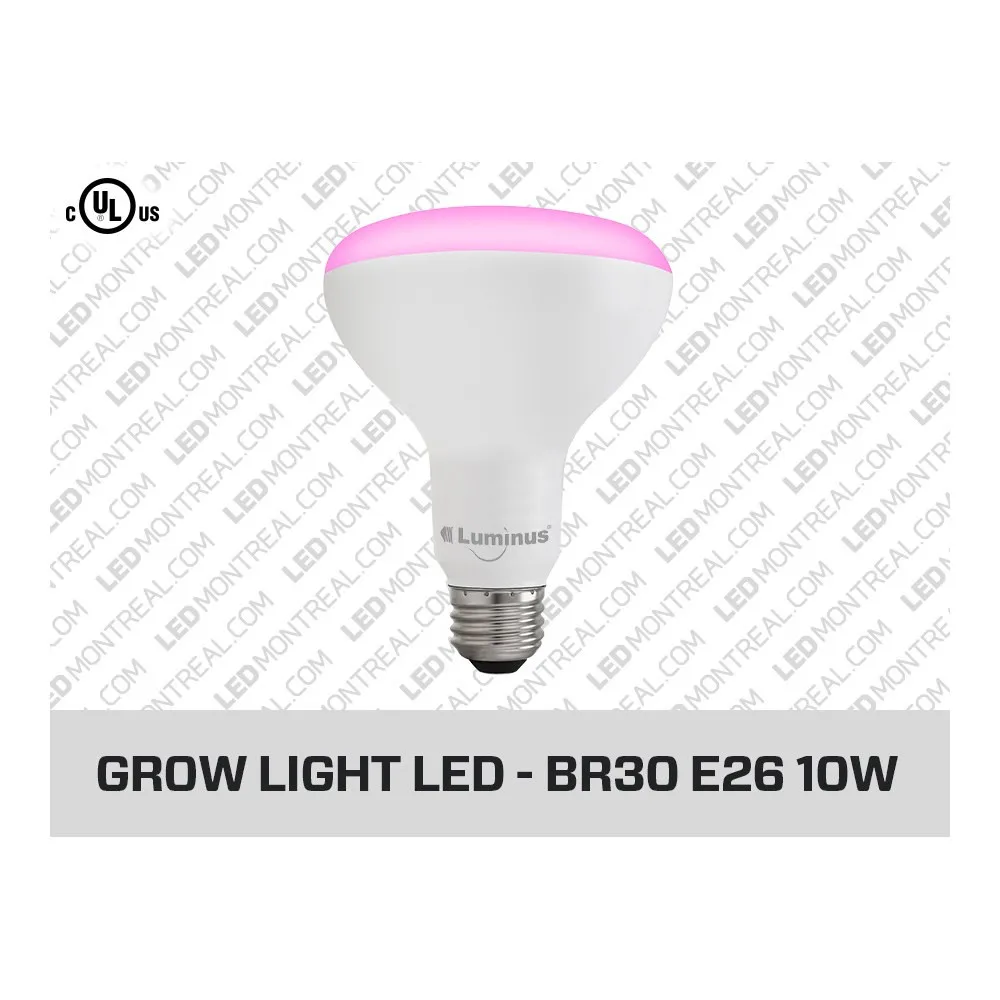
That is why the BR30 10W LED grow light combines two targeted wavelengths: 450 nm blue and 650 nm red. Blue light supports germination and compact, healthy vegetative growth, which keeps seedlings from stretching and going leggy. Red light drives photosynthesis, budding and flowering. The result is the familiar pink-purple glow of a horticultural lamp. Because lumens say little about plant growth, the BR30 lists its usable output as a PPF of 8.5 µmol/s, the amount of photosynthetic light the bulb emits each second.
If you are looking for bulbs to light a room rather than plants, see the general LED bulbs category and the guide to colour temperature and CRI.
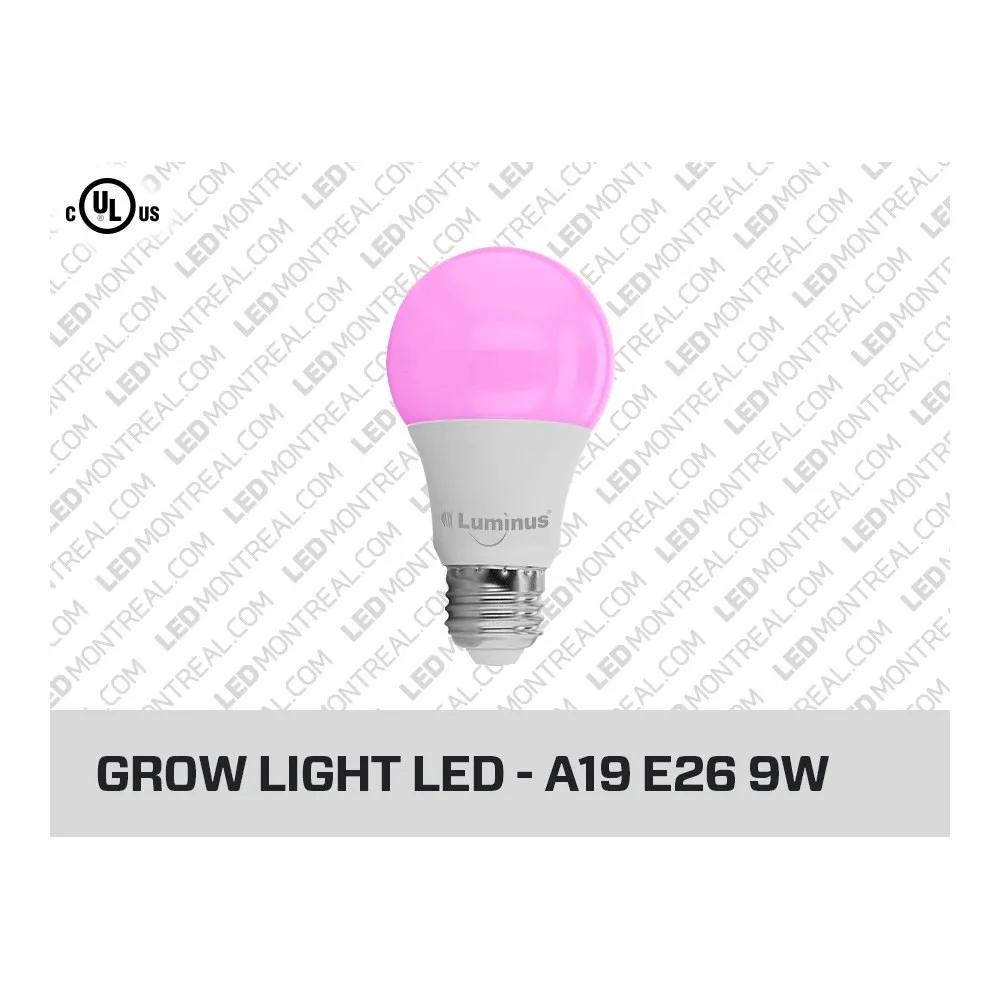
The A19 9W LED grow light keeps the familiar A19 bulb shape, measuring 11 cm long by 6 cm wide, with a standard E26 base. It threads into table lamps, clamp lamps and pendant sockets you already have. Inside, it uses Luminus LED components, and the product sheet lists a 15,000-hour life. As an LED source, it uses little energy and produces little heat, which matters when the bulb sits close to tender seedlings that a hot incandescent or halogen lamp could scorch.
The BR30 10W LED grow light uses a reflector shape that pushes the light forward in a broader beam. It suits recessed cans, track heads with a compatible socket and clamp lamps aimed down at a tray of seedlings or a group of pots. Its blue and red spectrum and its stated PPF make it easy to compare with other horticultural lamps.
| Bulb | Power | Shape | Specs from the product sheet |
|---|---|---|---|
| A19 grow light | 9 W | A19, 11 cm x 6 cm | E26 base, Luminus LED components, 15,000-hour life |
| BR30 grow light | 10 W | BR30 reflector | 450 nm blue and 650 nm red, PPF 8.5 µmol/s |
Choose the A19 when you want to reuse a standard lamp with an E26 socket: a desk lamp over a herb pot, a pendant over a plant shelf or a clamp lamp on a seed-starting rack. Choose the BR30 when you want a reflector beam aimed at a tray or a group of plants, or when you use an existing recessed or track fixture with a compatible socket.
Placement matters as much as the bulb. Keep the light directly above the plants rather than to the side, so the stems grow straight. Start with the bulb fairly close to seedlings and raise it as they grow; if plants stretch toward the light, the bulb is too far, and if leaves pale or curl, it is too close. A simple outlet timer keeps the daily light period consistent, which plants respond to far better than irregular hours. Several bulbs side by side give more even coverage on a wider shelf than one bulb pushed to its limit.
The pink-purple light of a blue and red grow bulb is not pleasant for reading or for judging leaf colour. In a living space, aim the bulb at the plants and keep regular room lighting for people. For a deeper look at greenhouse and indoor growing, read our LED grow lights and greenhouse guide.
At home, LED grow bulbs start vegetable and flower seedlings in spring, keep basil, parsley and other herbs productive in a kitchen all winter, and help houseplants that sit far from a window in the living room. A basement shelf with a few grow bulbs and a timer is a simple seed-starting station.
In businesses, the same bulbs keep plants healthy in lobbies, offices and waiting rooms with little daylight. Restaurants can grow herbs near the kitchen, and shops that sell plants can use grow bulbs to keep display plants green and compact in aisles far from the windows. In a small greenhouse, they can supplement daylight over a bench of young plants during short winter days.
A regular bulb gives some light, but its spectrum is designed for people. A grow bulb concentrates its output in the blue and red wavelengths that plants absorb most, such as the 450 nm and 650 nm of the BR30.
Blue and red light mixed together look pink-purple to the eye. That colour shows the bulb is focused on the wavelengths plants use rather than on the warm or cool white people prefer.
The A19 9W grow light has a standard E26 base and the familiar A19 shape, so it fits most household lamps with that socket. Check that the BR30 reflector shape fits your fixture before you order.
They produce far less heat than incandescent or halogen bulbs, which is why they can sit close to seedlings without scorching them. Keep normal clearances around any lamp.
PPF is the photosynthetic photon flux, in µmol/s: the amount of light usable by plants that the bulb emits each second. The BR30 lists a PPF of 8.5 µmol/s.
The A19 9W grow light lists a 15,000-hour life on its product sheet, thanks to its Luminus LED components.
See both bulbs in the LED grow lights category, or browse standard A19 LED bulbs for regular room lighting around your plants.