Nov 06, 2026 / By the Lumibox team / in LED Guides
Stair lights come in three main forms: a recessed LED step light set into the wall and wired to 120 V or to a low voltage circuit, an LED strip tucked under the nose of each step, or a mix of both controlled by a motion sensor. All three work indoors and outdoors, as long as the product is rated for the location where it will be installed.
This guide is for homeowners renovating a basement staircase, builders planning an indoor stairway, and contractors lighting deck stairs or porch steps in Canada. You will find a summary table, the specs to read on a product page, how to make stair lighting automatic and a simple installation plan.
Before comparing models, decide which family suits your staircase. The table below sums up the most common choices, with values taken from real product pages.
| Solution | Power | Mounting | Real example |
|---|---|---|---|
| 120 V step light | 120 V, straight from house wiring | Single gang or octagon junction box in the wall | LUMENSTARLED RT05, 120 V, 2 W |
| Low voltage step light | 12 V or 24 V, with a power supply | Small cut-out in the wall, riser or stringer | CANOLIGHT square, 3 W, 24 V DC, 80 lm |
| LED strip under the stair nose | 12 V or 24 V, with a power supply | In an aluminum channel under each tread | Outdoor COB strip, 24 V, 10 W/m, CRI 90 |
| Automatic stair lighting | 12-24 V DC sensor or 120 V fixture with built-in sensor | Sensor at the top and bottom, or built into the fixture | PIR sensor, 12-24 V, 6 A |
All of these products are listed under deck and step lights, which groups round, square and half-moon step lights in both low voltage and 120 V.
The step light is the classic stairway lighting solution: a small recessed housing set low in the wall, level with the treads, that throws light downward. It lights each tread without glaring in the eyes of someone going up or down.
If your electrician has already run 120 V wire, the simplest option is a step light that mounts in a standard electrical box. The LUMENSTARLED RT05 step light runs on 120 V, draws 2 W and fits a single gang junction box, the same box used for a light switch. There is no transformer to hide and no custom cut-out: install the box, connect the wires, screw on the faceplate. That is exactly what people mean by a step light with a back box.
For a round or octagon box, the RD05 from the same brand also runs on 120 V, at 3 W. If you are preparing the wall yourself, plan the boxes while the walls are still open.
At 12 V or 24 V, fixtures are smaller and wiring is lighter, but you need a power supply. The CANOLIGHT square step light measures 50 x 50 x 27 mm, runs on 24 V DC, draws 3 W for 80 lm, is dimmable and wet location rated. It comes in black or white, in 3000K or 4000K. The round version, 50 mm in diameter, is damp location rated.
On the 12 V side, LUMENSTARLED offers the M1 (1 W, 2700K), the M2 (2 LEDs, 0.5 W) and the MX-1 (2 W), all wet location rated, plus the low voltage RT05 (12 V, 2.2 W) that also fits a single gang box. ORTECH makes 1 W round and square step lights in 3000K, and NEXLEDS a 3 W 3CCT model that lets you pick the colour temperature at installation.
To power these fixtures, choose a supply of the right voltage whose capacity exceeds the total load of the fixtures with a comfortable margin. Power supplies are sorted by voltage and wattage.
For a modern, floating or open-tread staircase, an LED strip creates a continuous line of light under each stair nose. The effect is very different from a point source: every step seems to float, and the tread is lit across its full width.
The strip you choose matters. A COB strip, with no visible dots, looks best when it reflects on a varnished tread or on tile. Indoors, NEXLEDS 8 mm COB strips carry 320 chips per metre on a 5 metre reel, in 3000K or 4000K, and are IP65 waterproof, which helps at an entrance where snow melts on the steps. For exterior stairs, the LUMENSTARLED outdoor 24 V COB tape light offers 480 LEDs/m, 10 W/m (3 W/ft), CRI 90 and dimming, on a 5 m reel.
The strip goes into an aluminum channel: the channel draws away heat, protects the strip from kicks and hides the light points behind a lens. Choose outdoor LED strips and LED aluminium profiles together. Our guide on how to install LED strip lights covers cutting, connectors and power supply sizing.
Along the stringer (the side board that carries the steps), stair stringer lights follow the slope of the staircase. It is a good option when you would rather not touch the treads themselves.
A staircase that lights up as you approach is a comfort many people want, especially when heading down to the basement with full hands. There are two approaches.
The LUMENSTARLED RT05 motion sensor step light runs on 120 V AC, fits a single gang junction box and gives a 3000K warm white light. It is outdoor rated, which makes it the most direct outdoor junction box step light for porch steps, deck stairs or a garage entrance, with no separate sensor.
On a low voltage circuit, the sensor sits between the power supply and the fixtures. The LUMENSTARLED PIR motion sensor accepts 12 V to 24 V DC, handles up to 6 A and has an adjustable on-time. The LS-MS model from the same brand is surface mounted, with a 1 to 10 minute timer. From CSC LED, two 12 V sensors cover maximum mounting heights of 12 ft and 25 ft, useful in a tall stairwell.
On a long staircase, place one sensor at the top and one at the bottom so the lights come on in both directions. Always check that the total current of the fixtures stays below the maximum current of the sensor. All of these models are under motion sensors.
Outside, the question is not only light but resistance to rain, snow, salt and frost. Three ratings come up on product pages:
For wooden deck stairs, low voltage step lights connect to the same transformer as the rest of the yard: our low voltage LED landscape lighting guide explains the wiring. In Canada, check that every outdoor product carries a recognized certification (cUL or CSA) and have any 120 V work reviewed by a licensed electrician.
On a staircase, you want to see the edge of every step without glare. A few reference points:
As for brightness, a step light does not replace the ceiling fixture in a stairwell: it marks the steps. For a busy staircase, combine general ceiling lighting with step lighting, on two separate controls.
For more ideas by use, the LED staircase lighting page groups the products most often used on stairs.
For exterior steps or a 120 V installation, a step light with a built-in sensor, such as the LUMENSTARLED RT05 motion sensor model, fits a single gang box and needs no other device. For 12-24 V strips or fixtures, add a low voltage PIR sensor between the power supply and the lights.
A COB strip in an aluminum channel under the stair nose: you see the light, not the source. If you prefer fixtures, a small 50 mm square or round model recessed in the wall stays very discreet.
Yes, and it is common on decks. Choose a fixture that is wet location rated or IP65, and connect it to a low voltage transformer made for outdoor use.
It is a step light that fastens directly into a standard electrical box, single gang or octagon, and connects to 120 V. There is no separate power supply to hide, which simplifies renovations where the wire is already in place.
120 V is simple when each fixture has its own box. 12 V and 24 V allow smaller fixtures and strips, with a central power supply; 24 V is better suited to long strip runs.
You can easily build your own set: an LED strip, a channel for each step, a power supply of the right capacity and a low voltage motion sensor. That way you choose the colour temperature, length and control that suit your staircase.
To get started, browse deck and step lights, then add a strip and a sensor: a well-lit staircase is safer, better looking and far more pleasant to use.
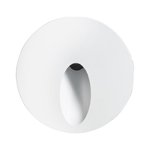 ROUND STEP LIGHT, RD25, 12V, 1W, WHITE TRIM, WARM WHITE 3000K
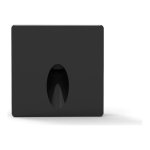 SQUARE STEP LIGHT 3W/24VDC DIA 50X50X27MM - SMD3535 - 80LM - DIMMABLE WET LOCATION 3000K B...
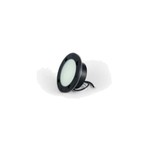 RD05 HIGH VOLTAGE ROUND STEP LIGHT ENGINE - 120V - 3W - FITS: OCTAGON/ROUND JUNCTION BOX -...
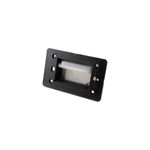 RT05 RECESSED HORIZONTAL - LOW VOLTAGE STEP LIGHT - 12V - 2W - FITS SINGLE GANG JUNCTION B...
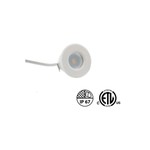 M2 - 2 LED DECK AND STEP LIGHT - 12V - 0.5W - WET LOCATION RATED - WARM WHITE 3000K
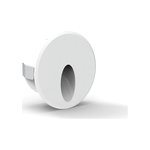 ROUND STEP LIGHT 3W/24VDC DIA 50X27MM - SMD3535 - 80LM/W - TRIAC DIMMABLE DAMP LOCATION 30...
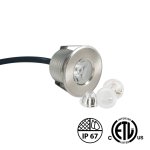 MX-1 POWER LED DECK AND STEP LIGHT - 12V - 2W - WET LOCATION RATED - WARM WHITE 3000K
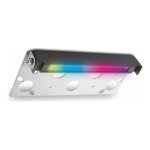 RGBCW 7 INCH LED HARDSCAPE PAVER LIGHT