Nov 06, 2026 / By the Lumibox team / in LED Guides
To choose the right LED flood lights for outdoor use, look at things in this order: the area to cover and the mounting height, the real lumen output, the beam angle, the colour temperature, the circuit voltage, then the control (photocell or motion sensor) and the floodlight accessories that go with it, such as the mount and the visor. Wattage comes last: it tells you what the fixture draws, not how much it lights.
This guide is for the homeowner lighting a driveway, a backyard or a garage, and for the electrician or property manager lighting a building facade, a parking lot or a sports field. You will find the specs to compare, a summary table and answers to the questions buyers ask most. To see the fixtures right away, open the outdoor LED flood lights category.
A floodlight is an aimable fixture that throws a strong beam in a chosen direction. Unlike a wall sconce or a porch ceiling light, it is not there to look decorative: it is there to put a lot of light exactly where it is needed, often from a distance. You mount it on a wall, under the eaves, on a pole or at ground level, and you aim it.
LED floodlights have replaced old halogen and metal halide floods almost everywhere. They turn on instantly, even in deep cold, they use far less power for the same light, and there is no lamp to change every season.
Floodlights cover three broad needs:
The most common question is how strong an outdoor flood light needs to be. The answer depends on the distance between the fixture and the surface you want to light. A small floodlight aimed well at a low height will do better than a large one placed badly.
The ranges break down roughly like this:
Once you have picked a range, compare the lumens listed on each spec sheet, not the watts. Two floodlights with the same wattage can deliver different amounts of light. Efficacy (lumens per watt) is the best indicator of how efficient a fixture really is.
Many current floodlights have selectable wattage: a switch sets the output at installation, handy when you are torn between two sizes.
The beam angle describes how the light spreads as it leaves the floodlight. A narrow beam concentrates the light and reaches far: that is what you want on a tall pole, to hit a specific spot or to light the top of a facade. A wide beam spreads light over a large, close surface: that is what you want under the eaves, above a garage door or in a yard.
A few practical rules of thumb:
The beam is also shaped by aiming. A flood pointed too high glares at neighbours and drivers and wastes light into the sky. Aim down, just enough to cover the area, and add a visor if needed.
Most floodlights in the category offer three colour temperatures, often selectable on the fixture (known as 3CCT):
| Temperature | Look | Typical uses |
|---|---|---|
| 3000K | Warm white, welcoming | Homes, facades, landscaping, patios |
| 4000K | Neutral white | Retail, building entrances, all-round compromise |
| 5000K | Cool white, close to daylight | Parking lots, industrial yards, security, sports fields |
In a residential neighbourhood, 3000K is easier on the neighbours. For areas where people need to see clearly, such as a loading yard or a sports field, 5000K is the usual choice: it is also the colour of the large stadium models and of the 400 W to 500 W TUROLIGHT floodlights. The parking lot lighting guide covers this choice for commercial sites.
Check the voltage before you buy. The commercial floodlights in the category, such as the FL05, FLM02, SP01B and the TUROLIGHT models, accept a 120-347 V range. They connect to a residential circuit just as well as to the 347 V found in commercial and industrial buildings. The 347V lighting guide explains this Canadian voltage.
At the other end, some small floodlights run on low voltage. The 10 W LUMENSTARLED floods come in 12 V AC, warm white 3000K, to connect to a garden lighting transformer, and in 12 V DC as an RGB version with an infrared remote for colour changes. These are accent lights, not security lights. To plan a low voltage system, read the low voltage landscape lighting guide.
A well-controlled floodlight uses less power and bothers fewer people. Three common options:
The first two are often combined: the photocell prevents daytime switching and the sensor limits operation to when there is activity. Always check that the control accepts the floodlight's voltage and load.
The right mount is the difference between a solid installation and a floodlight that works loose in the first winter storm. The floodlight accessories category gathers the parts designed for each model. The main types:
| Accessory | What it does | Catalogue examples |
|---|---|---|
| Yoke or U-shaped mount | Fixes to a wall, ceiling or structure and lets you aim the flood | FL05 yoke mount for 450 W, TUROLIGHT U-shaped mount in black or bronze |
| Slip fitter | Slides the floodlight onto the top of a round pole or tenon | FL05 slip fitter in black or bronze, CSC LED universal slip fitter |
| Pole mount | Fixes the floodlight to the side of a pole | FL05 pole mount in white |
| Multi mount | Several configurations: wall, pole, eave | FL05 multi mount in bronze or white |
| Knuckle mount | Fine aiming of a small floodlight | FLM02 knuckle mount, TUROLIGHT knuckle bracket |
| Visor (shield) | Cuts glare and light spilling onto the neighbour's property | FL05 visors for 100 W and 150 W or for 240 W and 300 W, SP01B visor for 500 W |
Two tips. First, an accessory is designed for one series and often for a wattage range: an FL05 visor for 100 W and 150 W will not fit a 300 W FL05. Read the product title. Second, match the finish (black, bronze or white) to the floodlight for a clean installation.
The floodlight shield deserves its own mention. It pushes light down toward the ground, reduces glare and keeps light out of the windows next door. Near a property line, it is often the accessory that settles a neighbour's complaint.
For a driveway or a garage, one or two small floodlights of 20 W to 50 W, in 3000K or 4000K, mounted under the eaves and aimed down, are enough in most cases. Add a motion sensor for security, or a photocell if you want light all night. For a tree or a facade, a small ground-mounted or low voltage floodlight gives a better effect than a big flood on the wall.
For a parking lot, a loading yard or a field, move up to floodlights of 100 W and more, in 120-347 V, on poles or on the building. Project specifications often require a DLC listing as proof of verified performance: several FL05 models and the SP01B are DLC Premium listed, and the FLM02 is DLC listed. Have a photometric layout done for a large site, and leave the wiring and code compliance to a licensed master electrician.
A small floodlight of 20 W to 50 W is usually enough, mounted above the door and aimed down. Pick 3000K or 4000K for a home, and add a motion sensor if the light is mainly for security.
In the category, the largest models reach 500 W, such as the SP01B stadium light and the TUROLIGHT floodlight selectable at 400 W, 450 W or 500 W. To compare real output, though, look at the lumens on the spec sheet, not just the watts.
At a minimum, the right mount for your surface: a yoke or multi mount for a wall, a slip fitter or pole mount for a pole. Add a visor if the flood could cause glare, and a photocell or motion sensor for control.
Yes. Floodlights from 100 W to 500 W in 120-347 V and 5000K are commonly used for parking lots and yards. On a large site, floodlights are often combined with street lights and wall packs; the parking and street lights category rounds out the range.
Yes. LUMENSTARLED offers a 10 W outdoor RGB floodlight in 12 V DC, supplied with an infrared remote to choose colours, brightness and effects. It is meant for accent lighting on a garden, a deck or a facade.
Yes, a 120-347 V fixture works on residential 120 V as well as on commercial 347 V. Have it installed by a licensed master electrician, and check with your municipality whether a bylaw covers outdoor lighting or light spilling onto neighbouring properties.
Ready to choose? Compare the LED floodlights by wattage, colour temperature and finish, then complete the installation with the mounts, visors and floodlight accessories from the same series.
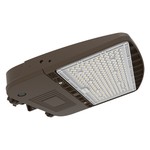 LED FLOODLIGHT - 70-100-150W - 30-40-50K - 120-347V - BRONZE
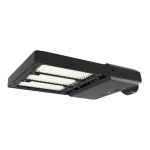 FL05 FLOOD LIGHT, FLOOD/AREA LIGHTS, 60W/80W/100W, 3000K/4000K/5000K, 120-347V, BLACK, DLC...
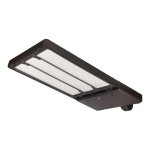 FL05 FLOOD LIGHT, FLOOD/AREA LIGHTS, 350W/400W/450W, 3000K/4000K/5000K, 120-347V, BRONZE
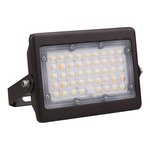 FLM02 MINI FLOOD LIGHT, FLOOD/AREA LIGHTS, 20W/30W/50W, 3000K/4000K/5000K, 120-347V, BRONZ...
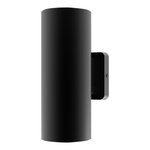 SSL ESC - WALL MTD. UP/DOWN CYLINDER - SELECTABLE 30-40-50K - SELECTABLE 40UD-20UD-20D-20U...
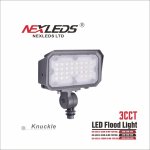 3CCT LED FLOOD LIGHT (NXSFLL-13-30W-H-MV-TCP)
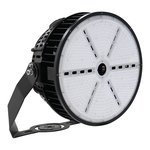 SP01B SPORTS STADIUM LIGHT, FLOOD/AREA LIGHTS, 500W, 5000K, 120-347V, BLACK, DLC PREMIUM P...
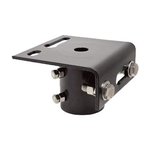 MOUNTINGS, AUXILIARY PRODUCTS, UNIVERSAL SLIP FITTER MOUNT