Nov 06, 2026 / By the Lumibox team / in LED Guides
Good parking lot lighting comes down to four choices: the fixture family (pole-mounted area lights, floodlights or wall packs), the light distribution type, the wattage and colour temperature, and the controls that switch it on at dusk. Get those four right and the lot is evenly lit, drivers and pedestrians see clearly, and the light stays on the pavement instead of in the neighbours' windows.
This guide is for property managers, contractors, electricians and business owners who are upgrading an older metal halide or high-pressure sodium lot, and for homeowners lighting a long driveway or a shared parking pad. It explains the fixture types, the Type III, IV and V distributions, how to read wattage and lumens, which mounts and accessories you need, and what to check before you order. Keep the LED parking and street lights category open in another tab to compare as you read.
Most LED parking lot lights fall into three families. Many lots use all three: pole heads for the open rows, wall packs along the building, and floodlights for the corners, signs and loading areas.
An area light, also called a shoebox or pole head, sits on top of a pole or on an arm and throws light down and out across the lot. It is the workhorse of commercial parking and the same family as the LED street light (the "lampadaire de rue" French-speaking buyers search for). The parking and street lights category groups 36 published fixtures, with dedicated LED street lights and street light accessories and mounts for arms, adapters and replacement parts.
A wall pack mounts on the building and lights the strip of pavement next to it: entrances, sidewalks, the first row of stalls, loading docks and back lanes. The LED wall packs category lists 122 published fixtures. Two styles matter for parking:
A floodlight on a slip fitter or a pole bracket is a flexible way to light a lot, especially when you need to aim the beam at a corner, an entrance or a sign. This is what "parking lot flood lights LED" searches are after. The LED floodlights category holds 134 published fixtures. The CSC LED FL05 family covers almost every lot size with three selectable wattages per housing: 100/125/150 W, 180/210/240 W, 260/280/300 W and 350/400/450 W, all with 3000/4000/5000 K selectable and a 120-347 V input. The 150 W, 240 W and 300 W versions are listed as DLC Premium.
For a small lot, a driveway or a side entrance, the CSC LED FLM02 mini flood light offers 20, 30 or 50 W, 3000/4000/5000 K and 120-347 V, and is DLC listed. For a sports court or a very large open area, the SP01B sports and stadium light delivers 500 W at 5000 K on 120-347 V, DLC Premium.
The distribution type describes the shape of the light pattern on the ground. It matters as much as wattage: the right pattern lights the lot evenly with fewer poles, while the wrong one leaves dark bands or spills light off the property. Here are the common reference points.
| Type | Pattern on the ground | Typical use |
|---|---|---|
| Type II | Long and fairly narrow | Walkways, narrow driveways, roadways |
| Type III | Wider, thrown forward | Poles along the edge of a lot, wall-mounted fixtures lighting outward |
| Type IV | Strong forward throw, very little light behind | Wall packs and perimeter poles where nothing should spill backward |
| Type V | Round or square, even in all directions | Poles in the middle of a lot, intersections of drive aisles |
Some wall packs let you change the optic. The CSC LED Keystone wall pack (20, 30 or 40 W, 3000/4000/5000 K, 120-347 V) accepts a Type III optic or a Type IV optic for the 40 W version. Type III spreads the light wide and forward along a building; Type IV pushes it farther out across the pavement with less light at the wall.
An LED fixture produces far more light per watt than the metal halide or sodium lamp it replaces, so the old lamp wattage is a poor guide. Compare lumens, and compare the pattern on the ground. When a product lists lumens for each setting, as the TUROLIGHT wall packs do, you can match the output to the space. When you are unsure, a fixture with selectable wattage lets you start at the middle setting and adjust on site without changing the fixture.
Most of the fixtures in this guide are 3CCT: you pick 3000, 4000 or 5000 K on the fixture. That makes it easy to match new wall packs to existing poles, or to keep one colour across the whole property.
Commercial lots in Canada are often wired at 347 V, while smaller buildings and homes run on 120 V. Every fixture listed above accepts a 120-347 V input, so one product can be used on either circuit. Always confirm the supply voltage on site before ordering.
The right bracket decides where the light lands. The FL05 floodlight family has a full set of mounts and shields:
Wall packs have their own accessories too, such as the wire guard for the CWPS slim wall pack (40 W and 80 W), useful where carts, trucks or vandalism are a risk. Browse the floodlight accessories and wall pack accessories before you finalize the order: it is easier to buy the right bracket with the fixture than to improvise on site.
Parking lighting should switch on at dusk and off at dawn without anyone touching a switch. A photocell does exactly that, and many outdoor fixtures accept one. In low-traffic areas, such as a back lane or the far rows of a lot after closing, a motion sensor can keep the light at a lower level and bring it to full output when someone arrives. Check the product sheet to see whether a fixture accepts a photocell, a sensor or dimming before you plan the controls.
Where there is no power at all, for example a remote lot or a gate at the end of a long road, consider solar LED lights. The solar LED lights guide explains how to size them for a Canadian winter.
For larger commercial projects, the commercial LED lighting guide for contractors and property managers covers the full building, inside and out.
There is no single best fixture: it depends on the pole height, the lot size and what surrounds it. For open rows, a pole-mounted area light or a floodlight on a slip fitter is the usual choice. Along a building, a full cut-off wall pack works best. Choose by lumens, distribution type and colour temperature, then confirm the mount.
Yes. Floodlights are widely used as area lights in parking lots, mounted on a pole with a slip fitter or a bracket. Add a visor when the fixture faces a street or homes, to limit glare and spill light. The FL05 family, with wattages from 100 W to 450 W, covers most lot sizes.
They are close cousins. A street light usually mounts on an arm and uses a long, narrow distribution (often Type II or III) to follow a roadway. A parking lot light more often uses a wider pattern (Type III, IV or V) to cover an open surface. Both are found in the parking and street lights category.
4000 K is a common choice for commercial lots. 3000 K is gentler next to homes, and 5000 K is often used for security and sports areas. With a 3CCT fixture you can switch between the three on site.
Covered parking needs low-profile fixtures rather than pole heads. LED canopy luminaires are designed for low ceilings and drive-through areas, and they are a common choice for a parking garage LED retrofit.
Yes. A small floodlight aimed at a sign, or dedicated sign lighting, makes entrances and directional signs readable at night.
Ready to compare? Start with the LED parking and street lights, then add LED wall packs for the building and LED floodlights for corners, signs and loading areas.
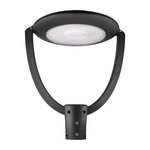 EDA-PT POST TOP - DB (DOUBLE ARM) - TYPE V-90D - 150L MW 150-125-100W - MK 30-40-50K - 120...
 LED LAMP POST TOP LIGHT IP65
 HYBRID WALL MOUNT - LED
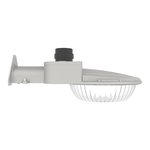 SSL-MAL - MINI AREA - 60M SELECTABLE (60-40-28W) (7800-5200-3640LM) - SELECTABLE - 120-347...
 SSL-AL3 AREA LIGHT - 150S - TYPE III - MULTI-WATT 150-100-70W - MULTI-K 30-40-50K - 120-34...
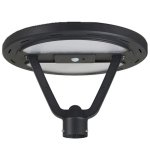 CIRCULAR SOLAR POST TOP - 4000K - SL-CPT-25L-40K-BK-G1
 SSL-AL3 AREA LIGHT - 300M - TYPE III - MW/MK - 120-347V AUTO-SENSING DRIVER - WHITE - 0-10...
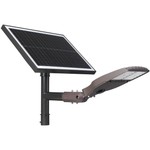 FLEX COLOR G3 30W SOLAR OFF-GRID AREA LIGHT