Nov 06, 2026 / By the Lumibox team / in LED Guides
A fire rated recessed downlight is a pot light built and tested so that cutting a hole in a fire-rated ceiling does not weaken that ceiling. The short answer: if the drywall above your head separates two homes, a home from a shared corridor, or a living space from an attached garage, the ceiling is probably part of a fire separation, and every recessed light you add there should carry a fire rating, usually stated in hours, such as 2 hours, on the fixture and its spec sheet.
This guide is for homeowners in condos, duplexes and multiplexes, for contractors finishing basements, and for electricians and property managers working on multi-unit buildings. It explains what a fire-rated ceiling is, how to read the 1-hour or 2-hour rating, what to check on a spec sheet, and which slim and gimbal models fit the job. When you are ready to compare, the full recessed lighting collection is the place to start.
A standard pot light leaves an opening in the ceiling. In a fire-rated assembly, the drywall, framing and insulation work together to slow fire and smoke from passing from one space to the next. An unprotected hole can become a weak point.
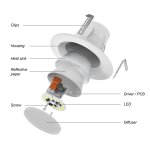
A fire rated downlight closes that gap. Depending on the design, it uses a sealed steel back, a heat-resistant housing, an intumescent material that swells when heated, or a combination of these. The fixture has been tested as part of a ceiling assembly, and the result is expressed as a duration: the assembly keeps its protection for the stated number of hours.
Codes and local bylaws decide where a ceiling must be fire-rated, and requirements vary from one municipality to another. As a general guide, these are the places where fire-rated ceilings are common:
If you are not sure whether your ceiling is part of a fire separation, ask before you cut. A master electrician, your building manager or the municipal permit office can confirm what the assembly is and what it requires. For condo owners, the building's management or the syndicate usually has rules on ceiling work as well. Our condo LED lighting page groups fixtures that suit low ceilings and tight plenums.
The hour figure describes how long the tested ceiling assembly, with the fixture installed, kept its fire resistance in the laboratory. It is a property of the assembly, not just of the light. A 2-hour rated downlight is designed to maintain the integrity of a ceiling rated for up to 2 hours; a 1-hour rated product is intended for 1-hour assemblies.
Three practical rules follow from that:
Every fire-rated model listed in this guide states a 2-hour rating on its product page, which covers the most common residential and multi-unit situations. Still, confirm the rating your ceiling requires with a qualified electrician or your municipality.
A fire-rated claim is only as good as the documentation behind it. When you compare fire rated LED downlights, look for these points on the product page or spec sheet.
The page should state the rating in hours and, ideally, the standards used. The TUROLIGHT ENDURA 6" fire-rated slim panel is a good example: its page describes a 2-hour rating secured by a reinforced, heat-resistant steel backplate, tested by an accredited lab for compliance with UL 263:2022, ASTM E119:2020 and CAN/ULC-S101-14-REV3(2021), with the full report available upon request. That level of detail makes inspections much easier.
Any fixture installed in Canada must carry a certification mark recognized here, such as cUL or CSA. Several of the slim discs in this guide state that they are certified to Canadian electrical standards. The fire rating is a separate claim from electrical safety, so check both.
Fire separation is not the only thing a ceiling does. Under an attic or a cold roof, the ceiling also holds the vapour barrier. An airtight fixture limits air leakage through the opening, which helps comfort and energy efficiency. Damp and wet location ratings tell you whether the light can go in a bathroom, a shower area or a covered porch. The ORTECH slim discs state IP54 and a wet rating; the BAZZ 4" models are described as airtight.
If insulation will touch the fixture, the product must be approved for insulation contact (often marked IC). Do not assume that a fire rating covers this: confirm it on the spec sheet, model by model.
Fire rating does not mean you give up on light quality. Look for lumens, CRI, selectable colour temperature and the dimming method. Most fire-rated slim panels here offer five selectable colour temperatures, from 2700K to 5000K, so you set the tone on site.
The table below summarizes real values taken from product pages.
| Model | Size and style | Power and output | Fire rating | Notable features |
|---|---|---|---|---|
| ORTECH SLIM4FR-5CCT | 4" slim disc | 12 W, 800 lm | 2 hours | 5CCT 2700K to 5000K, IP54, wet rated |
| ORTECH SLIM4FL+FR-5CCT | 4" floating gimbal | 9 W, 750 lm | 2 hours | Adjustable head, IP54, wet rated |
| ORTECH SLIM6FR-5CCT | 6" slim disc | 15 W, 1000 lm | 2 hours | 5CCT, IP54, wet rated |
| TUROLIGHT ENDURA 4" | 4" slim panel | 12 W, 800 lm | 2 hours | 120-347V, 0-10V and TRIAC, CRI 90 or more, FT6 cable |
| TUROLIGHT ENDURA 6" | 6" slim panel | 15 W, 1100 lm | 2 hours | 6.25" cut-out, steel backplate, 120° beam |
| SPECLITE SP4DFWAC009FDSY | 4" slim panel | 9 W, 120V | 2 hours | 5CCT, white frost, TRIAC dimming |
| ARANI SL6FR-VAR-R-WH-V3 | 6" round slim panel | 1400 lm | Fire rated | 5CCT variable, white |
Slim panels are the workhorse of fire-rated ceilings. They need very little depth, so they fit under ducts, between joists and in the shallow plenums common in condo towers. The 4" models suit hallways, closets and bathrooms; the 6" models cover kitchens and living rooms with fewer openings. Browse sizes in 3-4 inch LED downlights and 5-6 inch LED downlights.
When you want to wash a wall, highlight art or aim light at a kitchen island, a gimbal is the answer. The ORTECH 4" floating gimbal fire-rated fixture keeps a 2-hour rating with an adjustable head, and the NEXLEDS 4" 2-hour fire-rated floating gimbal adds dimming and a wet location rating. BAZZ also offers a 4" directional 2-hour model that is airtight.
A baffle or regressed trim sets the light source back from the ceiling and cuts glare. The BAZZ 4" 2-hour fire-rated airtight downlight and its baffle version give a more architectural look. LITELINE offers 3.5" trumpet and regressed downlights in its fire line, running on 120-277V with TRIAC dimming; check the rating on each product page.
Some projects call for a housing installed before the drywall. If your design uses a separate housing, compare options in recessed housings and confirm that the housing and trim combination carries the fire rating you need.
In a home, fire-rated slim panels are the simplest way to add pot lights to a condo, a garage ceiling below a bedroom or a basement unit. Selectable colour temperature lets you use the same fixture in the kitchen at a crisp white and in the bedroom at a warm white.
In commercial and multi-unit buildings, the priorities shift to voltage, controls and documentation. A model like the TUROLIGHT ENDURA 4", with 120-347V input and both 0-10V and TRIAC dimming, works in corridors on building circuits as well as in suites. LITELINE fire trumpets on 120-277V suit commercial ceilings. If you are new to the vocabulary, the guide pot lights vs recessed lights explains the terms.
A regular pot light leaves an unprotected opening. A fire rated downlight has been tested as part of a ceiling assembly and is built to keep that assembly's fire resistance for a stated number of hours, often 2 hours.
Very often, yes, because the ceiling between units or under a common corridor is usually a fire separation. Confirm with your building management and a master electrician before cutting.
Yes. A fixture rated for 2 hours meets or exceeds a 1-hour requirement. The reverse is not acceptable.
Many are. The ENDURA panels support 0-10V and TRIAC, and the SPECLITE 4" slim panel uses TRIAC. Check the product page and pair it with a compatible dimmer.
Yes, if it also carries a damp or wet location rating. The ORTECH slim discs are wet rated with IP54, and the NEXLEDS floating gimbal is rated for wet locations.
Not automatically. Fire rating, airtightness and insulation contact are separate claims. Some models, such as the BAZZ 4" downlights, state they are airtight; read each spec sheet.
Ready to light a fire-rated ceiling? Compare slim panels, discs and gimbals in recessed lighting, narrow down by size in 3-4 inch downlights, and check the rating on each product page before you order.