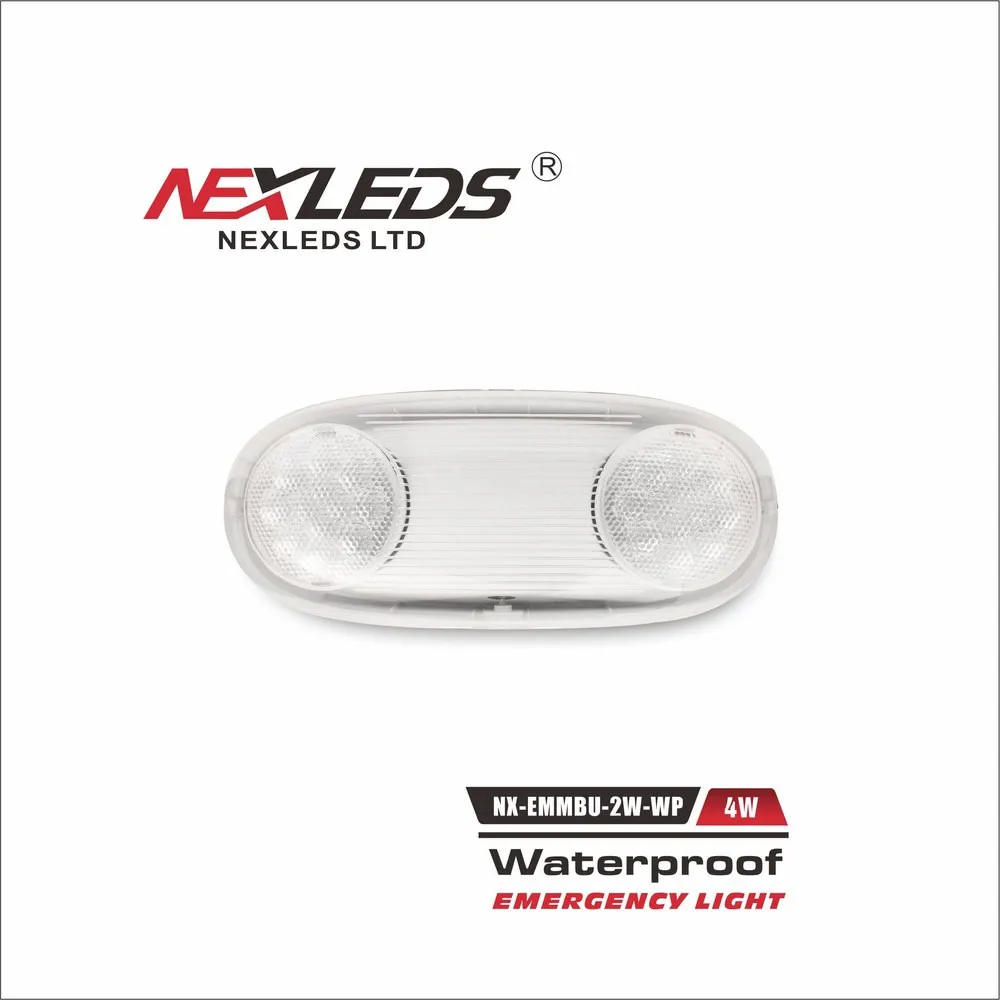
Built for wet, cold and dirty places
The WATERPROOF MINI BUG EYE EMERGENCY BATTERY UNIT 2W from NEXLEDS packs a self-contained emergency lighting system into a housing small enough to mount almost anywhere. The classic "bug eye" format — two round lamp heads on a compact back box — has been the workhorse of emergency lighting for decades, and this version brings it up to date with LED heads and a sealed, waterproof body. Where a standard indoor unit would corrode, fog up or short out, this one keeps doing its job in damp, dusty and wash-down environments.
Light quality and aiming
Both LED heads are adjustable, which is the single most useful feature of a bug eye emergency light. Point one head along the corridor and the other at the stair nosing, the door threshold or the piece of equipment people must walk past. LEDs strike instantly at full output — no warm-up, no dimming glow — and their tight, directional beam puts the light on the floor where it is needed instead of scattering it across the ceiling. Compared with the old halogen sealed-beam heads, an LED emergency head draws far less current, which means the same battery supports the required illumination without the heat and the frequent lamp replacements.
Technical specifications
Brand: NEXLEDS
SKU: NX-EMMBU-2W-WP
Type: Mini bug eye emergency battery unit
Wattage: 2W
Light source: LED
Heads: Two adjustable heads
Construction: Waterproof housing
Power: Self-contained rechargeable battery unit
Applications: Residential and commercial projects
Installation and service
Plan the mounting height and aiming before you drill: most installers set the unit above the door or along the corridor wall, high enough to clear traffic but low enough that the beams reach the walking surface. Because the battery is built in, you only bring power to the unit — there is no separate emergency lighting battery pack to locate, no long low-voltage run to a remote head, and no extra enclosure to weatherproof. Keep the unit on an unswitched circuit so the battery charges continuously, verify the charge indicator after commissioning, and test the unit on the schedule your local authority requires. In freezing or wash-down areas, make sure the mounting surface drains and that conduit enters from below or through a proper seal so water never tracks into the box.
Where it shines, and documentation
Think parking structures, loading docks, exterior vestibules and canopies, unheated storage, mechanical rooms, breweries and food-processing areas, kennels, greenhouses, marinas, garages and workshops — anywhere a standard unit would not survive a Canadian winter or a pressure washer. In retrofit work it is the easy answer when the wall space above a door is tight: a mini emergency unit gives you the same escape-path coverage without a bulky box. The technical PDF (NX-EMMBU-2W-WP Spec Sheet) is available in the Documentation tab of this page — download it for the full details before you finalize your layout or submit your package.