Nov 06, 2026 / By the Lumibox team / in LED Guides
A towel warmer for the bathroom, also called a heated towel rack, heated towel bar or heated towel rail, keeps your towels warm and dry between showers, with no plumbing and no boiler. The short answer: for a clean, permanent installation, pick a hardwired model, connected by a licensed master electrician to an electrical box hidden in the wall; for a quick trial or a rental, a plug-in model that goes into an outlet does the job. After that, three choices make all the difference: the number of bars (based on how many towels you need to dry), the finish (chrome, matte black or gold) and how you control it (switch, timer or programmable switch).
This guide is for homeowners renovating a bathroom in Canada, and for designers, contractors and small businesses (spas, salons, inns, gyms) that want the kind of small luxury people notice on the very first morning.
Before going into detail, here are the main choices at a glance. Each row is explained further down.
| Question | Common option | Key point |
|---|---|---|
| Electric or hot-water? | Electric | Works on its own, with no tie-in to central heating: ideal for renovations. |
| Plug-in or hardwired? | Hardwired for a permanent install | No visible cord; the connection is made by a master electrician. |
| How many bars? | 6, 8 or 13 bars in the LETO series | More bars = more towels at once, but a taller unit. |
| Which finish? | Chrome, matte black or gold | Match the finish to your faucets and cabinet hardware. |
| How to control it? | Switch or timer | A timer runs it only when you actually need it. |
There are two main families. A hot-water towel warmer connects to the heating loop of a home heated by a boiler: it needs a plumber, piping and a central system already in place. An electric towel warmer has its own heating element. Give it power and it heats, summer or winter, whether the house is heated by hot water, forced air or baseboards.
That is why electric is the most common choice in Canadian homes, especially in renovations. The units in our electric towel warmers category are all electric: the METIS product page, for example, notes that it works on its own, without any connection to a hot water heating system, which makes it practical for renovations as well as new builds.
A word on vocabulary: towel warmer, towel heater, towel dryer, heated towel rack and heated towel rail all describe the same appliance. The first name stresses comfort (a warm towel), the others stress the job (a dry towel that does not smell musty). A good unit does both.
A plug-in model comes with a cord and plug: you mount it on the wall and plug it into an existing outlet. It is quick and simple, and it moves with you. On the other hand, the cord stays visible, you need an outlet in the right spot, and a dangling cord in a humid room is not always ideal for looks or for cleaning.
A hardwired model connects directly to the home's electrical circuit, through an electrical box recessed behind the unit. The result is clean: no cord, no outlet taken up, and a unit that looks like it was planned with the bathroom. Several PARIS MIRROR models are designed this way. The LETO 8 towel warmer in chrome is described as an electric hardwired towel warmer that connects directly to your home's electrical system, with no plumbing. The CLIP in black is hardwired too, and the METIS spec sheet calls for a concealed wire connection that stays hidden in the wall.
Hardwired is the right call if you are already renovating the bathroom and the walls are open: that is the easiest moment to run the wire and set the box. Before you buy, always read the product's spec sheet: it lists the connection type, the wattage and the mounting dimensions.
| Criterion | Plug-in | Hardwired |
|---|---|---|
| Installation | Wall mounting and an existing outlet | Connection to a box in the wall |
| Who installs it | Usually the homeowner | A master electrician |
| Visible cord | Yes | No |
| Best for | Rentals, trials, finished rooms | Renovations, new builds, high-end projects |
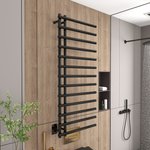
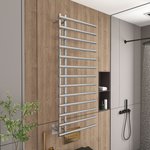
The size of a towel warmer is mostly read in the number of horizontal bars. More bars let you hang more towels at once, but the unit takes up more height on the wall. The LETO series shows the range well:
Other models focus on shape rather than bar count: the THEMIS has curved rails, the ARTEMIS uses a ladder-style layout with horizontal bars, and the CLIP has a slim, architectural profile. Measure the free wall space (between the vanity, the door and the shower) before choosing, and check the exact dimensions on the spec sheet.
Wattage is listed on each model's spec sheet. A towel warmer is not designed to heat the whole room like a baseboard heater: it delivers gentle heat into the towels, which also helps cut humidity and that musty smell. If your bathroom runs cold, keep a main heat source and think of the towel warmer as a comfort add-on. For a hardwired model, the spec-sheet wattage is what the master electrician uses to choose the circuit and the switch.
A towel warmer hangs on the wall in plain sight, so its finish matters as much as your faucet's. The models in the category come in three finishes.
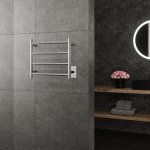
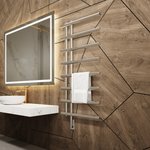
Chrome is the most versatile finish. It matches chrome faucets, hooks and cabinet pulls, and its reflective surface helps a small room feel brighter. The ARTEMIS in chrome, with its mirror-polished finish, is one of the most searched models: it suits modern, transitional and classic bathrooms alike.
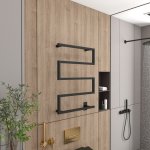
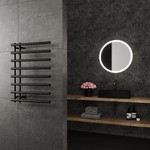
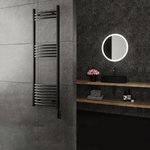
A black towel warmer follows the black-faucet trend. According to the black models' product pages, the matte finish resists fingerprints and everyday wear, a real advantage in a busy family bathroom where chrome shows every splash. It also creates a striking contrast with light tile.
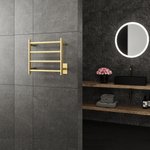
A gold towel warmer brings warmth and a jewellery-like touch to the wall. It pairs with white marble, green or navy tile, warm wood and brass accessories. The EOS in gold is a good example, along with the gold versions of the ARTEMIS, LETO, SELENE, RHEA, TERRA and CRONOS series.
A designer's tip: choose the finish at the same time as the mirror and the vanity light. A black towel warmer next to a black-framed LED mirror and a matching bathroom vanity light gives a bathroom that looks coherent at a glance.
A wall-mounted heated towel bar belongs where you reach as you step out of the shower or tub, at a height that is comfortable for everyone in the house. A few practical pointers:
If you are redoing the lighting at the same time, our bathroom renovation lighting guide helps you place the mirror, vanity light and pot lights without clashing with the towel warmer. For more room ideas, see the LED bathroom lighting page as well.
A towel warmer left on day and night uses power for nothing. The simplest fix is to control it with a wall switch or a timer. With a timer, you turn it on before your shower and it shuts itself off; with a programmable switch, it can start before you wake up and stop once everyone has left the house.
For a hardwired model, the master electrician installs the control on the wall, on the same circuit, in an accessible spot away from the shower. Make sure the switch or timer is rated for the towel warmer's wattage: the information is on both spec sheets. You will find options in our switches category, and our smart light switches guide explains Wi-Fi and programmable options.
What follows are common reference points, not wiring instructions. The exact rules depend on the building and electrical codes in force where you live, the layout of your bathroom and the unit you choose: for a hardwired model, call a licensed master electrician, who knows the current requirements and can check the circuit.
When in doubt, ask your master electrician or your municipality what applies to your home.
Start with the number of towels to dry (6, 8 or 13 bars in the LETO series, for example), the wall space and the finish of your faucets. Then choose the connection type: hardwired if you are renovating, plug-in if you want a quick install.
It depends on its wattage, listed on the spec sheet, and above all on how long it stays on. A timer or a programmable switch limits operation to the times you actually use it, and that makes the biggest difference on the bill.
Mounting it on the wall, yes; the electrical connection, no. Have a master electrician connect any hardwired model.
Yes, freestanding plug-in models exist. The ones in our category are wall-mounted: they keep the floor clear and blend better into the decor.
A hot-water unit only makes sense if your home already has a hot-water heating loop and you are ready to bring in a plumber. Electric works in any home, all year round, which is why it is the usual choice in renovations.
Yes, it is designed to: the TERRA gold product page notes that its gold coating is made to stand up to the humid, steam-rich air of a modern bathroom instead of dulling.
Ready to choose? Compare the chrome, black and gold models in our electric towel warmers category, then finish the room with a matching LED mirror and vanity light.