Nov 06, 2026 / By the Lumibox team / in LED Guides
Solar LED lights put light exactly where no wire reaches: the end of a long driveway, a shed at the back of the lot, a park path, a fence line or a rural entrance. A solar panel charges a battery during the day, and an LED engine turns that stored energy into light after dark. No trenching, no new circuit, no electrician to run line voltage across the yard.
This guide is for homeowners who want a wire-free upgrade, and for property managers and contractors who need to light a lot or a pathway where power is not worth bringing in. It covers the main types, the specs that matter, winter in Canada and mounting. To compare models as you read, open the LED solar lights category in another tab.
Every solar fixture, from a step light to an area light on a pole, is built from the same four parts.
A small panel and battery are fine for a glow along a path; a driveway or a lot needs a larger panel, more storage and smart operating modes.
Solar fixtures come in almost every outdoor format, and the solar lighting range covers each of them. Here are the families you will meet, from the most powerful to the most decorative.
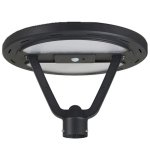
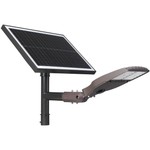
Post tops and area lights are the workhorses of solar lighting for driveways, condo grounds, parks, campuses and rural roads. The 20W solar post top light with PIR, 4000K from Light Efficient Design delivers 2000 lumens, compares to a 150W HID fixture and uses an LED engine rated for 100,000 hours. It measures 16" x 32", has an EPA of 2.2 and offers three operating modes. A 3000K version exists for a warmer look, and the Circular Solar Post Top comes in 3000K and 4000K for a cleaner, modern silhouette.
For larger areas, the Flex Color G3 30W solar off-grid area light pairs an included solar panel with an integrated battery and a selectable colour temperature, so one fixture can serve a warm patio approach or a crisp security zone. The G2 50W Solar Hybrid Light goes further with a dual-panel design: it is ordered with the 2 Solar Panel Kit for 50W Area Lights, which ships in a separate box. If you are replacing wired pole heads on a lot, compare these with the wired fixtures in parking and street lights.
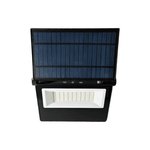
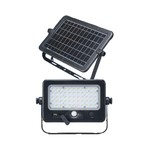
A solar wall pack is the fastest way to light a back door, a loading area, a barn wall or a storage yard that never got an electrical run. The 15W solar wall pack LiFePO4 is an all-in-one unit: panel, light engine and battery are built into one black housing. It delivers 1500 lumens at 4000K and compares to a 100W HID fixture. The 20W Solar Mount Light with PIR adds a motion sensor that switches the light on when movement is detected, a practical choice for garages and side yards. For a residential facade, the NEXLEDS Flexibeam Solar Wall Light comes in 2W and 8W versions.
Flood lights aim a wider beam at a driveway, a work area or a garden feature. Light Efficient Design offers a 20W Solar Flood Light and a 10W Solar Multi Functional Flood Light at 4000K, which can be mounted on a wall, a fence or a pole. Display lights are built for signs and facades: the 2 ft model is rated 10W and the 4 ft model 20W, ideal for an address sign, a commercial sign or an architectural detail.
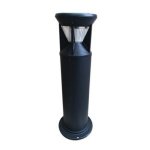
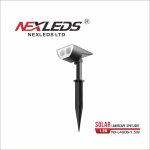
Low fixtures mark a path rather than flood it. A solar bollard lines a walkway or a driveway entrance: the 2W solar bollard fixture, 2700K gives a warm tone, and a 4000K version suits a more modern exterior. The 1W Solar Step Light mounts flush against stair risers, retaining walls and fence posts. The NEXLEDS LED Solar Landscape Spotlight stakes into the ground to highlight a tree or a garden bed. For wired options in the same formats, see LED landscape lighting and LED bollards.
The Tulum Solar LED Light, in 15" and 19" sizes, is a decorative lantern for a patio, a deck or a front walkway. It charges during the day, lights up automatically at night and offers a selectable colour temperature to set the mood.
| Fixture | Wattage | Colour temperature | Typical use |
|---|---|---|---|
| Solar post top with PIR | 20W (2000 lm) | 3000K or 4000K | Driveways, parks, condo grounds |
| Flex Color G3 area light | 30W | Selectable | Lots, sheds, remote areas |
| G2 solar hybrid light | 50W | 5000K | Larger areas, with 2-panel kit |
| Solar wall pack LiFePO4 | 15W (1500 lm) | 4000K | Back doors, loading areas, barns |
| Solar mount light with PIR | 20W | 4000K | Garages, side yards, security |
| Solar display light | 10W (2 ft) or 20W (4 ft) | 4000K | Signs, facades |
| Solar bollard | 2W | 2700K or 4000K | Walkways, driveway entrances |
| Solar step light | 1W | 4000K | Stairs, retaining walls |
Wattage tells you how much energy the LED draws; lumens tell you how much light reaches the ground. A 1W or 2W fixture marks a path. A wall pack around 1500 lumens lights a doorway and the area in front of it. A post top around 2000 lumens covers a driveway or a park path. An HID comparison tells you which old wired fixture it replaces. For general light-level targets, the guide how many lumens per room gives useful reference points, even outdoors.
2700K and 3000K give a warm, residential glow that flatters wood, stone and plants. 4000K is a neutral white that helps faces, steps and signs read clearly at night, which is why it is common for security and commercial sites. 5000K is a cooler, daylight-like white often chosen for larger areas. A selectable colour temperature lets you decide on site.
The panel size and the battery capacity decide how long the light runs and how well it recovers after cloudy days. An integrated panel keeps installation simple. A separate panel, or a two-panel kit, lets you aim the panel toward the sun even when the fixture itself faces a shaded wall.
A PIR sensor is the single best way to stretch a solar battery. The light stays at a low glow or off, then brightens when someone approaches. Several fixtures offer more than one operating mode, so you can trade constant light for longer runtime depending on the site.
Solar lighting works in Canada, but winter changes the equation: days are short, the sun sits low and snow can cover a panel overnight. Plan for it from the start.
A patio lantern can be dimmer in winter. A driveway or an entrance lit all year needs a commercial-grade fixture with a larger panel and a motion sensor.
Placement decides how well a solar fixture performs.
At home, solar LED lights shine on driveways, garden paths, deck stairs, fences, sheds, detached garages and address signs. For ideas by space, see LED driveway lighting. On commercial and municipal sites, solar post tops, area lights and wall packs light parks, condo grounds, campuses, rural roads, loading docks and storage yards without trenching across pavement. For a broader view of commercial projects, read the commercial LED lighting guide for Quebec.
Yes, if you choose the right class of fixture. A small garden light will only mark the edges. A solar post top delivering 2000 lumens, or an off-grid area light, is designed to light a driveway or a lane. Add a motion sensor so full brightness is there when a car arrives.
They do, with planning. Face the panel south, tilt it steeply, keep it free of shade and snow, and use a motion sensor or a dimmed mode. For year-round sites, choose a fixture with a larger or separate panel.
A solar bollard is a low post light with a built-in panel. It charges during the day and turns on at dusk to mark a walkway, a garden border or a driveway entrance. The 2W models come in warm 2700K and neutral 4000K.
The panel must see the sun, so solar fixtures are designed for outdoor use. A model with a separate panel can light a shed or a covered area while the panel stays outside. For indoor rooms, wired LED fixtures remain the practical choice.
Most LED strips are wired to a power supply. For outdoor linear lighting, look at the weatherproof outdoor LED strips; for wire-free light, a solar wall light or a display light is the better tool.
Use a pole tenon adapter or a pole mounting bracket sized for your pole. Light Efficient Design offers a 3" tenon for a standard round pole and a 3" to 6" bracket for a wider range of diameters. On a tall pole, check the fixture's EPA rating (its wind load surface) against what the pole can carry.
Whether you need a warm glow along a garden path or a commercial post top for a parking area, start with the place, the light level and the winter sun. Then compare panel, battery, sensor and mounting in the solar LED lights collection and pick the fixture that fits your site.