Nov 06, 2026 / By the Lumibox team / in LED Guides
An LED panel light is the simplest way to turn a tired drop ceiling into an even, glare-free ceiling of light. This guide explains how to choose between 2x2, 1x4 and 2x4 LED ceiling panels, how to mount them in a T-bar grid, on drywall or on cables, and which specs really matter: wattage, colour temperature, voltage and 0-10 V dimming.
It is written for homeowners finishing a basement or a home office, and for contractors, electricians and property managers who replace rows of fluorescent troffers in offices, schools, clinics and stores across Canada. Every product figure quoted below comes from real fixtures and accessories you can compare in our LED panels category.
The words get mixed up, so here is the short version. A flat panel is a thin, square or rectangular fixture with a uniform lens over its entire face. A troffer is the classic recessed fixture that sits in the opening of a suspended ceiling grid; the name originally described the deep metal housing of fluorescent tube fixtures. Today, most LED troffers are slim enough to look like panels, and most panels are designed to drop into the same grid, so the two terms overlap.
What really separates the models is how the light is produced:
The size is dictated first by your ceiling grid. A standard suspended ceiling uses tiles in nominal 2 ft x 2 ft or 2 ft x 4 ft openings, and a 1x4 fixture fits half of a 2x4 opening or a dedicated narrow slot. Measure the opening, not the old fixture, before you order.
| Size | Typical use | Real examples and outputs |
|---|---|---|
| 2x2 | Offices, classrooms, corridors, basements with 2x2 tiles | TUROLIGHT 2x2 panel, 30 W / 36 W / 40 W, 120-347 V; CSC LED PLS 2x2, 20 W / 30 W / 40 W |
| 1x4 | Narrow rooms, hallways, workbench lines, half-tile openings | TUROLIGHT 1x4 panel, 25 W / 30 W / 36 W, 120-347 V; CSC LED PLS 1x4, 20 W / 30 W / 40 W |
| 2x4 | Open offices, retail floors, warehouses with drop ceilings, large basements | ORTECH 2x4 back lit panel, 30 W / 40 W / 50 W, 125 lumens per watt, 0-10 V; CSC LED PLS 2x4, 30 W / 40 W / 50 W |
As a rule of thumb, 2x4 fixtures cover more floor per fixture and suit open areas, while 2x2 fixtures give a finer, more regular layout in smaller rooms. For a dimension-by-dimension selection, browse the 2x2 LED panels, the 1x4 LED panels and the 2x4 LED panels and troffers. To size the total light output of a room, our guide on how many lumens per room gives the common lumens-per-square-foot targets.
Many recent panels let you choose the power with a switch on the driver. The ORTECH 2x4 back lit panel is selectable at 30 W, 40 W or 50 W, and the CSC LED VOL 2x4 volumetric troffer at 20 W, 35 W or 40 W. The benefit is practical: one model can light a storage room at low output and an open office at high output, and you can correct a layout after installation instead of returning fixtures.
Most panels in this category are 3CCT, meaning you pick the colour temperature on the fixture. The common choice is 3500 K, 4000 K or 5000 K, as on the CSC LED PLS series and the ORTECH 3CCT panels. As a common reference, 3500 K feels softer and suits homes, waiting rooms and hospitality; 4000 K is the neutral white of offices and schools; 5000 K is a crisp daylight white that suits workshops, warehouses and inspection areas. Keep a single setting per room so the ceiling looks uniform.
Efficacy, in lumens per watt, tells you how much light you get for each watt. The ORTECH 2x4 back lit panel is rated at 125 lumens per watt. When two panels have the same wattage, the one with higher efficacy gives more light for the same energy use.
Homes run on 120 V, while many commercial and industrial buildings in Canada supply lighting circuits at 277 V or 347 V. The TUROLIGHT, ORTECH back lit and CSC LED VOL panels accept 120-347 V, which covers most Canadian buildings. The Light Efficient Design troffer transformers accept 120-277 V, so check the circuit before choosing them for a 347 V building.
0-10 V is the standard dimming protocol for commercial panels: two low-voltage wires go from the driver to a compatible wall dimmer or lighting control. The ORTECH 2x4 back lit panel is dimmable 0-10 V. A household TRIAC dimmer is a different technology, so confirm compatibility before you pair the two. Some fixtures go one step further: the sensor-ready 2x4 flat panel troffer from Light Efficient Design is built to accept an occupancy or daylight sensor later.
Look for a Canadian safety certification on every fixture and accessory. For commercial projects, a DLC listing is often requested by building owners and energy programs; the CSC LED VOL troffers carry a DLC Standard listing in their product names.
This is the fastest installation. The panel rests on the T-bar grid like a ceiling tile, and you connect the driver to the circuit. It is the natural answer to a search like "panel light for a drop ceiling". Use a junction box where your code requires it; the CSC LED PLS-JB junction box is made for all PLS and PLP panels.
No grid? A surface mount frame turns the panel into a low-profile ceiling fixture that screws to drywall, plaster or concrete. Frames exist for each size: TUROLIGHT RGD BLP frames in 2x2, 1x4 and 2x4, ORTECH frames for its 3CCT back lit panels, and CSC LED kits such as PLS24-SK, PLS14-SK, PLBX22-SK and PLBX24-SK. Always match the frame to the brand and size of the panel. The full range is in panel surface mount frames.
When you want the panel flush in a drywall ceiling without a grid, a recessed frame kit creates the opening and holds the fixture. CSC LED offers the PLS14-RFK for 1x4 and the PLS22-RFK for 2x2 panels.
In open ceilings, lofts, gyms or retail spaces with exposed structure, panels can hang on aircraft cables. The CSC LED 8 ft suspension kit fits all PLS and PLP panels, the TUROLIGHT RGD BLP kit includes two 10 ft AC cable hangers, and the ORTECH suspending kit works with its 1x4, 2x2 and 2x4 3CCT panels.
Fluorescent troffers age badly: ballasts fail, tubes flicker and lenses yellow. You have two clean ways to upgrade.
In both cases the fluorescent ballast is removed from the circuit, and the work should be done by a qualified electrician on commercial jobs. For a business case, read our guide on LED lighting ROI for Canadian businesses, and for larger projects the commercial LED lighting guide for contractors and property managers.
Residential. A finished basement with a drop ceiling is the classic case: a few 2x4 or 2x2 panels at 3500 K or 4000 K give bright, shadow-free light for a family room, a gym corner or a laundry area. See more ideas for LED basement lighting. A home office or a workshop benefits from 4000 K or 5000 K.
Commercial. Offices, classrooms, clinics, stores and warehouses with suspended ceilings are where panels shine. Choose 4000 K for most work areas, 0-10 V dimming where daylight enters, and 120-347 V drivers for flexibility on Canadian circuits. Our LED office lighting page groups fixtures for workspaces.
Layout tips. Align panels with the grid in regular rows, keep the same colour temperature and wattage setting in a room, and centre fixtures over work surfaces rather than over aisles. In a long room, rows of 1x4 panels follow the space better than scattered squares.
Choose the size of your grid opening first (2x2, 1x4 or 2x4), then a panel with selectable wattage and colour temperature so you can fine-tune after installation. For commercial buildings, a 120-347 V driver and 0-10 V dimming give the most flexibility.
Yes. Add a surface mount frame of the same size and brand to fix it on drywall or concrete, a recessed frame kit to set it flush in a flat ceiling, or a suspension kit to hang it on cables.
They fill the same 2x4 opening. "Troffer" usually refers to a recessed fixture with a housing and shaped lens, such as a volumetric troffer, while "panel" refers to a thin flat fixture. Both replace fluorescent troffers.
As a common reference, 3500 K for homes and reception areas, 4000 K for offices and classrooms, and 5000 K for workshops and warehouses. With a 3CCT panel you can switch on site.
Many are, usually with 0-10 V dimming, which needs a compatible 0-10 V control. Check the product sheet: the ORTECH 2x4 back lit panel, for example, is dimmable 0-10 V.
Only if its driver is rated for it. Panels marked 120-347 V, such as the TUROLIGHT and CSC LED VOL models, accept 347 V; fixtures marked 120-277 V do not.
Ready to upgrade your ceiling? Compare sizes, wattages and mounting accessories in our LED panel light collection, then add the frame or kit that matches your ceiling.
 LED PANEL 2X4 120-347V 3CCT (36W-40W-45W)
 12" ROUND CEILING PANEL LIGHT (WITH NIGHT LIGHT)
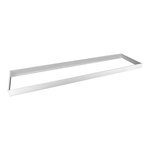 RGD-BLP6 - BACKLIT FLAT PANEL SURFACE MOUNT FRAME 1X4
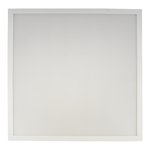 PLP PREMIUM PANEL LIGHT, PANELS/TROFFERS, 20W/30W/40W, 3000K/3500K/4000K, 120-347V, WHITE,...
 2FT X 4FT PANEL (VARIABLE CCT) | 30-40-50W 6500 LUMENS | DIMMABLE | 120-347V | V5
 CL-PL2-2X4-50-5CCT-PA5 - 2X4 FEET BACKLIT LED PANEL LIGHT, POWER ADJUSTABLE (30W, 35, 1 40...
 COMMERCIAL GRADE 2X2 LED TROFFER LIGHT. UNIQUE SLIM DESIGN WITH HIGH LIGHTING EFFICIENCY
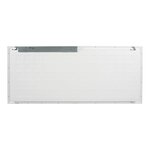 PLS STANDARD PANEL LIGHT, PANELS/TROFFERS, 30W/40W/50W, 3500K/4000K/5000K, WHITE