Nov 06, 2026 / By the Lumibox team / in LED Guides
Explosion proof lighting is required wherever flammable gases, vapours or combustible dust can be present in the air, because an ordinary fixture can become the spark that ignites them. In Canada, the space is first classified as a hazardous location (hazloc) by class and division, and you then choose an LED fixture certified for that exact class, division and group. If the area is not classified, a sealed vapour-tight fixture is usually enough; if it is, only a marked, certified explosion proof fixture belongs there.
This guide is for owners of shops, farm buildings, spray areas and fuel or solvent storage rooms, and for electricians, contractors and plant managers who specify explosion proof LED lights. It explains what "explosion proof" really means, how classes and divisions work, which LED fixture shapes exist, what to read on the label and how to protect and mount the fixture once it is chosen.
An explosion proof light is not a fixture that cannot break. It is an enclosure built so that if gas gets inside and ignites, the flame and hot gases are contained and cooled before they can reach the surrounding atmosphere. The housing, the joints, the lens and the cable entries are all designed around that goal.
Two other ideas sit next to it. A fixture for a dust location is designed to keep dust out and to stay below the temperature at which the dust layer on top of it could ignite. A vapour-tight or IP-rated fixture keeps out water and dirt, but it is not, by itself, approved for a hazardous location. That difference is the most common mix-up in this category: "sealed" and "explosion proof" are not the same thing.
LED technology suits these spaces well. It runs cooler than older metal halide or high-pressure sodium lamps, it starts instantly and it does not need lamp changes as often, which matters in areas where every maintenance visit means a permit, a shutdown or a gas test.
Canadian practice describes a hazardous location with three pieces of information: the class (what is in the air), the division (how often it is there) and the group (which substance). Some sites also use the zone system for gases. The table below is a general reference only: the classification of a real room is set by the engineer, the electrical inspector or the authority having jurisdiction, never by the fixture seller.
| Marking | What it means | Typical examples |
|---|---|---|
| Class I | Flammable gases or vapours | Fuel storage, solvent rooms, spray booths, some process areas |
| Class II | Combustible dust | Grain handling, flour, wood dust, some powder processes |
| Class III | Ignitable fibres or flyings | Textile, sawdust and fibre handling |
| Division 1 | The hazard can be present during normal operation | Inside or right next to a spray or transfer point |
| Division 2 | The hazard is present only if something goes wrong (leak, spill, failure) | The surrounding area, a room where sealed containers are stored |
| Groups | Letters that sort gases (A to D) and dusts (E to G) by how easily they ignite | Shown on the label next to the class |
| T-code | The maximum surface temperature class of the fixture | Must suit the ignition temperature of the substance present |
The short version: C1D1 (Class I, Division 1) is the most demanding gas rating. A fixture marked C1D1 for the right groups can generally also serve a Division 2 area of the same class, but the reverse is never true. Always check the full marking, not just the class.
Hazloc fixtures come in the same broad shapes as ordinary industrial lighting. The choice depends on ceiling height, the shape of the space and whether you are replacing a whole fixture or only the lamp.
Round fixtures light open areas from the ceiling, much like a UFO LED high bay does in a warehouse. The SPECLITE explosion proof UFO 100-80-60W is marked C1D1 and IP66, runs on 120-347V and offers three colour temperatures (4000K, 5000K and 6500K) with a grey housing and clear lens. A larger version covers 200-150-120W for higher ceilings.
For lower ceilings and smaller rooms, the CSC LED EXPR round series comes in 60W, 100W and 150W, all at 5000K and 120-277V, with a high-visibility orange finish. The EXPR round explosion proof fixture 100W sits in the middle of that range.
Linear fixtures follow aisles, benches, booths and narrow rooms, where a round fixture would leave dark edges. The SPECLITE explosion proof 4 ft linear fixture offers 80-60-40W, 120-347V, the same three colour temperatures and a C1D1, IP66 marking; a 2 ft model covers 60-50-40W. CSC LED's EXPL linear series comes in a 2 ft 40W and a 4 ft 80W, both 5000K and 120-277V. Outside hazardous areas, the same layout logic applies to ordinary LED linear fixtures and LED linear high bays.
Many sites still have certified hazloc fixtures with an old HID lamp inside. Light Efficient Design makes hazardous fixture retrofit lamps for that case, in 24W and 45W with an E26 or EX39 (mogul) base, and a 110W EX39 model, in 5700K or 5000K, for 120-277V or 347V. The 110W hazardous fixture retrofit EX39 is the high-output option. For non-hazardous high bays, the comparable products are in corn and HID retrofit bulbs.
A retrofit changes what is inside a certified enclosure. Before swapping, confirm that the lamp is accepted for that fixture and that the fixture marking still applies; when in doubt, replacing the complete fixture is the safer path.
Work through these points in order. Skipping the first one is how most wrong purchases happen.
Accessories for hazloc fixtures are not decoration. A guard or bracket from another product line can change clearances or stress the housing, so stick to the parts listed for your series.
Not every rough space is a hazardous location. A home garage, an unheated barn or a busy workshop often needs tough, bright light rather than a hazloc rating; our garage and workshop LED lighting guide covers that case, and industrial LED lighting groups the fixtures for plants and warehouses. For larger commercial projects, see the commercial LED lighting guide for Quebec.
Wherever the area has been classified as a hazardous location under the electrical code that applies in your province: places with flammable gases or vapours, combustible dust or ignitable fibres. The classification is made by a qualified person and checked by the inspection authority. Ask a master electrician or your municipality before buying.
Yes. The wire guards for the CSC LED EXPR round fixtures (small for 60W, large for 100W and 150W) and for the EXPL linear fixtures (2 ft and 4 ft) are sold as separate accessories, as is the EXPL yoke mount.
Yes. The SPECLITE explosion proof UFO and linear fixtures offer selectable wattage (for example 100-80-60W or 80-60-40W) and selectable 4000K, 5000K or 6500K, so one model can be tuned on site.
Some fixtures can be mounted on a wall or structure with the bracket made for them, such as a yoke mount on a linear fixture. Whether a given mounting position is allowed is stated on the manufacturer's spec sheet, so check it before planning a wall layout.
A vapour-tight fixture keeps out water, dust and dirt. An explosion proof fixture is certified to contain an internal ignition in a classified hazardous location. A vapour-tight fixture is fine in a wet or dirty space that is not classified, but it does not replace a hazloc rating.
No. Use only a lamp accepted for that fixture, such as a hazardous fixture retrofit designed for the purpose, and confirm that the fixture's marking still applies. A standard household bulb can run at a different temperature and void the certification.
Ready to compare models? Browse the full range of explosion proof LED luminaires, from compact round fixtures to C1D1 linear and UFO models, then confirm the rating with your electrician before you order.
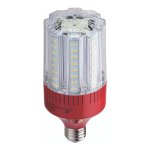 24W HAZARDOUS FIXTURE RETROFIT - E26 - 5700K 120-277V
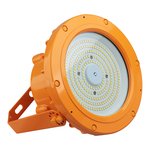 EXPR ROUND EXPLOSION PROOF FIXTURE, HAZLOC, 60W, 5000K, 120-277V, ORANGE
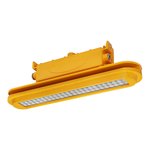 EXPL LINEAR EXPLOSION PROOF FIXTURE , HAZLOC, 40W, 5000K, 120-277V, ORANGE
 MARINE LIGHT 6" 20W 100-277V 50K GREY FROST DIM 0-10V DLC PREMIUM - DLC ID S-0ZGUWQ - 3,14...
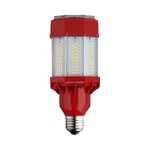 45W HAZARDOUS FIXTURE RETROFIT - E26 - 5700K 347V
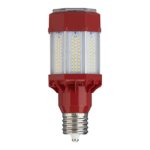 45W HAZARDOUS FIXTURE RETROFIT - EX39 - 5700K 347V
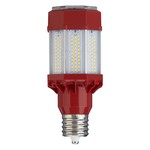 45W HAZARDOUS FIXTURE RETROFIT - EX39 - 5700K 120-277V
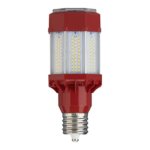 110W HAZARDOUS FIXTURE RETROFIT - EX39 - 5000K 120-277V